Nonstick pans sit in more than 9 out of 10 American kitchens, which makes them one of the most common manufactured objects in the country.
The black coating inside them is a plastic, and on its own it is close to inert.
Making that coating, for roughly fifty years, required a second chemical that was nothing like it.
That second chemical is in polar bear blood today, at levels measured in people who live beside a chemical plant.
It never came out of anybody’s kitchen. It left by the factory gate.
Which is a smaller story than the one usually told, and a much harder one to walk away from.
What the coating actually is
Because the black surface in a nonstick pan is not a chemical in the ordinary sense at all.
It is a plastic called polytetrafluoroethylene, a chain of carbon atoms wrapped in a sheath of fluorine.
That carbon to fluorine link is the strongest single bond in organic chemistry, which is why nothing sticks to it and nothing eats it.
People often say it is the strongest bond in all of chemistry, and that is not correct. Nitrogen gas and carbon monoxide both beat it comfortably.
The polymer itself is a huge molecule. It does not dissolve in water, it does not move through a bloodstream, and it does not accumulate.
A flake off a scratched pan is closer to swallowing a fingernail clipping than to swallowing a poison, and it leaves the body the same way.
The chemicals that made it
And that is where the real story sits, one step back in the factory.
Turning that polymer into a smooth coating used to require a processing aid, and for decades the aid of choice was a small acid known as PFOA.
PFOA is nothing like the polymer. It is tiny, water soluble, mobile, and it binds to blood proteins once it is inside an animal.
Its cousin PFOS did the same job in stain repellents and firefighting foam, and behaves the same way in a body.
American manufacturers phased both out by 2015, but the molecules that were already released do not degrade.
And cookware was never the main outlet. Firefighting foam, treated fabrics, grease resistant food packaging and factory discharge did far more of it.
How it reaches a bear
Which leaves the question of how a compound from a chemical plant ends up in the Arctic at all.
It travels on water and air, settles into sediment, and gets taken up by the smallest organisms in the chain.
From there it climbs, because each animal eats many of the animals below it and keeps what it eats.
That is biomagnification, the same mechanism that once concentrated DDT into the eggshells of birds of prey until the shells broke under the parent.
These compounds do one thing differently though. They attach to protein rather than fat, so they collect in liver and blood instead of body fat.
And a female passes her load on, through the placenta and then through milk, so the next generation starts already contaminated.
What has actually been measured
Then the surveys arrived, and the range of species involved is the part that stops people.
One review counted more than 120 different compounds from this family across roughly 330 wild species on nearly every continent, as the reporting laid out.
Polar bears carry the highest levels found in Arctic wildlife, comparable to concentrations in people who live beside a manufacturing plant.
Bottlenose dolphins in Charleston Harbor were studied for years, and the animals with the heaviest burden showed shifted immune markers in their bloodwork.
American alligators turned up with skin lesions and wounds that healed slowly, and sea otters carrying higher levels got sick more often than the rest.
Sea turtles produced fewer live hatchlings, which is the kind of effect nobody notices for a decade.
What to do about the pan anyway
None of which makes the pan on your stove innocent, and it does not make it the villain either.
Testing found undisclosed coatings on cookware sold as something else, including epoxy layers nobody had declared, as the laboratory reported.
Ceramic pans avoid the fluorine chemistry but wear out fast, so the swap trades one problem for a shorter life.
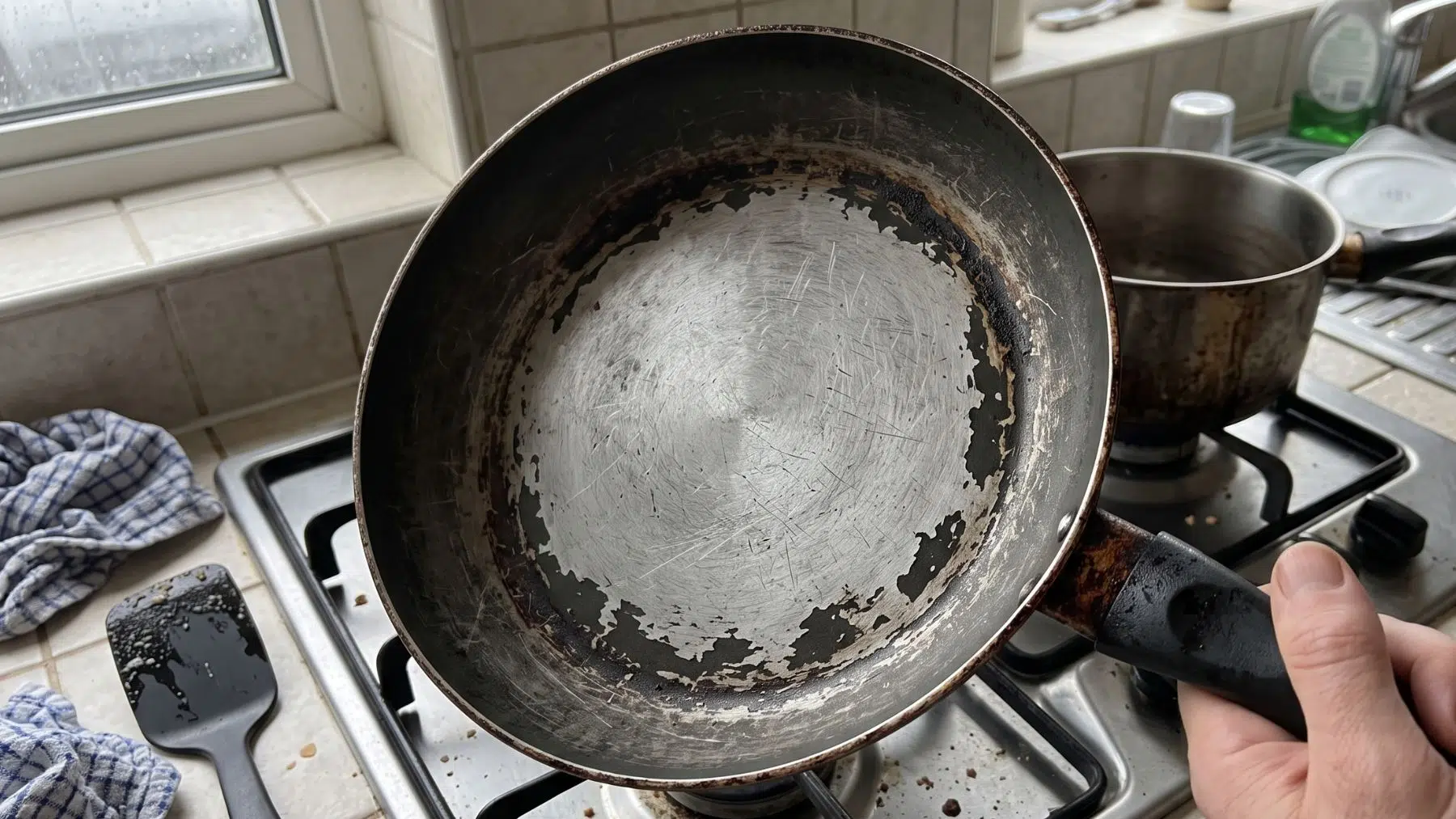
The practical rules are dull. Keep the heat moderate, since an empty pan on high can push the coating past its limit, and replace it once the surface is scoured through.
The larger fix is not in the kitchen. It is in the same place as the argument over an offshore project or a ground mounted solar site, which is what a plant is allowed to release.
Laboratories have found bacteria that can pull fluorine off certain of these molecules, which was thought close to impossible.
That work is early, narrow and slow, and no field application exists yet.
The bottom line is unglamorous. The bear on the ice is not waiting on it.
Read the whole thing?
Get the week's signal, not the noise
Our sharpest reporting on energy, climate and nature — free, once a week.