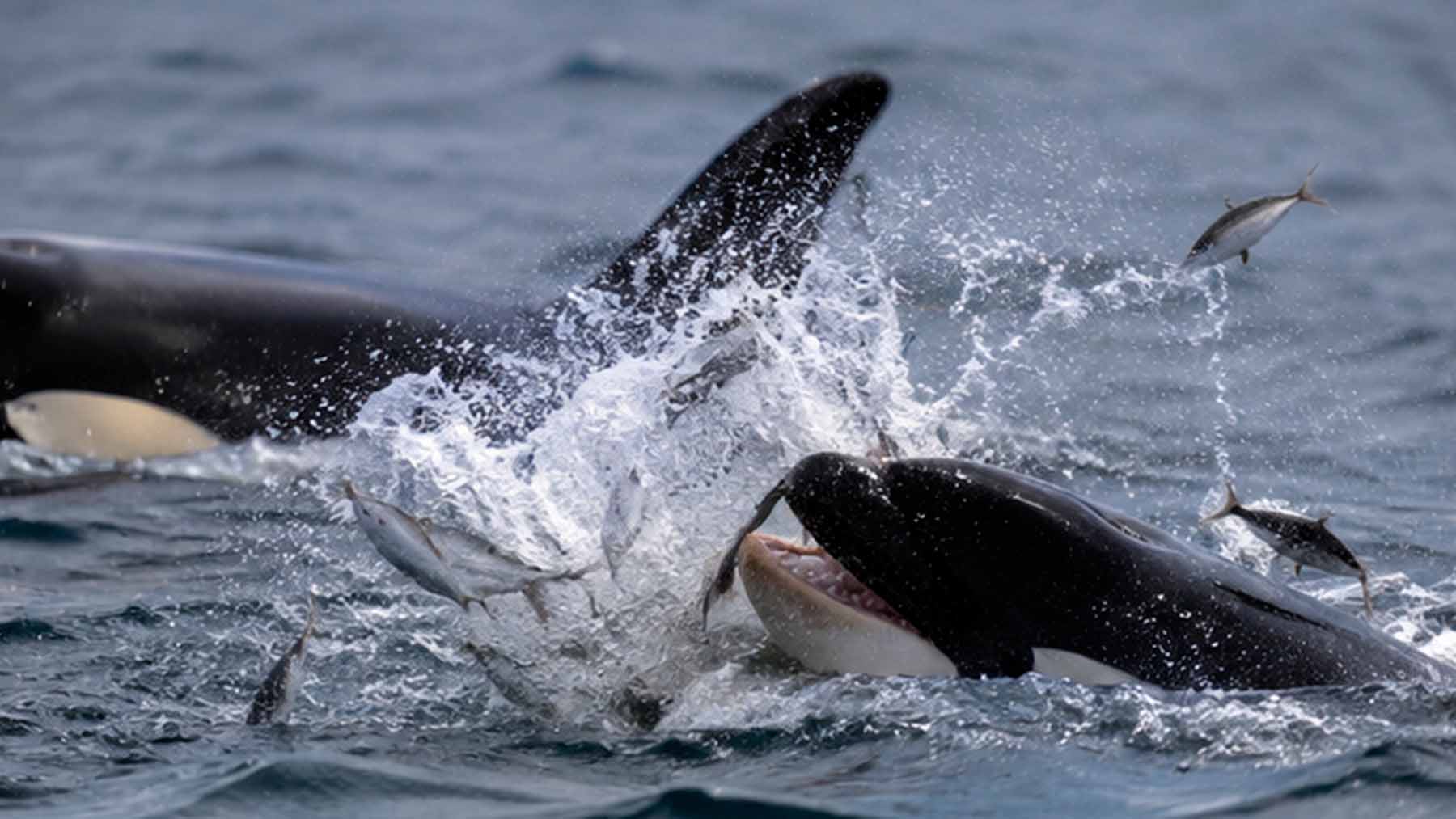
Off the northern coast of Norway, a pod of orcas moves in tight formation around a spinning ball of herring. The fish are doing exactly what their instincts tell them to do — pulling closer together, forming a dense, swirling mass. It’s a defense that has outlasted countless predators across millions of years of evolution.
This time, it won’t be enough.
What these whales do next has been captured on underwater cameras, tracked by sonar, and studied by researchers for years. It happens nowhere else on Earth.
A defense that becomes a trap
Herring have survived for millions of years partly because of one reliable reflex: when threatened, they school tighter. A dense, swirling ball offers genuine protection against most ocean predators. Picking off one fish from a compact mass is hard. The odds favor the group.
North Atlantic orcas figured out how to flip that logic entirely.
As they circle a herring school, these orcas slap their tails at the surface — a behavior researchers call “lobtailing” — while turning their white bellies toward the fish and releasing bursts of bubbles. Each signal alarms the herring, prompting the school to compress further. The orcas aren’t just reacting to the ball; they’re actively sculpting it, using the fish’s own fear response as a tool. The tighter the ball gets, the more trapped each fish becomes. What evolution designed as a shield becomes a cage.
The strike: precision, power, and cavitation
Once the herring ball is dense enough, the orcas shift from herding to striking. A whale drives its large tail fluke directly into the compressed mass. One well-placed slap can stun or kill up to 10 to 15 fish at once — sometimes more.
The sound is unmistakable: a sharp, loud thump that carries through the water. Researchers believe the noise comes from two sources simultaneously — the physical impact of the tail and the collapse of bubbles created by the strike, a process called cavitation. After the strike, everything slows. The orcas stop herding and simply swim through the water, picking off stunned fish one by one — a stark contrast to the coordinated chaos of the herding phase.
How scientists get a front-row seat to the hunt
Studying a behavior that happens underwater, often in open ocean, requires layered methods. Researchers position underwater cameras near active feeding pods to film the full sequence. Temporary suction-cup tags are also attached directly to the whales — devices that record movement, sound, and 4K video from the animal’s own perspective before self-releasing and floating to the surface for retrieval.
Sonar adds another dimension, letting scientists track herring schools and whale pods simultaneously. Underwater microphones capture the acoustic record of each hunt, including the distinctive thump of each tail slap and even the slurping sounds orcas make while eating. That last detail lets scientists count individual feeding events even when camera footage is too murky to be useful.
Teamwork, division of labor, and shared rewards
Not every orca in a pod delivers the tail slap. Studies show that certain individuals consistently take on the role of primary striker, while others focus on herding — different roles, coordinated toward a shared outcome.
Every member of the pod feeds on the stunned fish after the strike, including those who never slapped a tail. Scientists call this “by-product mutualism”: individuals benefit from a collective effort without contributing equally to its most demanding part.
The efficiency gains are real. Carousel feeding yields roughly one fish per minute — significantly better than alternatives like scavenging near fishing boats. For an adult orca that needs several hundred herring per day to meet its energy needs, that rate isn’t a luxury. It’s a necessity.
A skill passed down — but not guaranteed to survive
Carousel feeding is observed almost exclusively in pods off northern Norway and Iceland — specifically those whose diets center on Norwegian and Icelandic herring. Orca pods elsewhere, even those that also eat fish, don’t appear to use it. That geographic and dietary specificity points toward culture rather than instinct.
Scientists currently believe the technique is learned, passed from mothers to calves within specific pods over generations. This aligns with broader research on orca behavior, which consistently shows that hunting strategies vary by group and appear to be transmitted socially. The cultural transmission hypothesis, though, hasn’t been definitively proven yet.
That uncertainty carries weight. If carousel feeding is a learned tradition rather than a hardwired behavior, it exists only as long as the pods that practice it do. A technique refined over generations — precise enough to stun a dozen fish with a single strike — could vanish not through evolutionary pressure, but simply through loss.
Check the full study here: Domenici, P., Johansen, J. L., Karoliussen, R., Leggieri, F., Dykstra, P., & Jourdain, E. (2025). Spatially coordinated predation with division of labor increases feeding success in killer whales. Current Biology, 35(14), 3507-3514.
Read the whole thing?
Get the week's signal, not the noise
Our sharpest reporting on energy, climate and nature — free, once a week.