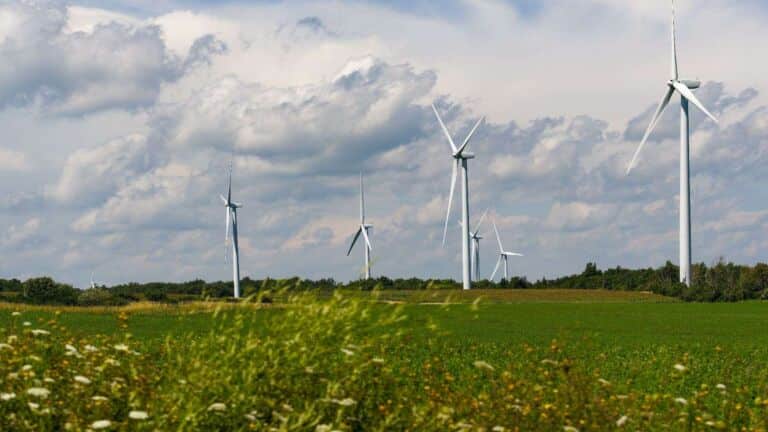
Eleven miles off the Norfolk coast, a steel tube runs down through sixty feet of water into the seabed.
Below the waterline it is not really steel anymore.
Mussels have crusted the whole leg, anemones sit in the gaps, and small fish hang in the slack water on the sheltered side.
A seal comes past, turns, and works the base of the tube for a few minutes.
Then it swims a straight line to the next one.
And then the next, and the next, until its track on a map looks like a drawn grid.
Why a steel leg is worth a predator’s time
Open sand is a poor place to hunt.
Prey is thin and evenly spread, and an animal crossing it is mostly guessing.
Put a hard vertical structure into that sand and the arithmetic changes inside a season.
Mussels and barnacles settle on it. Crabs move into the scour pit at its base. Small fish arrive for the shelter, and bigger fish arrive for the small fish.
Marine biologists call it the reef effect, and it is the same thing that happens around a shipwreck.
What is different about a wind farm is the geometry. A wreck is one point. A farm is dozens of identical points laid out on a survey grid, each the same distance from the last.
That turns a stretch of seabed into something a predator can learn and repeat.
What the track looked like on the screen
The tags are glued to the fur behind the head and come off at the annual molt.
Each one takes a position by GPS and sends the batch back over the mobile phone network when the animal surfaces near shore.
Plotted out, most seal tracks are loops and wanders and long featureless crossings.
These were not. One track across Sheringham Shoal is a set of straight runs between fixed points, kinking at each foundation and then heading dead level to the next.
You can read the layout of the farm off the animal.
Deborah Russell, who led the work at the University of St Andrews, said she was shocked the first time she saw it, and described the seal as traveling in straight lines between turbines as if it were checking them out for potential prey.
What the tags actually counted
96 harbor and gray seals were tagged on the Dutch coast, and another 22 on the coast of southeast England.
That is 118 animals carrying tags across the southern North Sea.
Two operating farms sat inside that range. Alpha Ventus, 12 turbines on the German side, 28 miles north of the island of Borkum. Sheringham Shoal, 88 turbines off Norfolk in about 60 feet of water.
Eleven tagged harbor seals went inside them, four at Alpha Ventus and seven at Sheringham Shoal.
Three of the eleven produced the grid pattern.
One of those three returned to Sheringham Shoal 13 times, and on every trip that was tracked it moved through the farm the same way.
The paper ran in Current Biology in July of 2014, with nine other authors alongside Russell.
What eleven animals can and cannot tell you
Start with the fraction. Eleven out of 118 went into a farm at all, and three of those showed the pattern.
Everything here rests on a handful of individuals, and the authors say so.
Then the harder problem. A structure that gathers fish is not necessarily a structure that makes more fish.
If the turbines only concentrate prey that was already there, the seals get an easier meal and the fish get a worse one, and nothing about the population improves. That question is unsettled, and it hangs over every claim that turbine bases work like artificial reefs.
Timing is the third limit. All of this covers farms that were already running.
Russell has been explicit that the construction phase is predicted to have the most dramatic negative effect on marine mammals, and pile driving is a different problem entirely.
The half of the work that rarely gets quoted
The paper is not called wind farms. It is called anthropogenic structures, and the other structure is pipe.
Two tagged seals followed sections of subsea pipeline back and forth for up to ten days at a stretch.
Same behavior, no turbines anywhere near it. Whatever these animals are keying on, it is hard structure standing on soft ground, not electricity.
Which matters more now than it did then, because the structures keep going in. Off Virginia Beach, 176 turbines are going up in water between 27 and 44 miles out, and the first of them started generating in the spring of 2026.
Cod have already been recorded moving into a 100 turbine farm elsewhere in these waters.
Russell’s own conclusion was that as more farms are built and the reefs on them mature, use by animals like these is likely to increase.
The North Sea seals in that data set were the early ones.
Read the whole thing?
Get the week's signal, not the noise
Our sharpest reporting on energy, climate and nature — free, once a week.