In the middle of the night, a tiny spider hangs suspended in a plastic dish, barely moving — but not quite still. Its legs twitch. Something flickers behind those layered eyes.
Researchers at the University of Bonn were watching when it happened. Their subject: Portia fimbriata, an Australian jumping spider no bigger than a coin, already known for hunting strategies that border on cunning. What the team recorded over several nights of infrared observation has now raised an uncomfortable question about which animals are truly capable of complex sleep — and how far back in evolutionary history that complexity might reach.
A spider that hunts with strategy — and apparently needs rest
Portia fimbriata is roughly the size of a one-euro coin, but its hunting methods set it apart from almost every other arthropod. Rather than ambushing prey, it lures web-building spiders by mimicking the vibrations of a trapped insect. The target moves toward what seems like an easy meal — then Portia strikes. That kind of deliberate deception is rare among invertebrates, and it’s what made this species such an appealing research subject in the first place.
If sleep serves cognitive functions — consolidating memory, restoring neural circuits — then a spider with unusually sophisticated behavior might show signs of unusually sophisticated sleep. Scientists at the University of Bonn followed that logic and set up their cameras.
Two sleep stages confirmed for the first time
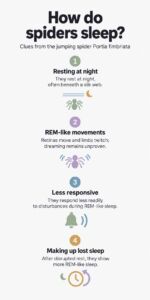
The research team monitored individual Portia fimbriata spiders over several days and nights inside 5-inch plastic enclosures. Infrared cameras captured their behavior without introducing visible light that might disturb them. What the recordings revealed was unambiguous: two clearly distinct sleep stages. One was quiet and still. The other involved eye movements and muscle twitches — behaviors that, in vertebrates, are the hallmarks of REM sleep, according to the study published in Proceedings of the National Academy of Sciences.
This is the first comprehensive experimental confirmation that spiders experience genuine, regulated sleep rather than simple inactivity. Sitting motionless and actually sleeping aren’t the same thing. Observing REM-like movements doesn’t confirm that spiders dream — the researchers were clear on that point — but what the findings do establish is that spider sleep is more structured and complex than anyone had previously demonstrated.
How the team proved the spiders were actually sleeping
Proving that an animal is asleep — rather than just still — requires more than a video of something not moving. The researchers used sound stimuli to measure how quickly the spiders responded to disturbances. A sleeping animal responds more slowly than an awake one, which helped the team distinguish genuine sleep from motionless wakefulness.
Sleep deprivation experiments came next. The researchers looked for what scientists call “sleep rebound” — the compensatory extra sleep an animal takes after its rest has been interrupted. Sleep rebound is a recognized marker of true sleep regulation, not passive inactivity. One significant limitation remained: the team couldn’t measure brain activity directly, since spiders don’t lend themselves easily to neural monitoring. The case rested instead on high-resolution behavioral data collected across many nights, and that combination of response testing, observation, and deprivation experiments built a convincing picture even without direct neural evidence.
What this means for understanding how sleep evolved
Most of what scientists know about sleep comes from vertebrates. Finding comparable sleep architecture in a spider — an animal whose nervous system is fundamentally different — raises a pointed evolutionary question: did multi-stage sleep evolve once, very early in animal history, or did it emerge independently in separate lineages?
The University of Bonn findings don’t answer that, but they sharpen it considerably. If spiders and humans share sleep complexity despite hundreds of millions of years of divergent evolution, that complexity may reflect something deep and essential about how nervous systems function. The researchers argue that future sleep studies should deliberately include animals with simpler or radically different nervous systems — a call that, until recently, would have seemed unnecessary.
Next steps: climate, light pollution, and the dream question
The University of Bonn team is now comparing sleep patterns across multiple spider species and between lab and natural environments. A major focus is the relationship between sleep and cognition — specifically, whether different sleep stages contribute to learning and memory in spiders and insects.
Environmental pressures are also on the agenda. The team plans to examine how artificial light at night and climate change may disrupt arthropod sleep. Given how little we understand about invertebrate sleep, the potential effects of these stressors are almost entirely unknown.
Whether spiders dream remains genuinely unanswered. But the more interesting question may be the one underneath it: how many other animals are sleeping in ways we haven’t thought to look for? A jumping spider twitching in the dark at 2 a.m. suggests the biology of rest is stranger, older, and more widespread than the textbooks currently reflect.
Read the whole thing?
Get the week's signal, not the noise
Our sharpest reporting on energy, climate and nature — free, once a week.