Offshore wind farms have generated electricity for years, while seaweed farming has remained largely experimental.
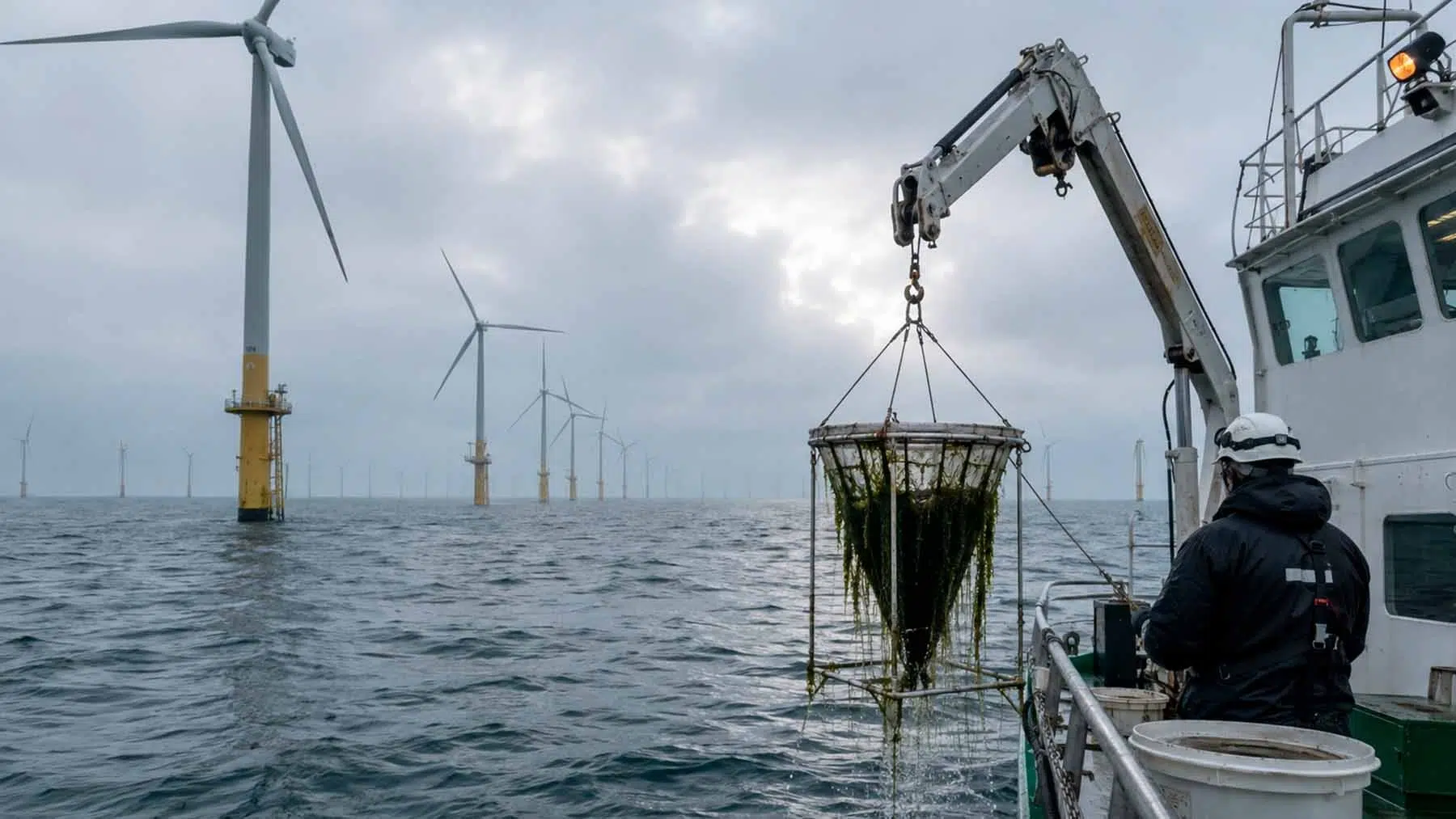
A vessel entered the Hollandse Kust Zuid wind farm and collected algae growing among the turbines.
The harvest came from North Sea Farm 1, the world’s first large-scale commercial seaweed farm located inside the wind farm. For researchers, this represented a major milestone.
It also presented a new question.
If algae can be cultivated between operational wind turbines, why is it any different from algae found elsewhere?
Nobody expected to find a seaweed farm here
North Sea Farm 1 is approximately 11 miles (18 km) off the coast of the Netherlands within the Hollandse Kust Zuid (West Holland) offshore wind farm. Instead of occupying a separate area of the ocean, the farm utilizes the spaces between wind turbines.
In addition to producing seaweed, researchers believe it offers other opportunities.
Specifically, they want to know whether commercial-scale seaweed farming can succeed in the harsher conditions of the North Sea.
Those conditions include waves, tides, water depth, and distance from shore.
Research into offshore seaweed cultivation there has historically been limited to small-scale pilot projects and experimental sites. Therefore, it marks a step toward commercial-scale seaweed farming in the region.
The harvest was only the beginning
The harvest itself was only one part of the project. Researchers are using the site to investigate questions that extend well beyond food production. Several organizations are working on North Sea Farm 1.
These include North Sea Farmers, Deltares, Plymouth Marine Laboratory, and Silvestrum Climate Associates. Together, they are investigating how the project performs in practice.
North Sea Farmers operates as the European Seaweed Association.
Deltares is one of the organizations helping evaluate the project’s environmental impacts and scaling potential.
Their work extends far beyond food production. They are conducting field visits and using satellite imagery to monitor seaweed growth and potential environmental impacts.
The team is also creating computer models to assess how carbon moves through coastal ecosystems.
Researchers hope to learn whether seaweed farming could help meet climate-related objectives. They also hope to identify limitations that may restrict expansion across larger portions of the North Sea.
Another focus is understanding how increased seaweed farming could affect local biodiversity and the surrounding marine ecosystem.
These questions help explain why the initial harvest from North Sea Farm 1 has received so much attention.
The turbines were only part of the story
The difference comes from where and why the seaweed is being grown. North Sea Farm 1 is located inside an active offshore wind farm. The marine space used by the farm already supports renewable energy production.
Researchers want to know whether seaweed can be grown alongside offshore wind turbines.
They also want to know whether commercial production and environmental research can operate in the same space.
While the primary focus of North Sea Farm 1 has always been cultivation, its broader significance lies elsewhere. The project is testing whether a single area of sea can serve multiple purposes at the same time.
According to North Sea Farmers, the project demonstrates co-use within an offshore wind farm.
What came ashore meant more than seaweed
That first harvest therefore represents more than a crop being brought ashore. It also provides researchers with information from a commercial-scale operation inside a working wind farm.
Therefore, when we refer to “the harvest,” we are referring to more than a crop being removed from a specific body of water.
It also represents real-world data from a commercially viable operation utilizing a portion of an operational offshore wind farm.
The next question is whether projects like this could reshape offshore wind development through seaweed and marine life beneath offshore wind farms.
Read the whole thing?
Get the week's signal, not the noise
Our sharpest reporting on energy, climate and nature — free, once a week.