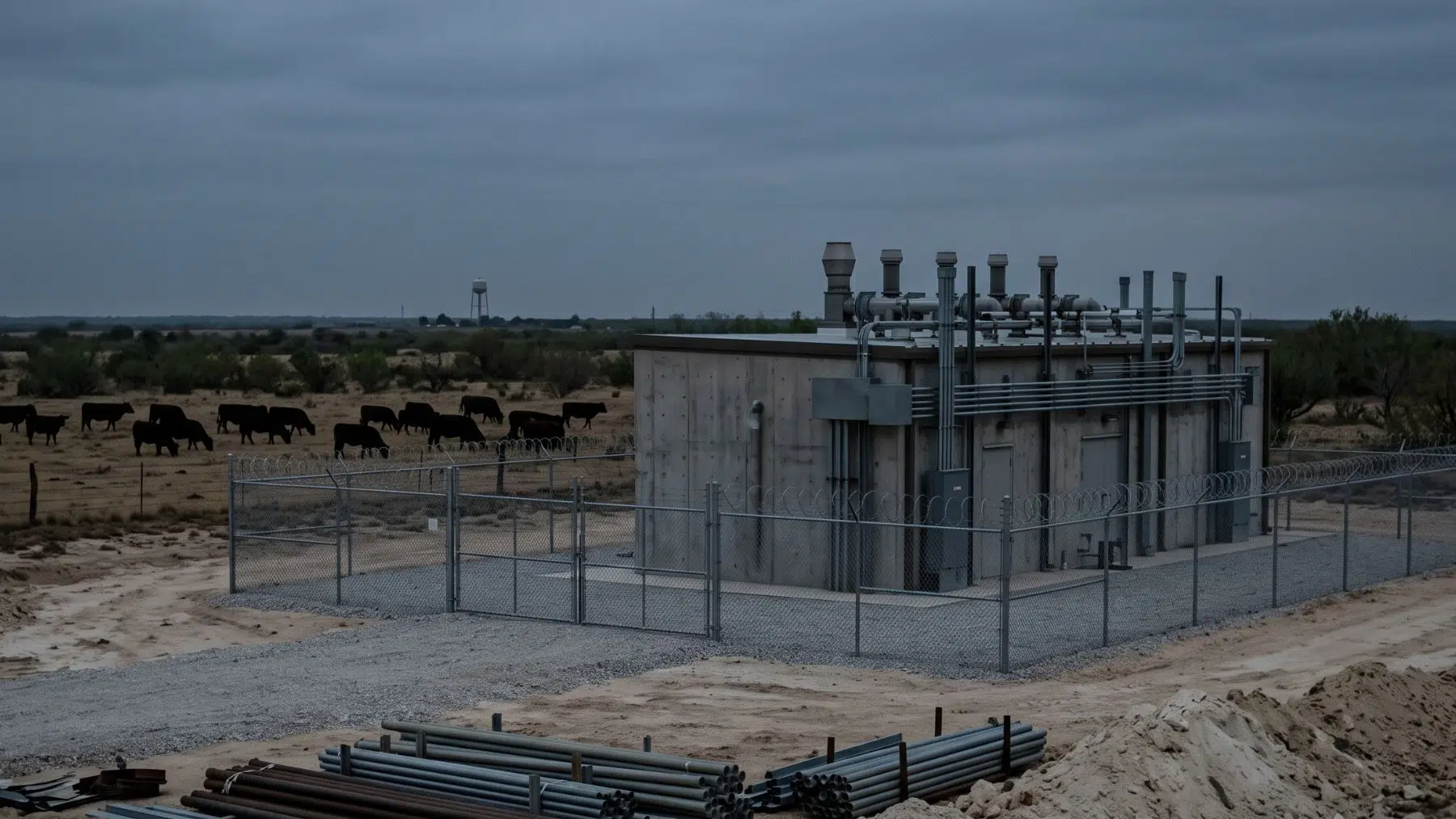
On a Wednesday night in August, a low building on flat pasture south of Austin came alive.
No steam. No turbine. No line running out to the grid.
Only a shallow pool of water, a lattice of fuel sitting under it, and a neutron count that finally held steady on its own.
The nearest town slept through it.
What happened in that building matters most to people who will never hear about it, lying flat inside a hospital scanner.
To see why, start with a number nobody in American medicine likes to say out loud.
The scan that runs on a foreign reactor
About 40,000 Americans a day walk into a nuclear medicine department for a look at a heart, a bone or a suspected tumor.
Almost all of those scans use one tracer, technetium 99m.
It does not come in a bottle off a shelf. It is drawn dose by dose from a small generator holding its parent isotope, molybdenum 99, which decays into the tracer over a few days.
The United States has had no steady commercial source of that parent since the late 1980s.
Almost every gram arrives on a passenger flight from Australia, Europe or South Africa.
Why nobody can keep a stockpile
Molybdenum 99 has a half life of 66 hours. Its daughter lasts about six.
So the supply cannot be warehoused against a bad week. It has to be made, purified, flown and used inside a few days, then made again, forever.
The reactors doing the making are old and few, and each one shuts down on a schedule for maintenance.
Most were built for research decades ago, and there is very little spare capacity anywhere in the network.
When two go quiet at once, the slack in the system is thin to none.
Hospitals feel that directly. Appointments slide and pharmacies ration, all because a research reactor in another hemisphere is offline for repairs.
Two decades of plans that did not hold
Congress noticed a long time ago. A 2012 law told the federal nuclear security agency to rebuild a domestic supply without weapons usable uranium, and roughly a quarter billion dollars in cost shared awards followed.
One American producer did reach the market. It ran from 2018 until October 2023, then stopped, unable to price against subsidized European reactors.
A second company in Wisconsin is about three quarters built and carries a federal loan commitment of up to 263 million dollars, with enough planned capacity to cover most of national demand.
The pattern repeats. The money is real, the physics works, and the finish line keeps sliding.
What has been missing is not ambition or money. It is speed on site.
A greenfield pasture that beat the calendar
That is what changed in Caldwell County, Texas.
At 9:19 in the evening Eastern time on August 5, a pool type test reactor called Groves reached first criticality, a controlled chain reaction holding itself steady at very low power. Its owner announced it the next morning, and the American Nuclear Society confirmed the milestone.
The site sits near Lockhart, about 30 miles south of Austin, on private land that was raw ground the previous September.
Less than 11 months from first shovel to first chain reaction.
Federal officials count it as the fifth reactor to reach criticality under a new pilot program, and the first anywhere in that program to do it on private land from a greenfield start. Texas has been collecting energy firsts lately, from hail battered solar plants to the aerial surveys rewriting home insurance across Austin rooftops.
Groves itself is a plain machine. Light water, no pressure, low enriched fuel, and slots where target material can sit in the neutron flux.
What it proves and what it does not
Groves will not fill a single hospital order.
It is a test reactor, built to prove out procedures, training, safety programs and supply chains rather than to ship product, and the company has been open about that limit.
The production machine is supposed to come later, a foundry of up to four isotope reactors of about 15 megawatts thermal each, planned for the Idaho desert.
That project is not yet licensed. The subsidiary behind it filed a construction permit application in September, pulled it back in December, and regulators formally granted the withdrawal this past January. No commercial start date has been given.
So the honest reading is narrow and still large.
Nobody has proved yet that America can supply its own medical isotopes.
What did get proved is that a licensed reactor can go from bare pasture to a working chain reaction in the time it takes to put up a warehouse.
That was the part everyone said could not be done.
Read the whole thing?
Get the week's signal, not the noise
Our sharpest reporting on energy, climate and nature — free, once a week.