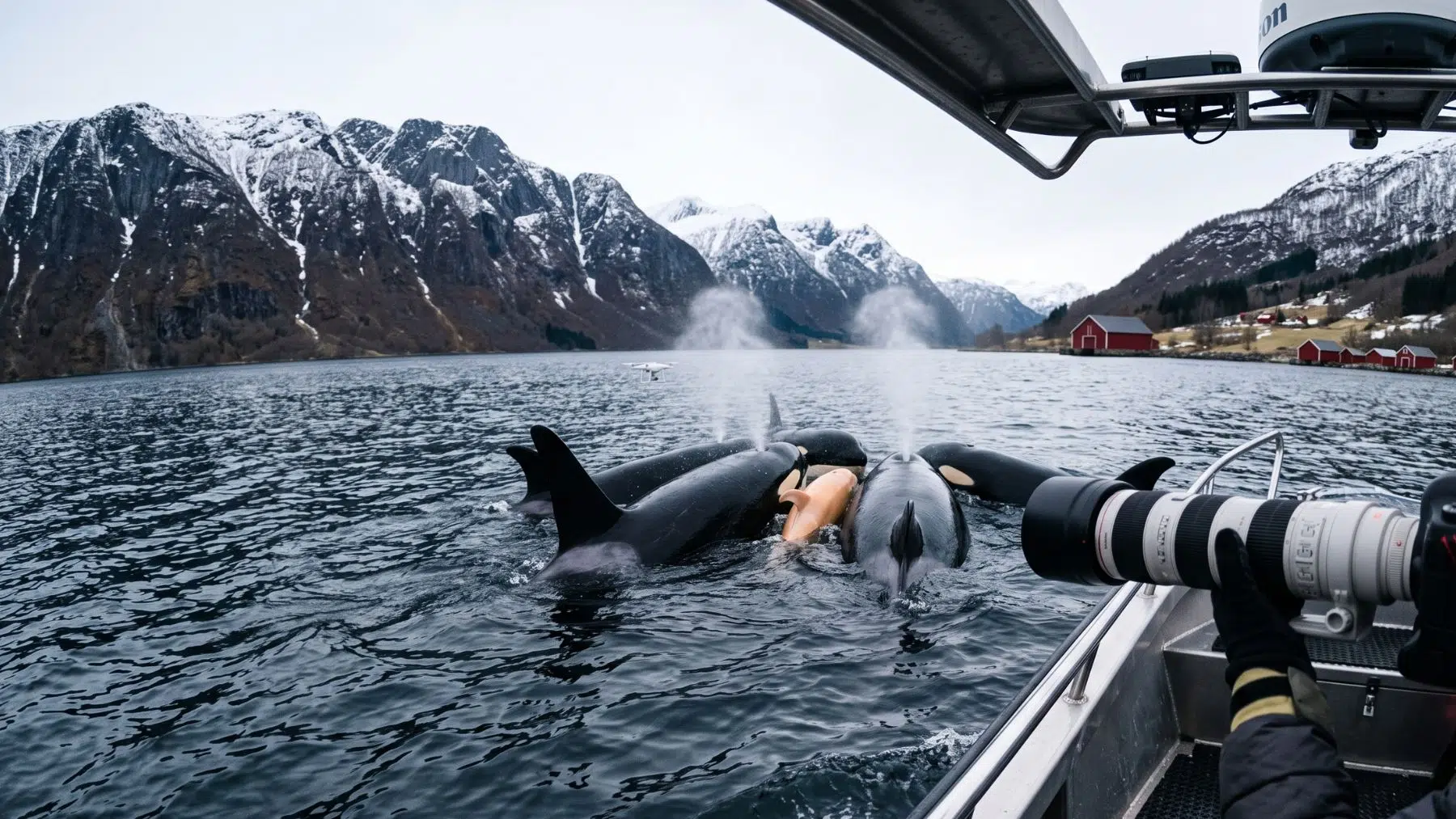
A killer whale calf arrived in the water off Skjervoy in northern Norway on an afternoon in early November.
Six whale watching boats were sitting nearby, out there for the herring season rather than for anything like this.
One of them had a camera running, and it kept firing through the whole thing.
What came out of that afternoon is the first orca birth ever documented outside a tank, together with the first hour that followed it.
For about fifteen minutes the newborn could barely hold itself at the surface, and nobody on the water was sure it had made it.
Then the animals around it closed in and started lifting.
Why this had never been filmed
Because an orca birth is short, unannounced and almost never happens in front of anyone.
Gestation runs somewhere around seventeen months, and the delivery itself is over in a matter of minutes.
There is no swelling, no nest and no stretch of coast where it reliably occurs.
Northern Norway is the closest thing to a good bet, because the whales follow herring into the fjords every autumn and the boats follow the whales.
Even there, being pointed at the right patch of water at the right minute is luck rather than method.
Births in tanks have been on film for decades, but a tank holds a handful of animals and tells you almost nothing about what a whole pod does.
What the boats were actually looking at
The mother is a known animal rather than a stranger passing through.
She is catalogued as NKW-591, first identified in 2013, and she has raised several calves already.
The photographer on the water was Krisztina Balotay of Orca Channel, who had the sequence running before anyone understood what was in the frame.
Researchers from Norwegian Orca Survey put a drone up almost immediately, along with acoustic sensors listening under the hulls.
The boats held station at the legal minimum, roughly 1,000 feet off, which is far enough that the surface view was ambiguous.
From the rail it looked like a calf that was not moving. From directly above, it was.
The circle that closed around it
What the drone recorded is the part that no aquarium could have shown.
The animals nearest the newborn were mostly females and juveniles, and they packed in tight around it.
They formed a ring, and they pushed the calf upward toward air, repeatedly and with real force.
Some of them carried it along on their backs when it sank below the surface.
Roughly three hours after it arrived, the calf was swimming under its own power.
The boats stayed with the group until the light went, which in that fjord in November is early in the afternoon.
Why the newborn looked orange
One detail in the pictures surprises almost everyone who sees them, and it has nothing to do with the birth going wrong.
The calf is peach colored rather than white, and the dorsal fin lies folded flat against one side.
A newborn carries under an inch of blubber, against something closer to 4 inches in a grown animal, so the blood underneath shows through the skin.
The folded fin is the same story, a soft structure pressed against the body wall for months that has not stiffened yet, as reporting on the sighting laid out.
Both fix themselves within weeks, which is why the orange window is so rarely photographed.
The tint fades as the fat layer thickens, and by the time most people ever see a young orca it already looks like a small adult.
It is the same reason an unexpected animal in an unexpected place ends up documented at all, which is that somebody happened to be standing there with a lens ready.
What the next few months decide
The hard part for this calf starts after the cameras go away.
Killer whale milk runs up to 40 percent fat, and a calf can put on hundreds of pounds inside its first year on it.
Even so, roughly half of newborns in some studied populations are never recorded again after their first months.
That figure is the reason researchers are careful about celebrating, and the reason a documented first hour matters at all.
Nobody had a baseline for how a wild pod behaves in those opening minutes, so every detail counts, including the pushing and the carrying.
Norwegian Orca Survey intends to publish the sequence as a scientific paper, which would turn one afternoon of luck into a reference point.
Until then it sits alongside every other marine record that exists only because a boat happened to be sitting in exactly the right water on exactly the right afternoon.
Read the whole thing?
Get the week's signal, not the noise
Our sharpest reporting on energy, climate and nature — free, once a week.