The rock shelf in northeast Brazil looks like nothing much.
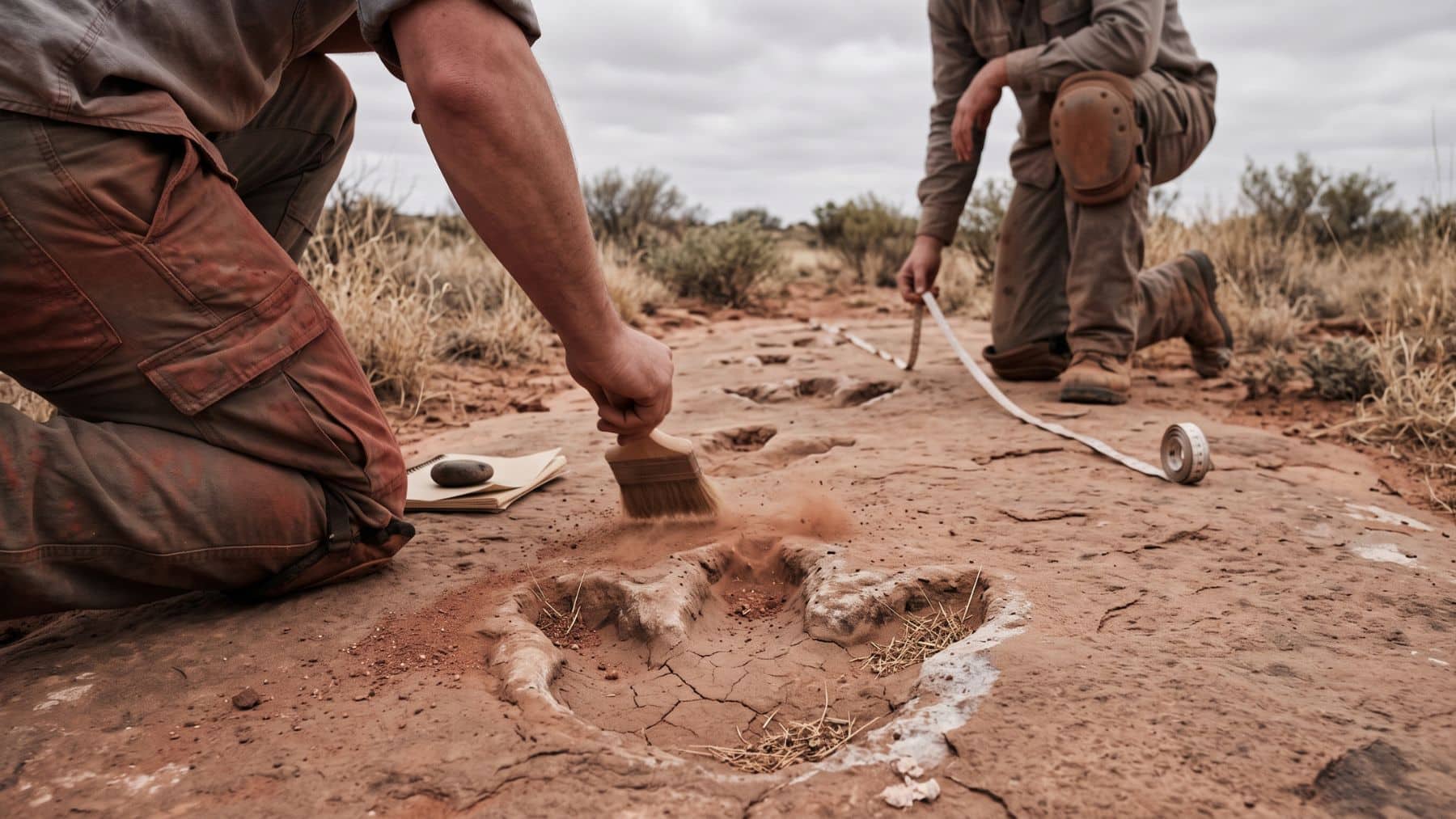
Then you crouch.
Three toes, pressed into mud that has since turned to stone, and not one print but a walking line of them across a flat slab.
Somebody left those.
The awkward part is that the same marks, made by the same kind of animal at what appears to be the same moment, are sitting in rock on the far side of an ocean.
Why one animal could stand on both sides
Africa and South America did not come apart in a single motion.
The crust stretched and broke along old lines of weakness, magma rose into the gaps, and new sea floor formed between the pieces as they drifted away from each other.
The South Atlantic opened from the south, like a zipper pulling northward, and for a long stretch the top of it had not opened at all.
The split had already been running for twenty million years by then.
The last stitch held in one specific place.
The elbow of northeastern Brazil sat against what is now the coast of Cameroon, and while that seam was intact an animal could walk from one continent to the other without getting wet.
Along the Gulf of Guinea, on ground nobody can go and look at now, because it is under water and has been for most of the time since.
The mud had to be exactly right
A footprint is a fragile thing to try to keep.
Too dry and nothing registers. Too wet and the edges slump back in before anything sets.
What the corridor had was river and lake country, low and flooded on a seasonal cycle, laying down the fine soft sediment that takes an impression and then hardens around it.
Both basins are half grabens.
That is a rift structure, a block of crust dropped along a fault on one side and tilted, which is what forms while a continent pulls itself apart and where the sediment collects.
So the geology that opened the corridor also kept the notebook.
And the corridor was not a bare causeway.
Rivers ran through it, lakes stood in it, plants grew and fed the animals that fed the animals leaving the prints, which makes it a place rather than a route.
What the count and the dating show
More than 260 dinosaur footprints have been catalogued across the two sites.
The Sousa Basin in northeastern Brazil, the Koum Basin in northern Cameroon, 3,700 miles apart today.
Most were left by three toed theropods, with a smaller number likely made by sauropods or ornithischians.
Fossil pollen in the sediments puts both sets at about 120 million years, which ties them to one narrow window rather than to a vague shared era.
The lead author put the case in three parts. Similar in age. Similar in geological and plate tectonic context. Almost identical in shape.
Three matches, not one.
The work came out through a natural history museum rather than a journal, in a volume honoring a track specialist who had spent a career on footprints and had died the year before.
Five authors, four institutions, two continents.
What footprints will never tell anyone
They do not say which animals crossed.
They do not say which way most of the traffic ran, or whether any single individual standing on the Brazilian slab had ever stood on the African one.
A footprint records a moment and almost nothing about the life around it.
That any of it survives is the strange part. Prints do not normally fossilize, and getting them buried intact on both sides of the same rift, inside the same window, is rarer still.
The oldest animal beds have the reverse problem, where the bodies are missing and researchers are left reading almost no trace at all.
Bones give you a body. A Sahara predator rebuilt from them tells you what an animal was, and a print tells you only where it went.
Why the door shut
The ground kept moving while the animals were using it.
Magma kept rising, new oceanic crust kept forming, and the two plates went on separating until the South Atlantic filled the space where the crossing had been.
Not in a day. But it shut.
Whatever was standing on the wrong side when the water arrived stayed on that side.
Which is why these prints are worth more than their number, because they sit at the very end of the last land connection between the two continents.
After the water came in, the populations on either side were left to evolve alone, and everything that happened on each continent afterward happened separately.
The research announcement carries the geology. The photographs are worth the click on their own.
Read the whole thing?
Get the week's signal, not the noise
Our sharpest reporting on energy, climate and nature — free, once a week.