
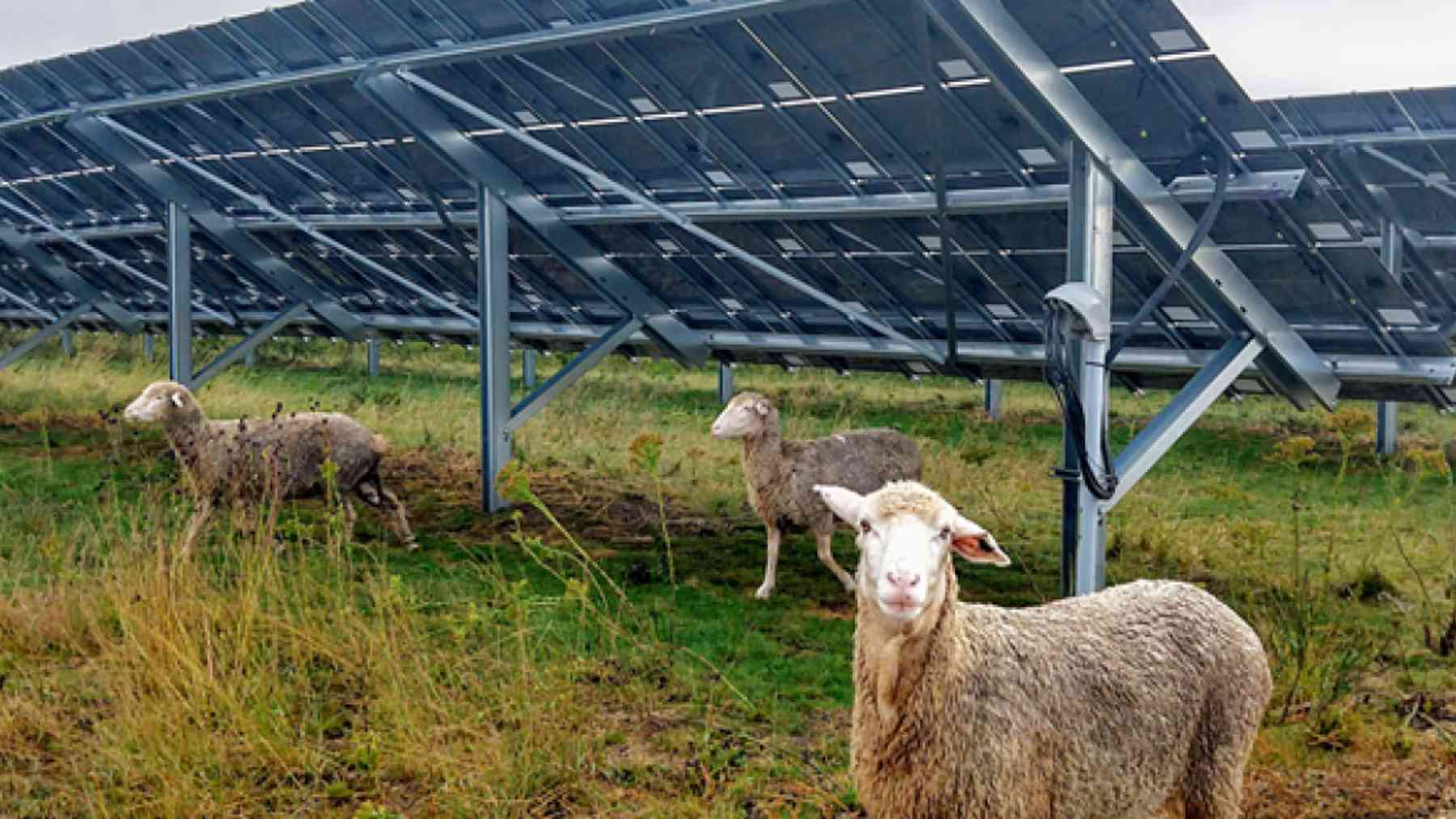
The grass used to come up to the bottom edge of the panels before anyone could stop it.
Then a flock arrived.
Thousands of sheep, moving in a slow wave between the rows.
Heads down, jaws working, leaving the glass alone.
So why do the sheep succeed where machines keep struggling?
A grazing animal built for narrow rows
The advantage is mostly about shape and temperament. Sheep are low, steady and uninterested in climbing, which means they can work beneath the tilted edge of a panel without scrambling onto the steel frame above them. They also feed with their heads down, which keeps them away from wiring, and that combination is why they have become the default animal on solar sites.
Goats keep getting turned away. Graziers who hold solar contracts say sheep are preferred precisely because, unlike goats, they will not jump onto the panels or chew them.
Cattle have a different problem. They are simply too big for the tight lanes between panel rows, while sheep are narrow enough to pass through gaps a riding mower cannot reach, and light enough that their hooves barely disturb the soil beneath them.
One flock of 3,000 covers 4,000 acres south of Austin
Picture the scene in Milam County, Texas, on a solar farm operated by SB Energy near the town of Buckholts. Hundreds of rows of panels stretch across what used to be open pasture, and underneath them a troop of stocky sheep rummages through the grass, moving in rotation from one section to the next as the grass regrows behind them.
That site alone covers about 4,000 acres and generates 900 megawatts of electricity, making it one of the largest solar projects in the country.
Even so, the scale did not happen by design. A rancher named JR Howard began contracting his family’s flock to solar companies almost by accident.
He told reporters, “Just the growth has been kind of crazy for us,” describing a workload that has since left him with more clients than he can take.
Livestock now handle 70 to 80 percent of the mowing
Howard, who runs Texas Solar Sheep, says the mowers have not disappeared, but that 70 to 80 percent of the work is done by livestock, with machines left for the edges and the equipment the animals cannot reach. After heavy rain, crews sometimes cannot get machinery onto a site at all, while the sheep keep eating regardless.
Texas has become the center of this practice nationally. A census of solar grazing taken in 2024 by the American Solar Grazing Association with the National Renewable Energy Laboratory counted roughly 68,600 acres and 36,200 sheep on Texas solar sites, more than half of the roughly 129,000 acres recorded across the country.
Howard’s own operation had grown by early 2025 to more than 8,000 sheep and about 26 employees.
A San Angelo sheep farmer and solar vegetation manager named Reid Redden called solar grazing “probably the biggest opportunity that the sheep industry had in the United States in several generations.”
Farmland fell by over 1 million acres between two censuses
What makes the arrangement more than a curiosity is the land pressure sitting underneath it. Land in farms in Texas fell by more than 1.5 million acres between the last two federal agricultural censuses, and competition for open ground, including solar development, is a sore subject in plenty of rural counties.
Against that backdrop, solar grazing works less like competition and more like an unexpected truce, similar in spirit to how a solar canopy in Switzerland shares its footprint with fruit trees instead of replacing them.
Companies get cheaper vegetation control that makes less noise for rural neighbors, while ranchers gain access to flat, fenced, well watered land they do not own. The same logic turns up wherever solar hardware sits on working land rather than replacing it, including the solar panels built over irrigation canals in California.
Soil questions still outnumber the answers
Even with the momentum behind it, solar grazing has limits nobody has fully worked out. Winter feed and shelter for thousands of animals, predator pressure in open country, and the driving distance between scattered sites all remain real costs for ranchers who take on this work.
Soil health under long term shading is also still being studied.
Nuria Gomez-Casanovas, a Texas A&M researcher in regenerative system ecology, has said of the practice, “We really have more questions than answers,” noting that results so far look context dependent.
For now, the picture in Milam County stays simple. Thousands of sheep move slowly between glinting rows of glass, chewing through grass that would otherwise need a machine, and turning a fenced industrial site back into something that looks, and sounds, a little more like a working ranch.
Read the whole thing?
Get the week's signal, not the noise
Our sharpest reporting on energy, climate and nature — free, once a week.


