
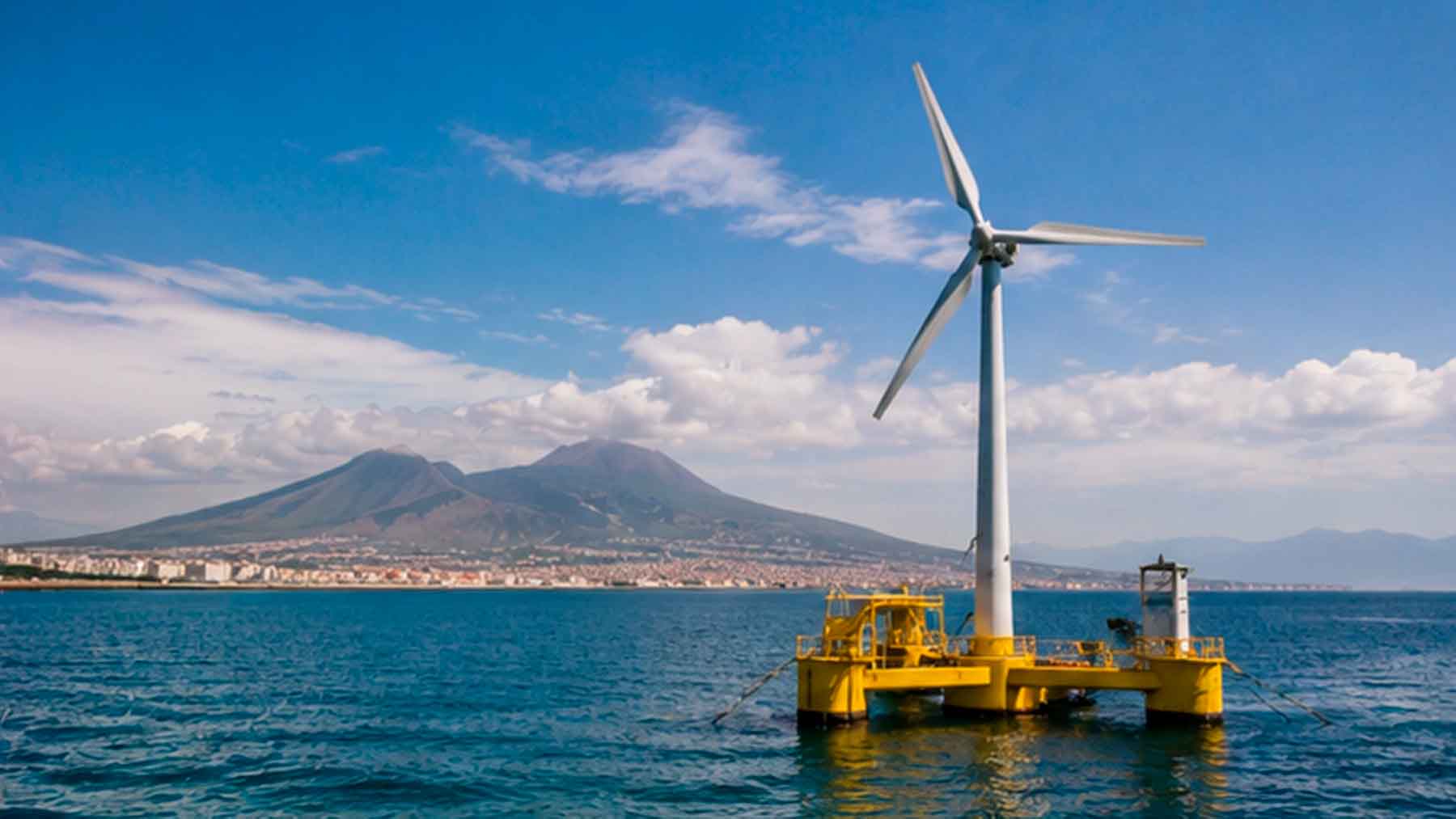
An acoustic recorder is capturing the soundscape almost 100 feet underwater near the Port of Naples.
The sounds picked up so far around a floating wind turbine prototype reveal steady biological activity. Fish “choruses,” snapping shrimp, and even dolphin clicks have been logged.
The loudest frequencies were created by background noise from shipping traffic and natural wave action at the surface. The low-frequency noise from the turbine itself remained quieter.
How baseline underwater acoustics are recorded off a Naples pier
The MareLAB (Marine Renewable Energy Laboratory) is an offshore test facility around 330 feet from the Naples harbor pier in Italy.
Its purpose is to measure real-world conditions around renewable energy installations to evaluate operational dynamics, structural performances, and environmental impact.
A hydrophone was anchored around eight feet off the seabed to record ambient noise and acoustic turbine emissions between September and December 2023.
Data analysis showed that shipping and meteorological events were the heaviest influences on the coastal environment.
Vessels like cargo ships, passenger ferries, hydrofoils, and motorized boats produced frequent low-frequency pulses. The acoustic levels were also elevated by wind and waves.
Biological sounds continued in addition to human activities and weather. A manual review of the research data confirmed biological sounds produced by snapping-shrimp choruses, fish choruses, and occasional delphinid clicks. Wild delphinids also featured occasionally, adding echolocation clicks to the mix.
In the beginning, attempting to gather baseline measurements was tricky. Background sound fluctuated constantly according to marine traffic and meteorological conditions.
It took some time before researchers could isolate the specific operational noise generated by the turbine prototype.
What the turbine contributes to acoustic signatures
The prototype at the center of the acoustic study is a SAIPEM HexaFloat model. It stands 33 feet above the surface, with blades 21.3 feet long.
The comprehensive study covered four operational states, from stationary to maximum power output.
Most of the turbine noise was low-pitched. At full speed, the low-frequency sound increased by more than five decibels compared to its inactive state. It produced a hum at around 400 hertz.
In calm ocean conditions with waves under 3.3 feet (1 meter) tall, operating the turbine raised sound levels by about four decibels specifically within the 63 Hz and 125 Hz one-third-octave frequency bands.
The movement of the steel anchor chains also contributed to the acoustic environment. Their signals were distinct, with friction and strain causing short broadband pulses peaking at around three kilohertz. Some longer tones reached 10 kilohertz.
The noise emissions from the chains shifted in intensity according to the height of the waves and wind conditions around the structure.
Ecological implications and scaling constraints
Recorded acoustic levels remained below established scientific thresholds for physiological damage in marine organisms.
Because operational output was lower than background shipping traffic, recorded sound levels remained below published thresholds for physiological risk, though short-term behavioral masking could not be ruled out.
However, researchers noted that potential behavioral disruption cannot be ruled out.
The 400-hertz tone and low-frequency turbine noise overlap with frequencies used by local fish species. When turbine operation coincides with natural biological activity, mechanical noise may mask acoustic communication among marine organisms in the immediate area.
How do these findings apply to commercial-scale projects?
Significant research questions remain regarding how these findings apply to commercial offshore energy projects.
The study evaluated a scaled prototype equipped with 21.3-foot blades in 98 feet of water near an active harbor pier. Full-scale commercial floating turbines feature substantially larger generators, longer blades, and heavier mooring structures installed in deep open-sea locations.
Consequently, measured noise levels from this single scaled prototype cannot be extrapolated to predict the acoustic impact of full-scale commercial units or multi-turbine arrays.
Future empirical field studies across commercial deployment sites are necessary to determine how cumulative sound emissions, complex mooring dynamics, and array-level mechanical interactions alter underwater noise profiles across broader marine ecosystems in the long term.
The full study can be found here: Buscaino, G., Papale, E., Ceraulo, M., Bardazzi, A., Lucarelli, A., Gao, R., … & Lugni, C. (2026). Acoustic Impact of a Floating Wind Turbine Prototype in the Mediterranean Sea. In The Effects of Noise on Aquatic Life IV (pp. 1-13). Cham: Springer Nature Switzerland.
Read the whole thing?
Get the week's signal, not the noise
Our sharpest reporting on energy, climate and nature — free, once a week.


