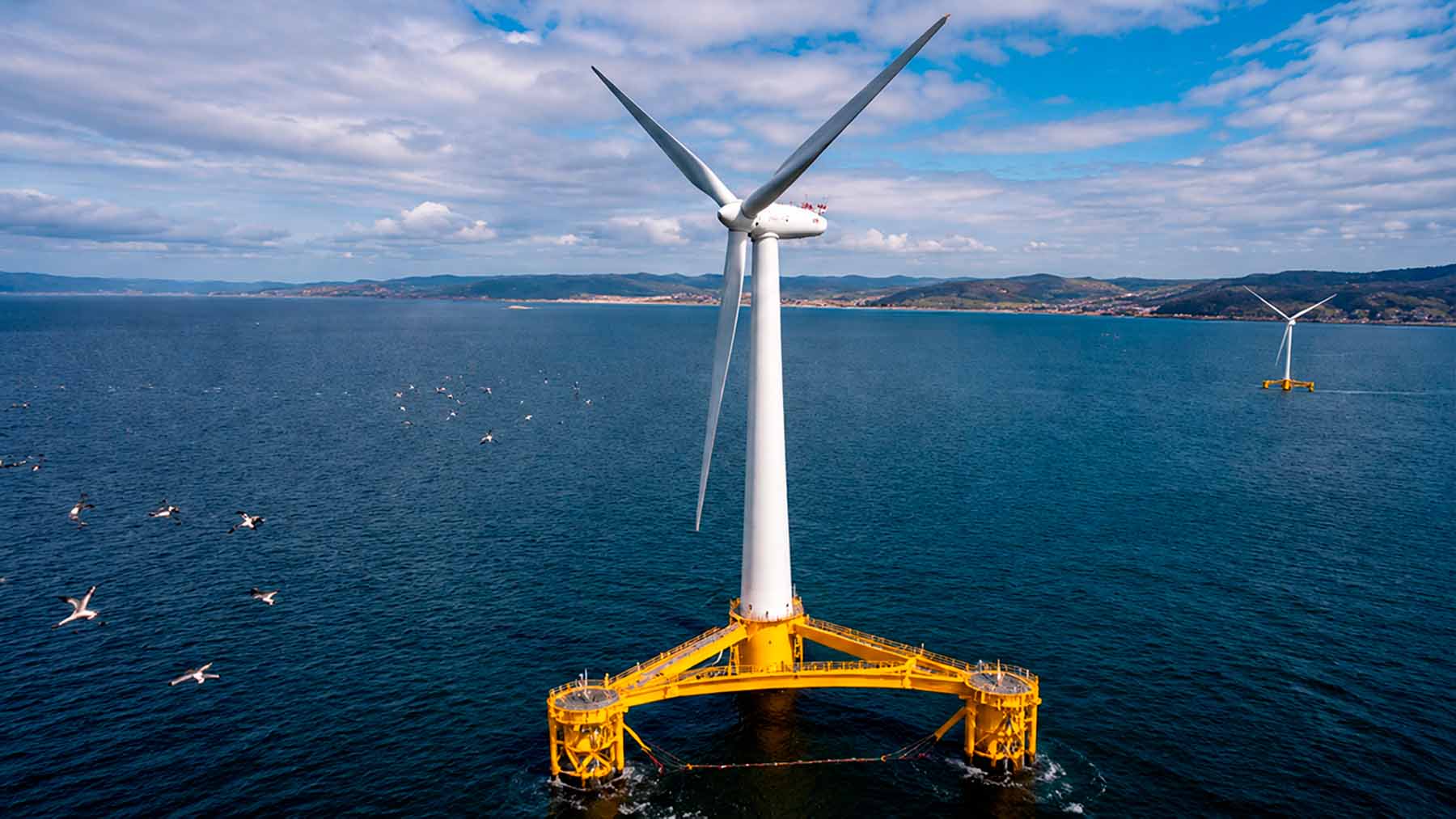
A deepwater floating wind farm nine miles off the eastern coast of Scotland is sending clean power to the grid. The airspace is shared with hundreds of seabirds that use the same wind corridors for migration.
The risk of collisions with the rotating industrial-scale blades has been a concern for conservationists since the birth of the wind energy sector.
Advances in automated tracking technology mean that avian patterns can be monitored in real time. How do the different bird species react to offshore energy infrastructure?
How offshore wind deployment comes with environmental monitoring requirements
The expansion of floating wind energy farms into deeper waters involves fixing the platforms to the seafloor hundreds of feet deep and many miles from shore.
Scotland’s Kincardine project sits in 190 to 260 feet of seawater and sends vital clean power to local onshore grids. But this region of the ocean also supports resident and migratory bird species like gulls, northern gannets, and black-legged kittiwakes. Energy operators are legally mandated to evaluate the dangers that offshore infrastructure poses to birdlife. Regulators want to know if flight paths are altered and how many fatal collisions occur.
Traditional environmental surveys rely on human observers working from research vessels. The manual counts are not reliable, being affected by weather, lack of visibility at nighttime, and high operational costs.
The other problem is that observers working onboard boats cannot see what is happening around the blades hundreds of feet above the surface. Manual tracking cannot record how birds behave around the blades at close distances.
To comply with regulations set by the Scottish Government, researchers needed to come up with an automated continuous monitoring system that could collect data under all conditions.
Tracking reveals flight patterns and avoidance behavior
There are several technical challenges involved in deploying sensitive sensors on floating platforms. The optical tracking equipment is frequently disrupted by fog, sea spray, and the constant motion of the turbine platforms.
Despite these complications, Kincardine’s monitoring gear recorded thousands of hours of flight logs and video. Data analysis shows distinct seabird behavior patterns around the offshore array. Many migrating species practice what is called macro-avoidance, where they shift their flight paths hundreds of yards before reaching the outer turbines.
Smaller numbers of local birds behave differently, navigating between the individual turbines. Closer to the rotors, the birds practice micro-avoidance. They alter their altitude or bank sharply in flight to dodge the moving blades.
However, to process datasets at such a scale, false triggers had to be filtered out. These could be caused by waves or clouds. Engineers needed to come up with an automated mechanism to identify approaching birds and activate a deterrence solution.
Acoustic warnings and active blade curtailment
The system works by pairing high-resolution optical cameras with automated deterrence controls directly on each turbine structure.
Mounted around the platform transition piece, daylight and infrared camera modules continuously scan a 360-degree perimeter surrounding the rotating blades.
When a bird enters a designated warning zone, the system automatically triggers acoustic speakers that emit species-specific warning sounds to encourage early course correction. If the bird keeps flying toward the rotor sweep area, the software sends an immediate signal to the turbine control interface, initiating rapid rotor slowdown or complete blade curtailment.
At the Kincardine facility, this integrated DTBird® setup logged high detection accuracy and successfully triggered automated blade slowdowns during critical close-approach events.
Filtering out fog, waves, and species size
However, researchers emphasize that performance depends heavily on site-specific factors, including local fog density, ambient wave noise, and target species size, detailed in another report from DTBird®. Further multi-year monitoring remains necessary to determine whether continuous acoustic warnings lead to long-term habituation among resident seabirds.
Testing automated detection and curtailment tools on floating platforms represents a crucial step toward lowering avian risks across commercial deepwater energy developments.
Read the whole thing?
Get the week's signal, not the noise
Our sharpest reporting on energy, climate and nature — free, once a week.