Behind almost every restaurant in America there is a squat plastic tank with a lid that locks.
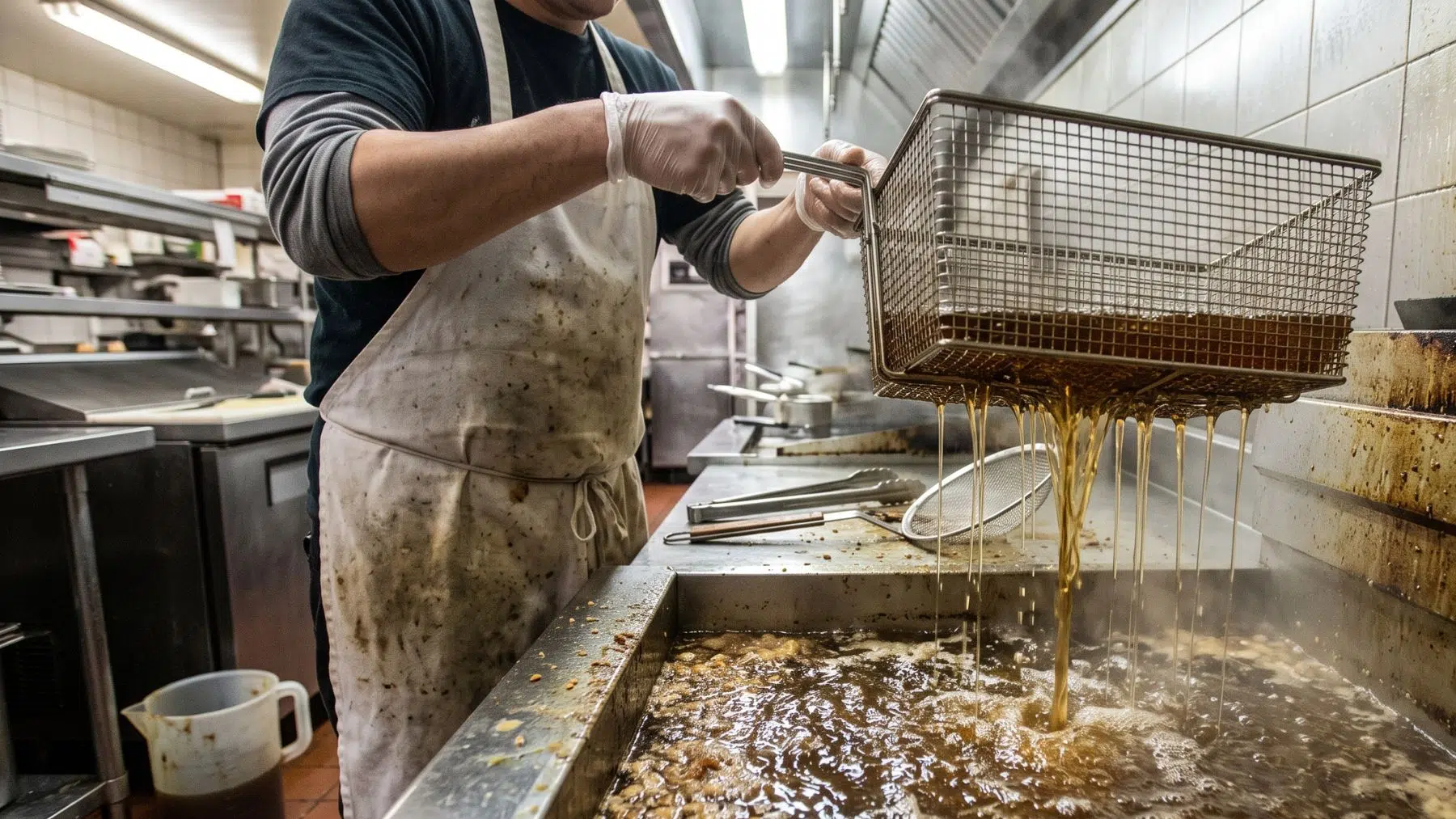
What goes into it is the oil out of the fryers, strained, cooled and the color of syrup.
American kitchens pour out roughly 2 million gallons of it every day.
For most of the last century a restaurant paid a company to come and take that away.
The same company pays the restaurant today, and the lock is new.
What the barrel out back is worth
Because the thing that changed here was never the oil. It was the price.
Yellow grease, which is the trade name for what comes off a fryer, moves between 21 and 41 cents a pound depending on the month.
A busy kitchen fills a tank in a couple of weeks, and one tanker route can empty a hundred of them in a day.
Multiply that across the country and the collection business handles around 850 million gallons a year.
That is roughly a quarter of everything gathered worldwide, which makes American fryers a serious supplier of a global commodity.
Nobody planned it that way. It fell out of a change in what refineries were willing to buy, and the kitchens simply happened to be holding the supply.
How it stopped being garbage
And the flip happened inside a single generation, which is why plenty of operators were slow to notice it.
Renderers have collected fryer oil for well over a century, boiling it down into soap, animal feed, cosmetics and industrial lubricants.
Those buyers paid very little, so the hauler charged the restaurant a removal fee and everybody treated the barrel as trash.
Then fuel policy rewrote the arithmetic. A gallon of used cooking oil earns credits at a refinery that a gallon of crude cannot.
The hauler started paying the kitchen instead, and the tank out back turned into a small revenue line.
A line that used to be a cost became a check in the mail.
Why the lid has a lock
Which explains a piece of equipment nobody would have bothered with a generation ago.
Grease tanks are sold with bolted steel lids, keyed hasps and level sensors that report a sudden drop straight to a dispatcher.
Collection trucks carry trackers, and a load travels with paperwork that follows the oil from the kitchen door to the refinery gate.
The industry association reckons that hundreds of millions of dollars worth of it goes missing across the country in a year.
So a bin that used to sit open in an alley is handled like a cash drawer.
Which is a strange sentence to write about the leftovers from a basket of fries, and it is the plainest measure of how far the price has moved.
From the fryer to the wing
Then comes the part that made the whole chain worth building in the first place.
The oil is stripped of water and food solids, then either reacted with alcohol into biodiesel or run through a hydrogen process that yields renewable diesel.
Push that same route a step further and the product is jet fuel, which is where the demand is heading, as the trade press covers.
Fuel made this way can cut lifecycle emissions by up to 80 percent against fossil kerosene.
Airlines cannot reach that figure any other way today, so they are bidding against soap makers and feed mills for the same barrels, as the trade data shows.
A basket of fries is an energy input, which nobody would have said out loud a generation ago.
The three quarters that get away
Which leaves the awkward half of this, and it belongs to households rather than to restaurants.
Only about a quarter of the cooking oil used in American food service is recovered at all, and collection works out to roughly two and a half gallons a person.
Home kitchens are barely in the system, and most of what they use goes down a drain or into the trash inside a jar.
Down the drain it cools, clings to the pipe wall and builds the fat deposits that crews have to cut out of sewers by hand.
Cities have started running household drop off points at the same sites that already take paint and batteries.
The bottleneck is the one that turns up around an offshore project or a coastal solar site, where the hardware is never the hard part.
Somebody has to pay for the route that carries the material to whoever wants it.
So the useful move at home is a small one. Let the oil cool, pour it back into a bottle, and check what the county waste site takes.
The tank behind your local restaurant has a padlock on it for a reason.
Read the whole thing?
Get the week's signal, not the noise
Our sharpest reporting on energy, climate and nature — free, once a week.