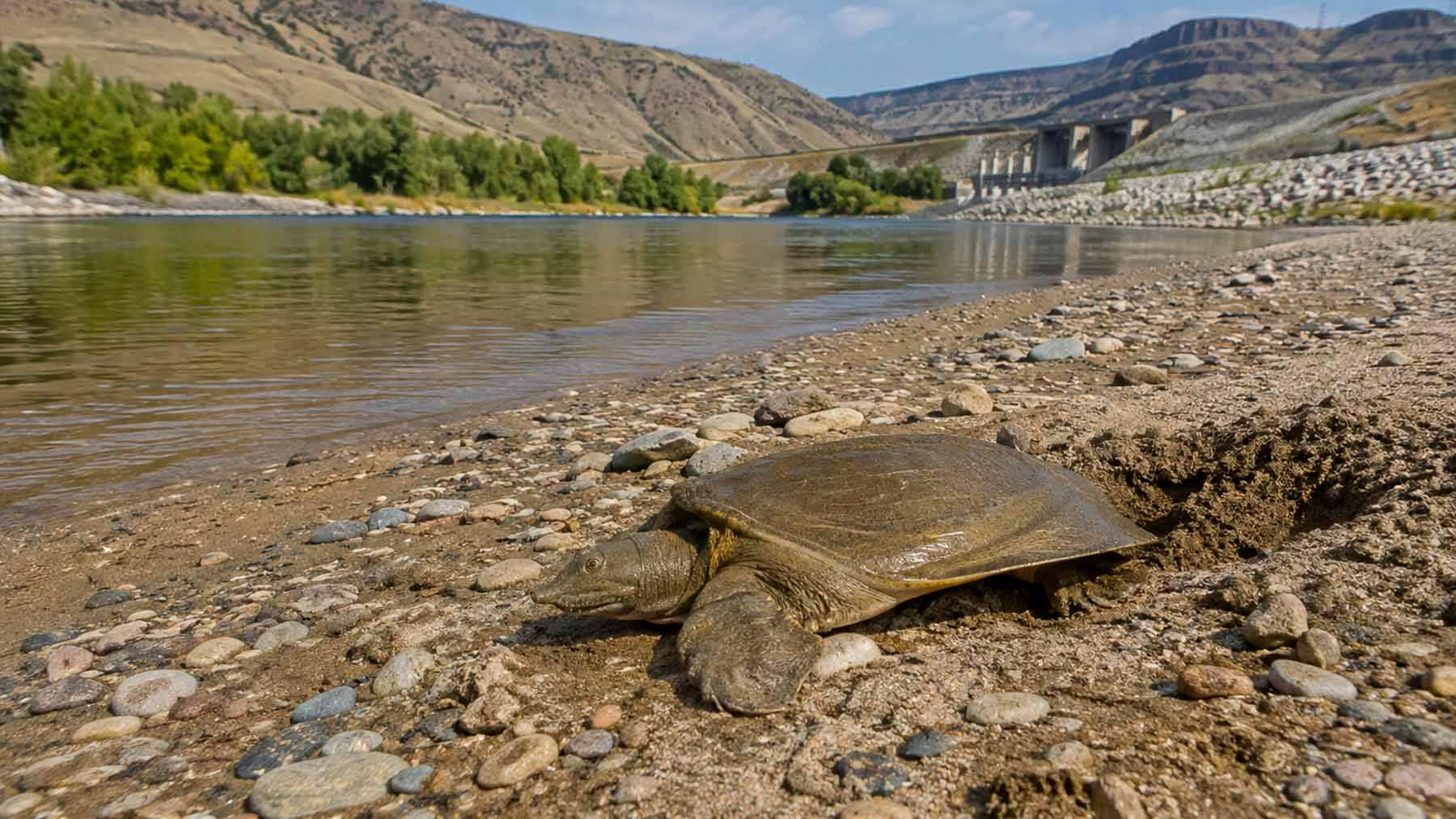
Eastern Montana is one of the preferred locations for female softshell turtles to lay eggs. They appreciate the region’s gravel shores, channels, and clean river sand.
A recently published ecological survey focused on 504 nests across two waterways, one managed and one wild. The findings showed that habitat shrinks where the river flow is artificially controlled.
What is it about hydropower operations that changes the landscape this species depends on to survive?
How softshell turtle nests were mapped in Montana’s waterways
Researchers focused on two nesting sites along the Bighorn and Yellowstone rivers. The aim was to evaluate how dam operations affect the habitat. The softshell species’ hatching success depends on exposed, sunny sandbars with loose sediment that need to be located near deep water channels.
When these conditions are met, egg-laying can take place above the waterline as fast as possible, and the females can move away from predator high-risk areas out of the water.
The survey was extensive, with 504 individual nests tracked along both rivers. The contrast between the two corridors was notable.
The Yellowstone River, which has no dams, sees seasonal floods in the spring that reshape the riverbed and water courses. This clears encroaching vegetation and deposits new mounds of clean sand. The unhindered water movement creates ideal open riverbank nesting sites many miles long.
It is not the same along the Bighorn River, which has two hydropower dams upstream. Its discharges are managed by Yellowtail Dam and Afterbay Dam, so natural sediment movement is restricted. The result is the creation of much fewer sandbars suitable for turtle nesting.
Regulated rivers mean habitat crowding
The study’s spatial mapping data demonstrated how regulating the flow of water concentrates wildlife in limited spaces. Along the Yellowstone, turtle nests were spread widely apart along the sandbars. These areas provided up to seven times more territory for nesting.
There was a contrast along the Bighorn River. Almost 80 percent of the recorded nests were crowded into just nine isolated locations.
The turtle nests are vulnerable in the concentrated areas downstream of the hydropower dam. The risk of nest destruction increases when female turtles lay eggs in high-density, limited locations. Raccoons, skunks, and other land predators have a much easier time locating and exploiting nesting grounds.
There is also a vegetation issue. Without high-flow events to clear plants, they take over the banks. Sandbars become covered with dense brush, which is not suitable for laying.
Female softshell turtles end up being left with limited options during the brief breeding season.
Restoring natural river flow with seasonal runoff management
The management of high water runoff in spring is important. Hydropower plants do not function unless they hold water back for releasing later. This is how energy is stored. But clearing brush and piling up fresh sand needs regular flooding. If this does not happen, open nesting beaches eventually disappear.
We do not know yet how much the overcrowding of laying locations affects hatchling survival rates because this study only looked at two locations over one season. Follow-up studies are needed for years’ worth of tracking.
Targeted water pulses may hold the key to nesting habitat preservation
It does not require dismantling dams to fix the problem. This would be counterproductive to clean energy production. Operators could implement targeted water pulses, which are planned water releases that create mini floods. This way, sandbars could be rebuilt without any interruptions to energy production.
The differences between the Bighorn River and the Yellowstone River show how limiting the water flow with man-made dams changes life in the water. To truly restore a river, it takes more than the flow of the river. The sediment also has to move naturally again. When old dams are removed, free-flowing currents have room to rebuild lost floodplains.
You can find all the details of the study here: Ostovar, K., L. Saarel, J.-L. C. Borgogna, et al. 2026. “ Hydropower Operations Reduce Alluvial Nesting Habitat and Alter Riverine Turtle Population Demographics.” River Research and Applications 42, no. 6: 1322–1334. https://doi.org/10.1002/rra.70146.
Read the whole thing?
Get the week's signal, not the noise
Our sharpest reporting on energy, climate and nature — free, once a week.