
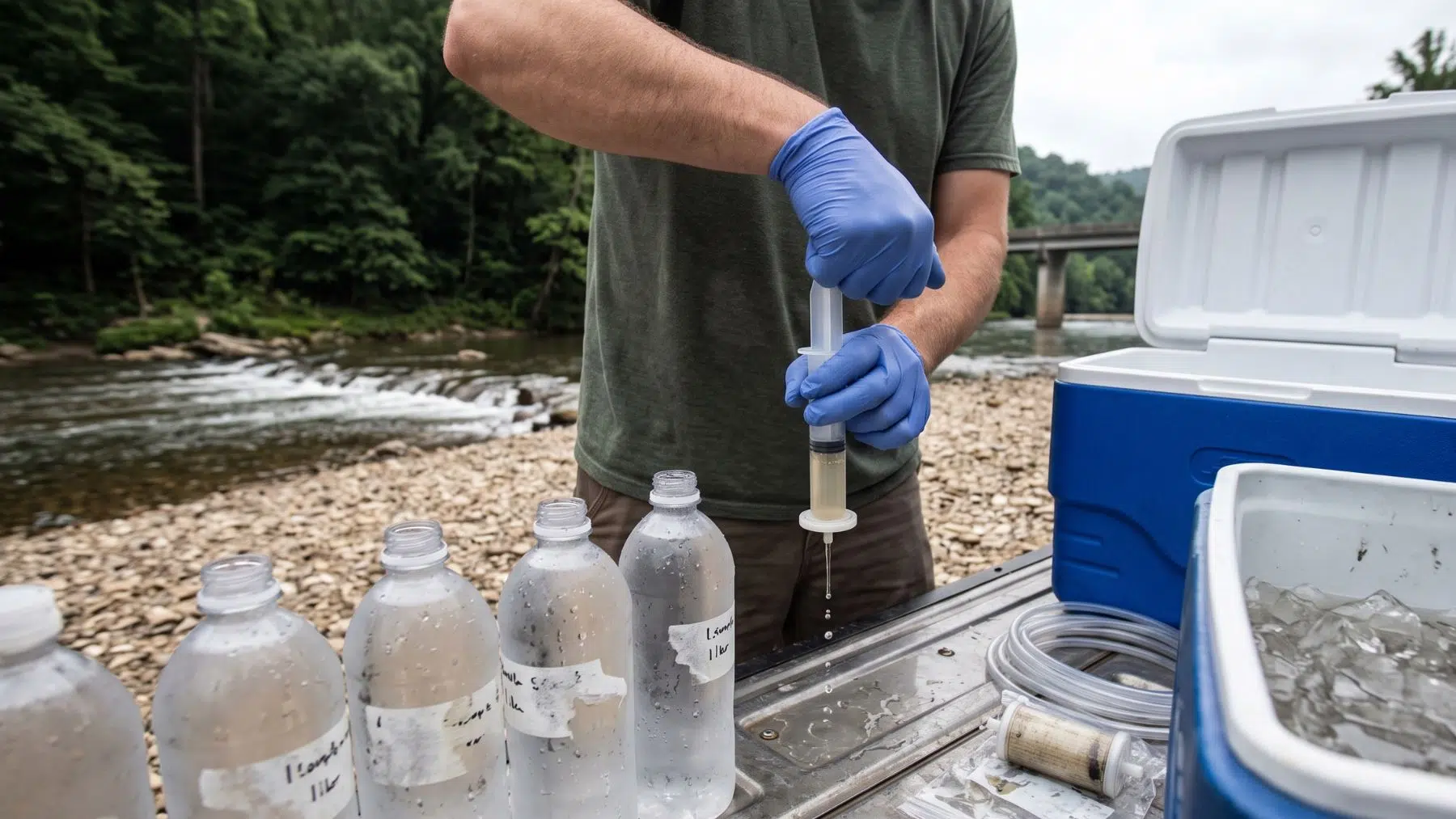
Pull a bottle of water out of the Clinch River in eastern Tennessee and it looks like nothing at all.
What is actually in it is shed skin cells, mucus and waste from everything living upstream of the bottle.
A crew filtered 43 such bottles across two rivers and found the fingerprint of a fish nobody has caught since the mid nineties.
Three of the sites came back positive for the slender chub, which is a minnow the length of an adult finger.
The stranger part of this is what it took to build the test at all, because the search nearly could not be run.
The last frozen tissue of the species had already been thrown away by accident, and not by anyone’s decision.
A minnow with almost nowhere to be
This is not a fish that ever lived across half a state.
It reaches about 4 inches, and it holds the smallest range of any freshwater minnow in North America.
Its whole world was the Clinch, the Powell and the lower Holston, all inside the upper Tennessee River basin.
It wants swift current over clean gravel shoals, and it picks mayfly, caddisfly and midge larvae out of the stones.
That habitat is the first thing a dam removes, and the last catch from the Holston came in 1941, before Cherokee Dam closed.
Federal protection arrived in 1977 and a recovery plan in 1983, but the Powell records stop in the early eighties and the Clinch records stop a decade later.
The freezer that made everything harder
Here is the detail that turns this from a survey into a story.
A federal five year review noted flatly that the only known tissue samples of the species were lost when the freezer holding them failed.
No fault, no incident, no headline. A compressor stopped, and the reference material for a fish that may no longer exist went with it.
That same review pointed out the consequence, which is that a genetic search becomes considerably harder without tissue to build it from.
It also named the workaround, which is pulling usable DNA out of museum specimens that have sat in preservative for decades.
So the assay that found these three hits had to be assembled around a hole in the archive.
What is actually in the water
The method itself is less exotic than it sounds.
Every fish, frog, mussel and crayfish in a river is constantly shedding cells, and scales drift loose while waste breaks apart.
Those fragments carry DNA, and in flowing water the DNA stays readable for hours to weeks before it degrades.
A crew pushes river water through a filter fine enough to trap that material, then tests what the filter caught.
The test is not a sequencer reading everything present. It is a targeted assay, tuned to amplify one species and ignore the rest.
Which means the sampling is trivial and the chemistry is not.
Three sites out of forty three
The field work itself was ordinary once the assay existed, which is the part worth noticing.
A team sampled 43 sites across the Clinch and the Powell in the summer of 2022, chosen from historic records and from stretches that still looked suitable, as the survey describes.
Three came back positive, and the hits were spread across both rivers rather than clustered in one stretch.
Everything else in that set of 43 came back completely silent, which is the result everyone involved had been bracing for.
That is a small number and an enormous one at the same time, because the running count for two decades had been zero.
The same review that recorded the freezer loss had already listed the species as one where conventional gear kept coming up empty, as the review laid out.
Nets, seines and snorkel surveys had been run for years by people who knew exactly where to look, and none of it produced a fish.
What three hits do not prove
The authors are careful in a way the headlines around this usually are not.
A positive result confirms that the DNA was there. It does not confirm a living fish anywhere nearby.
It also cannot rule out a hybrid, since a cross between related minnows can carry enough of the sequence to trip the assay.
What the result does is narrow the search from two entire rivers down to three specific places worth putting divers and nets into.
That is the same role monitoring plays around an offshore array or a fenced solar site, which is telling people where to go and look properly.
For a fish last held in someone’s hand before most of the crew was born, that is the entire point.
Read the whole thing?
Get the week's signal, not the noise
Our sharpest reporting on energy, climate and nature — free, once a week.




