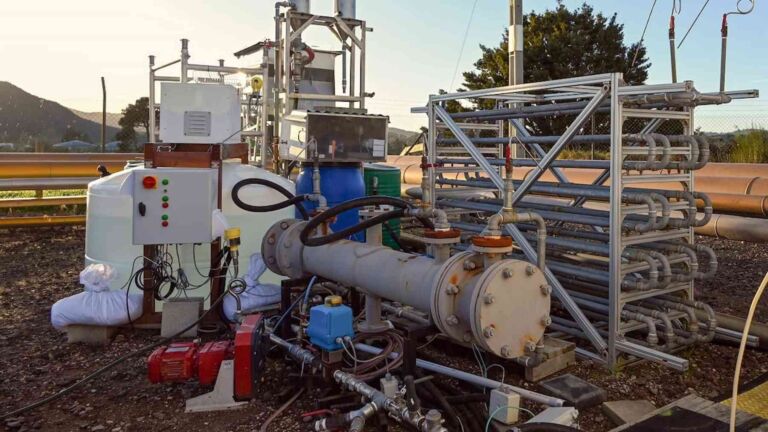
A trap waits at the end of a pipe on a small stream in Maine.
Water rushes through it toward a spinning wheel of metal.
Somewhere inside that wheel, a handful of silvery fish no longer than a finger are about to find out if they survive the trip.
For decades the answer at dams like this one was grim.
At Freedom Falls, a small hydro plant, something different happened.
What changed inside that spinning wheel is the whole story.
Thick blunt blades replaced thin fast ones
The mechanism is almost stubbornly simple. A conventional propeller turbine runner relies on thin, fast spinning blades to wring as much energy as possible out of moving water, and those blades carry a leading edge made as sharp as possible, which is not kind to a fish that drifts into its path.
So a California turbine maker took the opposite approach, building a runner with fewer, thicker blades, rounded leading edges and a forward slant running from the hub out to the blade tip. The clearance around those blades matters more than it sounds.
Because the design keeps the gap between the spinning runner and the housing around it to a minimum, a fish that might otherwise be caught between a moving blade and a stationary wall instead rides past on a blunt, forgiving surface, more nudge than blow. The company calls this a fish safe runner, built so migratory species can pass straight through a working turbine rather than around it.
That framing matters commercially, since screens and bypasses, the industry’s usual fix, add cost and still miss fish that slip past the fine mesh meant to exclude them.
A mill dam on a central Maine stream
The setting for the real test was ordinary enough. Freedom Falls is a 35 kilowatt hydropower project at a refurbished historical mill dam on Sandy Stream, in central Maine, the kind of small structure that dots New England rivers by the hundreds.
There, alewife, which are river herring that spend their adult lives at sea and return to freshwater to spawn, send their young drifting back downstream past dams like this one each year. Shad and river herring are an unusually sensitive group of migratory fish where hydropower is concerned, so the team needed real juveniles rather than a hardier stand in.
That sensitivity is the reason the site is interesting. A result from a tough, resilient species would say little about what happens to the fish most likely to be hurt.
484 fish passed through in a three day trial
The trial ran at Freedom Falls over three days at the end of September 2021, working with the fisheries consultancy Kleinschmidt Associates. A total of 484 juvenile alewives, roughly 3 to 5 inches long, were released into the intake of a 1.8 foot diameter runner in groups of 140 to 170 and recaptured with a specialized trap at the discharge outlet.
Passage through the runner region was recorded on high speed video, and the fish were checked again after 24 and 48 hours.
Corrected for mortality in the control groups, the pooled immediate survival estimate was 98.2 percent, and the pooled 48 hour estimate was 100.0 percent. The authors note that the apparent rise came from higher delayed mortality among control fish rather than from recovery in the turbine groups, and the published results carry wide confidence intervals on both figures. For comparison, earlier estimates of juvenile alosine survival at larger hydropower plants span a huge range, from 34 to 97 percent, and a turbine built to generate power came out near the top of that range, with the fish filmed going through rather than merely counted afterward.
Eel and trout tested too at other sites
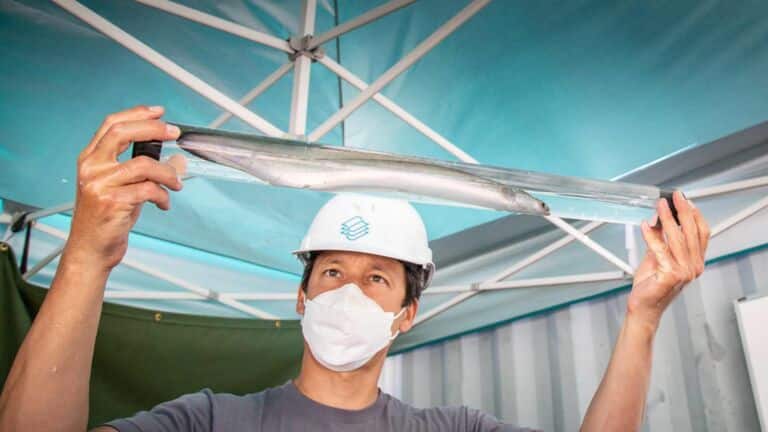
The same design has been run with other species at company and partner facilities in Oregon and California. In testing with the Pacific Northwest National Laboratory, American eel and rainbow trout between 8 and 20 inches long were passed through the runner, and more than 99 percent came through safely, which suggests the blunt blade approach is not a one species trick.
That work had federal backing. The Department of Energy’s Water Power Technologies Office put nearly 9 million dollars into the turbine across seven programs over eight years, and later awards have funded further passage research.
Even so, wider use would mean retrofitting or replacing runners at existing dams, a slower and costlier job than swapping a single test rig. Similar engineering tradeoffs show up elsewhere, including work built around protecting endangered species that cross paths with energy infrastructure.
A 98 percent survival rate leaves questions open
None of this erases the basic tension between hydropower and migratory fish, a conflict that has shaped river policy for a century. The trial covered one small plant on one Maine stream during a single migration season, and capture and transport killed roughly half the fish collected before testing even began, so only uninjured, normally swimming individuals went into the runs.
River herring runs sit far below their historical abundance across much of the Atlantic coast, which is why every percentage point of survival at a dam matters to the rivers still trying to rebuild them. A blunter blade will not reopen blocked habitat, but it changes what happens to fish that still must pass the barriers left standing.
Engineers elsewhere are testing related ideas, including wider corridors built into other kinds of energy infrastructure entirely. As one researcher involved in fish passage testing put it, the goal is proving a turbine can generate power and still let a migratory fish survive the trip. The caveats are real, but so is the trap at the end of that Maine pipe, filling with small fish that swam through a spinning wheel and kept going.
Read the whole thing?
Get the week's signal, not the noise
Our sharpest reporting on energy, climate and nature — free, once a week.