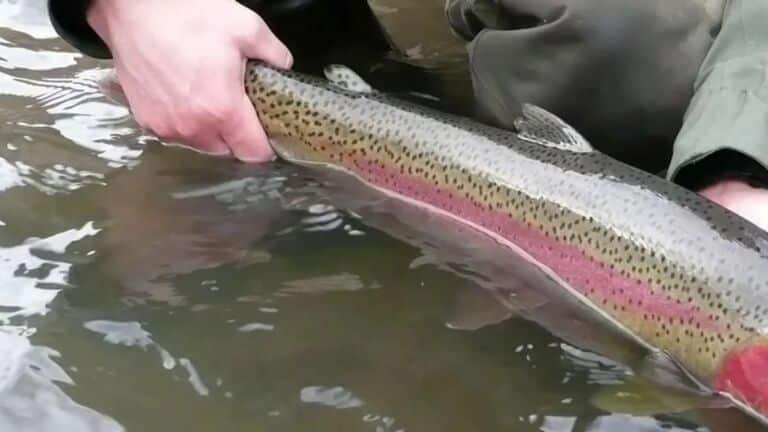
The fish comes up fighting, the way they do in cold water.
A gloved hand holds it on its side, a needle goes into the base of the tail, and a few drops of plasma go into a vial packed in ice.
The fish goes back in the river.
The vial goes into a freezer, where it can sit for years before anybody decides what to test it for, and this one was eventually tested for forever chemicals.
What came back sorted itself into three tiers.
Not by species, not by size, but by what sits upstream of the place each fish was caught, which is the part nobody had ordered.
Why the blood and not the fillet
PFAS are a family of synthetic compounds built around a carbon fluorine bond.
That bond is one of the strongest in organic chemistry, which is what makes the coatings on a pan and the water repellency in a jacket work, and it is also why almost nothing in nature breaks them apart.
They do not settle in fat.
Unlike the older contaminants that built up in fatty tissue, these bind to proteins, which sends them to the blood and liver rather than into the muscle a person would put on a plate.
That is why the sampling looks the way it does.
Testing a fillet would understate the exposure, so researchers draw plasma instead, and it is also the reason the same study concludes that fillets are safe to eat.
Why this particular fish
Smallmouth bass do not travel far.
They hold a stretch of river for years, eating what hatches and swims there, which makes them a record of that stretch rather than of a watershed in general.
They have also been in trouble.
Populations across this watershed have gone through disease outbreaks, mortality events and declines, alongside intersex findings and reproductive disruption, without any consistent contaminant explanation being found in water or tissue.
They are worth money as well.
The species is among the most important warmwater game fishes in the country, which means a river with sick bass has an economic problem attached to its ecological one.
What the sampling actually covered
Three hundred and eighty adult bass, from ten sites across four river systems.
Pennsylvania holds most of them, with one Maryland creek and three West Virginia sites, and the plasma was collected between 2014 and 2019 before the analysis was published in 2024.
Four compounds appeared in every single sample.
PFOS, PFDA, PFUnA and PFDoA, with PFOS running far higher than the other three, and at the two hottest sites the researchers ran an expanded panel looking for 28 different compounds.
Those two sites are named.
Swatara Creek and Little Neshaminy Creek, the second of which produced the highest site average in the study at 546 parts per billion of PFOS.
The three tiers, and what the headline gets wrong
Sort the ten sites by PFOS and the land use sorts itself.
Sites under 100 parts per billion had the least developed land upstream.
Sites between 220 and 240 had almost no development but a high share of farmland, and sites above 350 had the most developed land and the most industrial PFAS sources.
That last group is where the airports and military installations are.
So the farm rivers did not match them. They landed at roughly two thirds of the developed tier and more than double the cleanest one, which is a different and more interesting finding than a tie.
The surprise is the middle, not the top.
Nobody expected a creek with no factories upstream to carry this much, and the same national picture shows up in a survey of 501 sampling points where freshwater fish ran far above anything sold in a shop.
How it would get there from a field
The pathway is a hypothesis and the agency says so.
Three routes are on the list. Sewage sludge spread as fertilizer, manure from livestock that ate contaminated forage, and pesticides that either contain these compounds or break down into them.
The lead biologist has been careful about it.
She has said that certain pesticides are considered to contain PFAS, and that some can be precursors to the ones her team measures.
Diet, she adds, is very likely a major exposure pathway for a fish just as it is for a person.
The pesticide route is not theoretical.
More than 2.5 million pounds of these compounds were sprayed onto California crops in recent years.
Even so, the agency behind this work says further research is needed before anyone calls the farm route proven.
What is not in doubt is the reading itself.
Every one of the 380 smallmouth bass carried four of these compounds in its blood, and the published paper stops exactly where the evidence does.
That stopping point is a correlation nobody has yet turned into a cause.
Read the whole thing?
Get the week's signal, not the noise
Our sharpest reporting on energy, climate and nature — free, once a week.