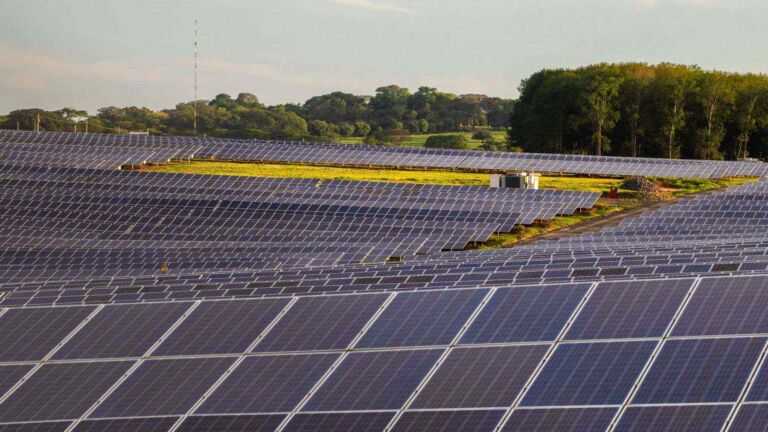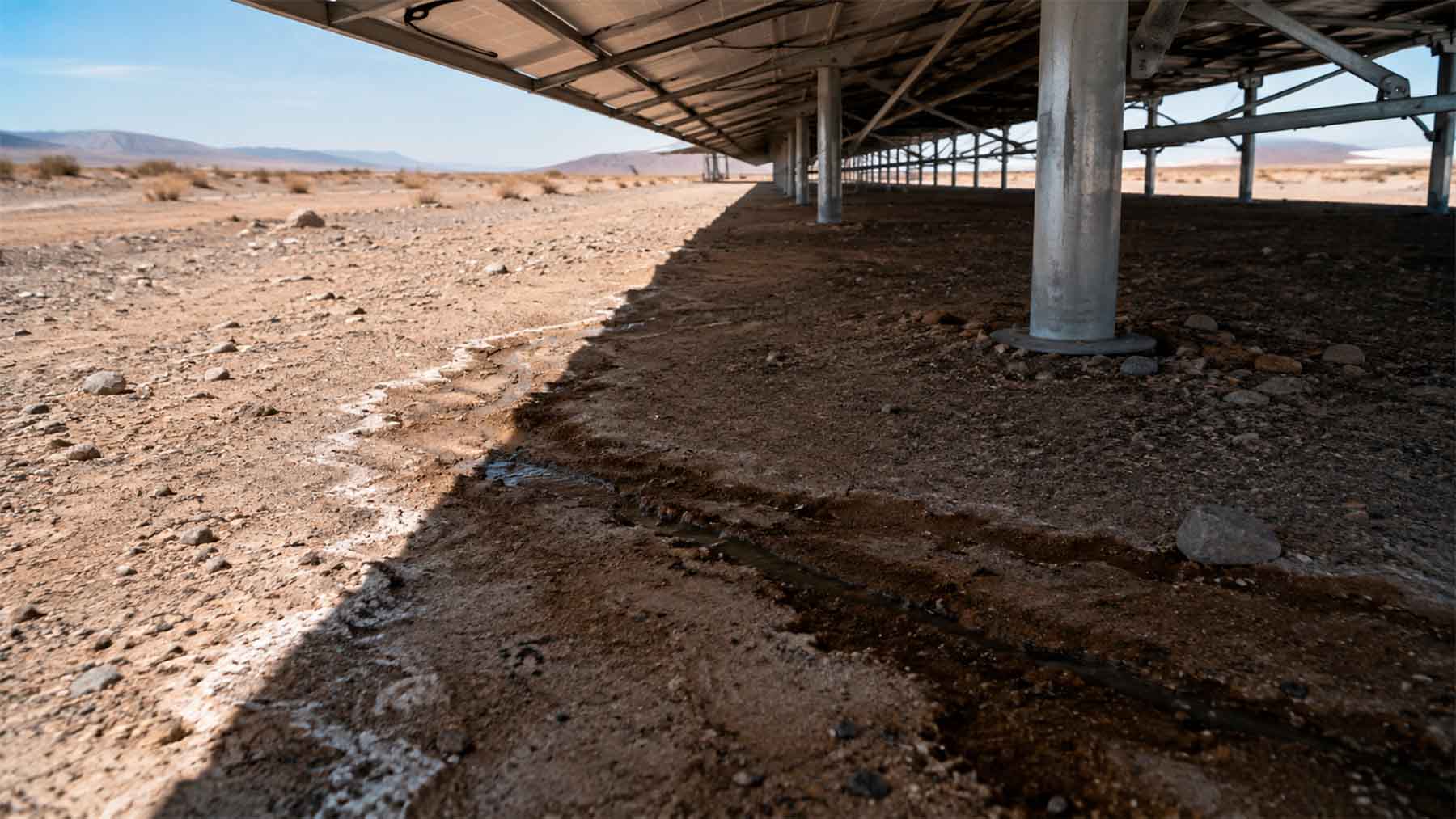
The Gobi Desert is shaded in some places by thousands of solar panels.
One utility-scale facility was put under field monitoring, which recorded underground dynamics that no one predicted.
Heat in the sand was moving upwards, which is opposite to normal thermal gradients. At the same time, moisture under the surface was moving sideways under the arrays.
These kinds of shifts in microclimates challenge scientific assumptions about thermodynamics. What was it about the solar farm infrastructure that caused these effects?
How microclimates under desert solar farms are monitored
The temperature across the Gobi Desert’s unshaded landscapes swings daily.
Exposed ground is under the most direct solar radiation in the afternoon, and the intense heat evaporates whatever moisture is present into the atmosphere.
When photovoltaic arrays are installed, the natural balance of radiation is changed because the panels block sunlight from reaching the ground below.
To evaluate what effect these physical additions have on the microclimate beneath, environmental scientists fitted sensors under the raised rows of panels. Nearby control zones with no panels were monitored in the same way.
The sensors were automated to measure the temperature of the soil, heat fluctuations, and moisture levels at varying depths over extended periods.
When the data was analyzed, the logs revealed notable contrasts between the shaded and exposed ground.
The soil in the open desert regions went through intense heating cycles, but the shaded ground under the arrays remained cooler at the surface.
The shade did more than just drop the ground-level temperature. Unusual energy transference and water movement patterns were also noted in the shallow soil layers.
Dryland biomes are undergoing thermodynamic shifts
The expansion of green energy globally sees more and more drylands being taken up by solar power generation. The scale of the new installations means that baseline surface conditions are altered over large geographic areas.
Asia’s desert basins have projects that cover hundreds of square miles. Sand that was previously open to the sun is now covered by mounted silicon solar modules.
These facilities are transforming the localized energy balances at a regional scale.
Under normal conditions, energy is absorbed by the soil during the day, and heat is radiated upward during the night.
But PV panels interrupt this cycle. The solar modules absorb radiation to generate power while creating shadows where previously, there was sun.
Soil dynamics can be changed across entire energy zones because ground evaporation is reduced under the panels.
A reversal of the natural temperature gradient and water migration
Permanent shading under the solar panel installations had the effect of reversing the natural vertical temperature gradient between the top layer of soil and deeper layers beneath.
In the open desert, the surface catches all the solar radiation. Thermal energy is forced downwards during the daylight hours. However, under the arrays, the constant shade means the topsoil remains cool and the deeper parts of the ground retain some heat.
This is a thermal inversion that drives heat upward from the subsoil to the surface.
Concurrently, the swings in temperature and moisture between the gaps between the panels and the strips of cooler shaded ground create strong matric potential gradients.
Their effect is forcing the moisture in the soil to move laterally to the shaded zones.
There are limits when depth is a factor
Researchers explain that there are observational boundaries in this kind of sensor monitoring.
The instruments were only able to measure the microclimatic factors down to three feet, so interactions at deeper levels have not been studied yet.
The study concluded that solar farms in arid environments function as thermodynamic modifiers. There are not just passive structures on the surface. The effect of the energy infrastructure on microclimates needs to be understood for the evaluation of long-term ground stability in desert energy corridors.
The full study is available here: Yang, Z., Gao, X., Yang, L., Chen, B., Ying, J., Jin, X., … & Li, Z. (2026). Observed effects of utility-scale photovoltaic plants on soil hydrothermal conditions in Gobi desert. Solar Energy, 303, 114086.
Read the whole thing?
Get the week's signal, not the noise
Our sharpest reporting on energy, climate and nature — free, once a week.