
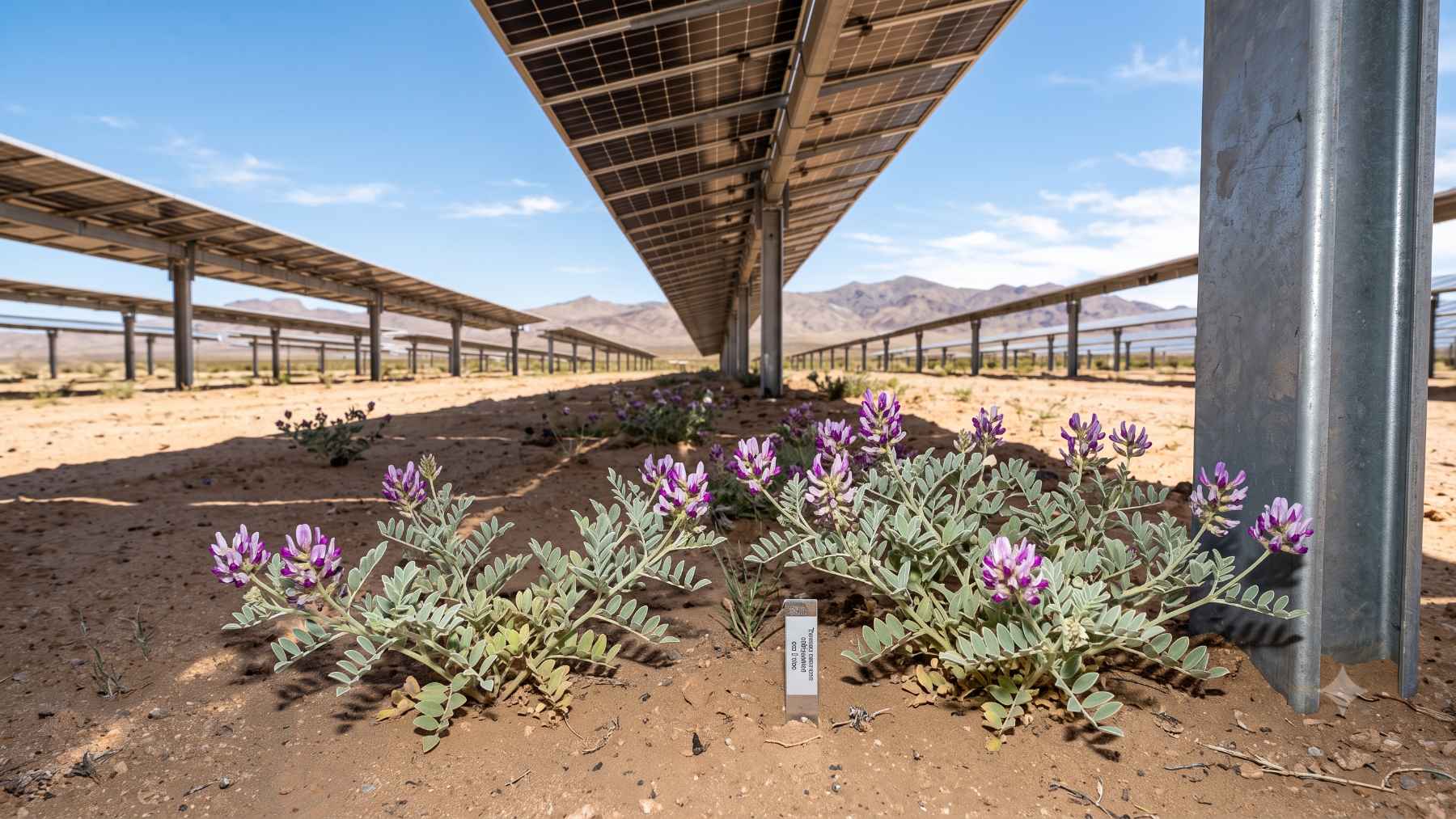
Field botanists had an important job to do in a dry stretch of the Mojave Desert before construction crews were allowed to break ground on a solar project.
Individual plant stems in the hard earth had to be marked and recorded, and only 12 of the rare and endangered species were counted across the whole site.
Scientists returned years later to inspect the land and discovered 93 of the plants. What changes led to this increase?
How a low plant baseline had conservationists concerned
The Mojave Desert is a harsh place to try to survive in. Temperatures in the summer can exceed 110 degrees Fahrenheit, and annual rainfall is typically under five inches.
A portion of empty land in Clark County, Nevada, was allocated for a solar power plant, but first, baseline surveys had to be done. Environmental rules stipulated that teams of botanical scientists had to walk the thousands of acres and count sensitive native plant species.
In the beginning, they recorded just 12 individual threecorner milkvetch (Astragalus geyeri var. triquetrus) plants across the whole 6,500 acres of the Gemini Solar Project.
The number was so low that it was expected that the utility-scale installation would wipe them all out.
In the construction process, heavy trucks and earth-moving machinery compacted the soil, destroying roots and stripping the topsoil. Conservationists predicted that the industrial facility in the sensitive habitat would make survival unlikely after the soil disturbance.
An opposite effect had conservationists clapping
Construction was completed over several square miles, with the land eventually hosting a dense grid of arrays with solar panels numbering in the millions.
The process involved raising heavy steel mounts and aligning rows of energy-absorbing glass across the landscape. When it was complete, environmental stipulations mandated follow-up surveys to check how the plants fared during the changes to the environment.
Researchers look at the same plots surveyed years before, expecting to find either empty soil or the dead stems of threecorner milkvetches where the living plants had been before.
Instead, they documented 93 living specimens in the installation footprint. The original 12 were now 93 rare plants, which is an eightfold increase. Botanists were surprised at the raised count but confirmed that the threecorner milkvetch was actively growing and multiplying in the solar field.
Questions around the driver of the sudden growth were immediately raised.
Microclimate shifts and dormant seed banks
Field checks showed that the solar panels created new microclimates across the desert floor. In the open Mojave, extreme soil heat and quick moisture loss stop seeds from taking root. The overhead panels provided constant shade, cooling ground temperatures by several degrees and slowing evaporation after rare rains.
Water runoff from the panel edges also funneled rainwater directly onto specific drip lines, soaking small patches of dirt. This extra moisture and shade triggered germination in seeds that had sat dormant in the soil for years.
Security fences around the facility also blocked off-road vehicles, protecting the ground from tire damage.
There are limits to the findings, according to researchers
Deep shade can alter how stems grow and reduce future seed output.
Some of the increase may also come from better access during follow-up searches rather than actual ecological recovery, according to the Desert Research Institute.
The survey shows how solar builds can unintentionally alter ground conditions to trigger dormant growth. Standing in the shaded rows, the botanists’ count highlights how panel shade alters native plant survival.
Whether these 93 plants can form a lasting population under permanent shade remains unproven, but for now, conservationists are satisfied with the energy installation’s performance. It could be a model for future desert solar installations, suggesting that energy infrastructure is not always an enemy of ecology.
You can read the full study here: Pereira TJ, Karban CC, Kobelt LA and Munson SM (2025) Rare milkvetch (Astragalus) persistence at a utility-scale solar energy facility in the Mojave Desert. Front. Ecol. Evol. 13:1697878. doi: 10.3389/fevo.2025.1697878
Read the whole thing?
Get the week's signal, not the noise
Our sharpest reporting on energy, climate and nature — free, once a week.


