

The U.K.’s latest tidal-power effort faces a challenge that only appears after the turbines start running. Eventually, something breaks down. Then the ocean starts getting costly again. Engineers need boats, gear, good weather, and access to equipment submerged beneath the waves.
A new Welsh tidal-power effort is trying to solve that problem before it happens.
Unlike other systems where turbines are left in the water forever, QED Naval has created a platform that lowers itself to the seafloor to produce electricity. When maintenance is needed, it can return to the surface for repairs.
The company calls the system a “self-deployable platform.” It uses ballast and buoyancy to drop and retrieve itself without specialized heavy-lifting ships.
The maintenance strategy was built into the design. Not added after the fact.
The most expensive part of tidal power may never reach the seabed
Predictability has always been a strength for tidal energy. The tides occur whether the wind is blowing or not.
However, deploying the equipment into the water is much easier than keeping it there.
According to QED Naval, its SubHub platform was specifically designed to meet those realities.
The company says ballast and buoyancy allow the structure to deploy and recover without specialized lifting vessels.
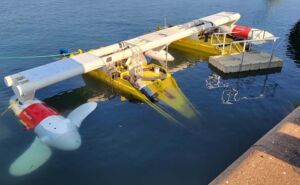
Additionally, QED Naval’s system does not require the use of pilings or fixed structures on the bottom of the ocean floor.
Even though export cables will sit stationary on the seafloor, the SubHub platform can still be raised above the surface for maintenance purposes. That changes the economics of access.
Lower maintenance costs could become the real advantage
Maintenance of a unit that sits on top of the water is obviously easier than maintaining one that is permanently below the surface. It is also easier to service, repair, modify, and upgrade units that can be removed from their station under normal circumstances.
As these types of units make their transition from demonstration phases into actual commercial power-generating phases, these types of considerations take on greater importance.
Commercial contracts are beginning to replace speculation
This technology is being rolled out past the experimental phase.
QED Naval Limited received a Contract for Difference award through its wholly owned subsidiary, Mor Energy Ltd., covering an initial phase at the Morlais tidal energy test site near Anglesey in Wales, where two SubHub platforms will carry multiple turbines. Support for that contract helped commercialize the technology.
QED Naval Limited announced that Mor Energy was awarded another 5.5 MW Contract for Difference through Round 7a of the UK Government’s allocation process in February 2026, bringing Mor Energy’s total CfD-backed capacity at Morlais to 10 MW.
Real contracts are replacing theoretical potential
Commercial power generation from the AR7a award is anticipated to begin in 2029. These figures are significant since tidal energy has generally been evaluated based upon potential rather than actual performance.
Delivery-based commercial contracts allow for discussion regarding current feasibility.
There is no longer talk of possibility, and instead there is talk of implementation.
Years of operation will decide whether the concept delivers
The idea itself is straightforward. It sinks to the seabed to generate electricity and returns to the surface when maintenance is needed.
Determining whether that concept produces substantial cost savings over decades of operation is a much tougher question.
Currently, that question has not yet been answered.
QED Naval says the SubHub system has already been deployed and recovered in real-world conditions. While those experiences demonstrate operational progress, they are not direct indicators of long-term cost effectiveness.
Evidence of that cost-effectiveness will come from commercial operation at Morlais. That will determine whether easier deployment, recovery, and maintenance reduce lifetime costs.
Read the whole thing?
Get the week's signal, not the noise
Our sharpest reporting on energy, climate and nature — free, once a week.


