The water in this channel is not calm and has never been calm.
It runs hard one way for six hours, goes slack, then runs hard the other way.
Nothing about that changes.
It ran on this schedule before anyone lived on either island and will keep running after, which is a rare thing to say about anything at all.
Somebody finally put something down there to stand in the way.
Why slow water hits harder than fast air
The whole case for putting a rotor underwater sits in one number. Seawater is about 800 times denser than air, and the force a moving fluid delivers rises with the square of its speed.
Work that through and the result is almost silly.
A current creeping at 2.5 miles an hour, slower than a brisk walk, pushes on a blade exactly as hard as a 74 mile an hour wind. That is a category one hurricane, made by water you could stroll beside.
Which is why these rotors are stubby. A wind turbine needs an enormous sweep because air is thin, while a machine in a strait pulls the same power from a far smaller circle, and does it fully submerged.
The same number is the problem. Everything down there is 800 times heavier to fight, so a bearing or a seal that lasts twenty years in air is a different question underwater.
What is actually bolted to the bottom
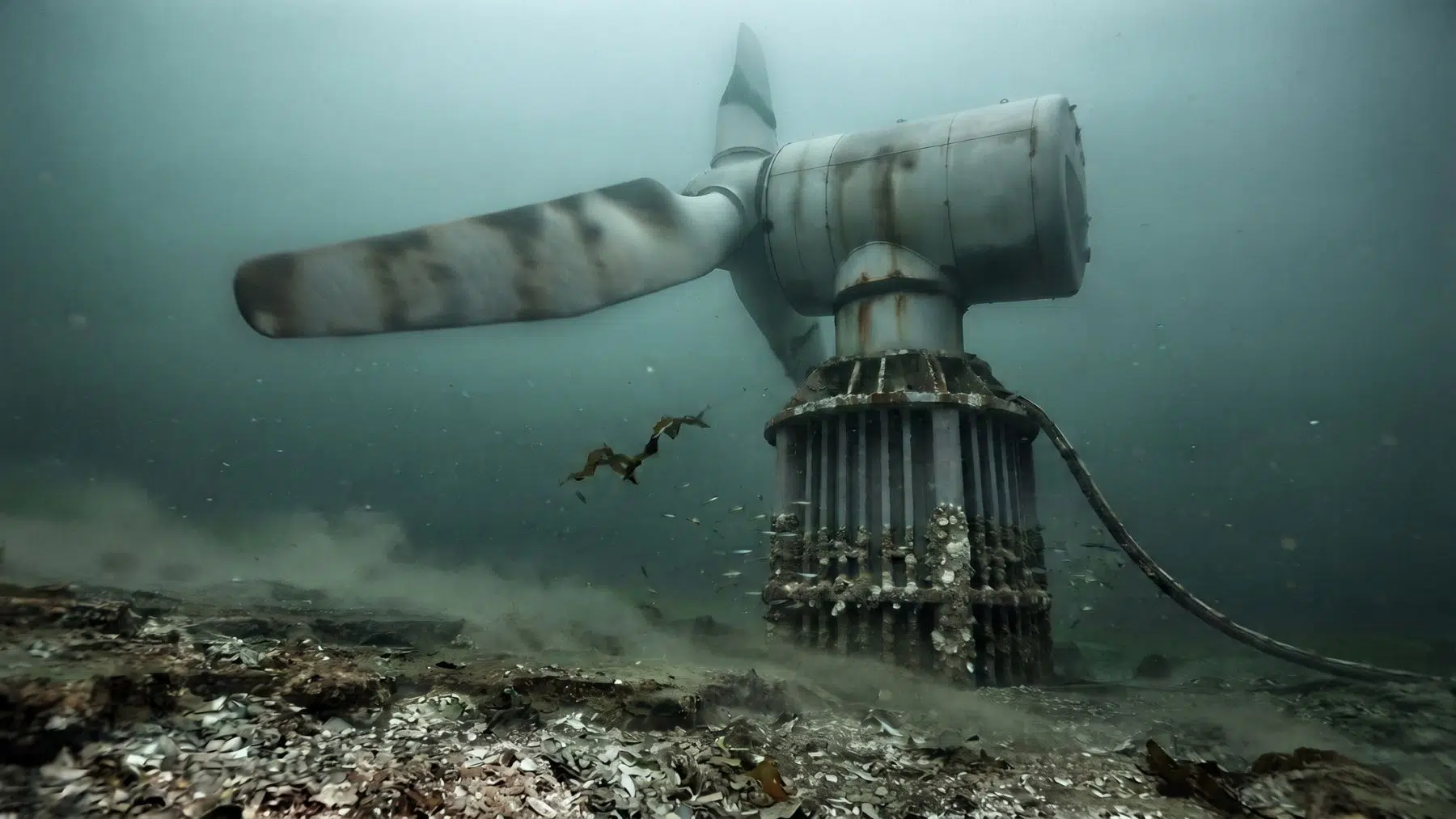
The tidal turbine sits on a gravity base, held by its own weight rather than by piles driven into rock. Nothing is hammered in and nothing is anchored, so it can be lifted off again.
Three blades turn on a horizontal shaft, and they are carbon fiber rather than steel.
That choice was made for a reason nobody thinks about with a windmill. The composite is stiff and shrugs off salt, but what settled it is that a broken blade sinks instead of floating, so a failure puts no debris in a shipping lane.
Each blade also carries its own pitch motor inside the hub, feathering as the flow builds and eases. And because the tide reverses, the whole nacelle is swung around on a hydraulic bearing to face the other way, twice every day.
Where the numbers come from
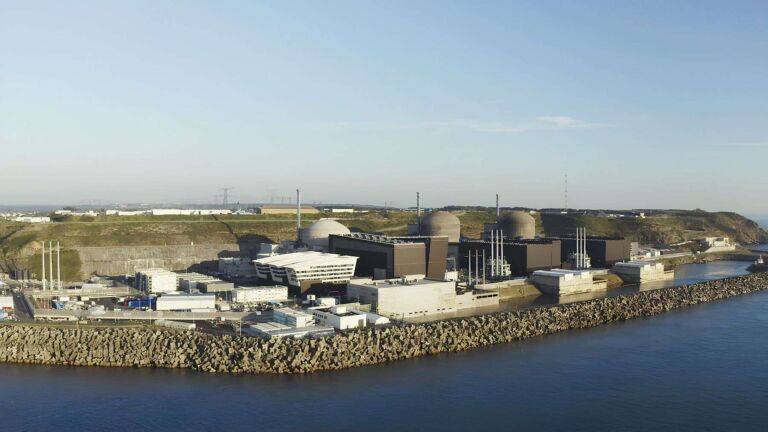
The site is the Naru Strait, in the Goto Islands off Nagasaki, and the work there ran in two stages rather than one.
A 500 kilowatt machine went in first and finished its pilot at the end of 2021 holding 97 percent availability, which is the figure that unlocked everything after it. The bigger unit went into the water in February of last year.
The full sized machine is rated at 1.1 megawatts and runs to shore on a single subsea cable. Japan’s trade ministry certified it, and it has been exporting to the grid since the middle of last year.
One detail gets lost in most retellings. The turbine is not a Japanese machine at all but a British one, built in the United Kingdom and installed for a Japanese utility with backing from the environment ministry.
Its chief executive was measured about what it proves. “We are proving the scalability” of tidal energy as a viable power source, he said.
Why this is not the bigger prize
Tidal is not the same thing as ocean current, and the two get mixed up constantly. A tide goes slack four times a day, so the machine stops, turns and starts again, and there are hours in every cycle when it makes nothing at all.
An ocean current does not do that. It runs one direction forever.
The great one off Japan shifts something like 65 million cubic yards a second, and a separate program has been testing a floating rotor in it, moored deep enough to duck the typhoons, with a full sized version aimed at 2 megawatts.
The resource in that one current runs to hundreds of gigawatts.
Against that, a strait between two islands is a small thing. It is also the one that is already running, which counts for more than it sounds.
What a turbine on a clock is worth
The real argument for this is not the megawatts. It is that the fuel arrives on a timetable.
Wind and solar are forecast. Tides are calculated instead, from the moon and the sun, decades ahead and to the minute, so an operator can be handed the output for a Tuesday in the 2030s and treat it as fixed.
Nothing else renewable does that. Every other clean source needs storage or something burning behind it, because nobody can promise what the weather will do, and that hedging sits on the bill.
The certification notice reads like paperwork and is not.
What went down in that channel is one turbine, and it will never be a large share of anything. But it is the only kind of generator on the grid whose worst day can be looked up before it happens.
Read the whole thing?
Get the week's signal, not the noise
Our sharpest reporting on energy, climate and nature — free, once a week.