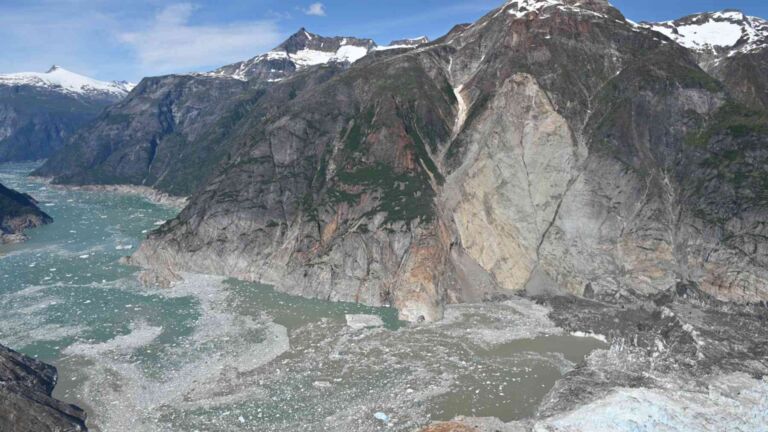
Four years after the Calf Canyon/Hermits Peak Fire tore through 341,471 acres of northern New Mexico, the burn scar still stretches for miles — a vast expanse of charred, leafless trees baking under an unrelenting sun. Surface temperatures on these scorched grounds can reach 150°F, where dark, ashen soil absorbs solar radiation with almost nothing left alive to shade it.
It is a landscape repeated across the state. Over the past 20 years, wildfires have burned more than 5.45 million acres in New Mexico. Planting seedlings to replace what has been lost is straightforward enough. Getting them to survive is another problem altogether.
A landscape that kills ordinary seedlings
The numbers are stark. Ground temperatures on burn scars can hit 150°F — dark, ashen soil absorbs solar radiation far more aggressively than light-colored or vegetated ground. With almost no shade remaining, seedlings planted there face a relentless thermal assault from the moment they go in.
Drought compounds the problem. As of May 2026, approximately 94 percent of New Mexico was experiencing drought conditions. Drier winters mean less insulating snowpack, leaving young seedlings exposed to temperature swings that would challenge even mature trees.
The results have been predictably grim. Seedling survival across wildfire footprints in the Southwest has averaged only about 25 percent. Early reforestation efforts in New Mexico made things worse — seedlings were purchased from a supplier in Idaho, and the long-distance transport piled yet another layer of stress onto plants already heading into brutal conditions.
“So yes, we’re planting, but are we actually reforesting?” asked Jenn Auchter, director of the New Mexico Reforestation Center.
Building the pipeline: from pine cone to planted tree
The answer to Auchter’s question is the reforestation pipeline — a coordinated, interagency system designed to address every step between seed collection and field planting. Researchers from New Mexico Highlands University, New Mexico State University, the University of New Mexico, and the state’s Energy, Minerals and Natural Resources Department are all part of it.
It starts in the forest. Each spring, researchers from New Mexico Highlands University scout for mature pine cones across the state, targeting what they call the “best trees on the worst site” — individuals that have already survived drought, fire, or extreme temperatures. Seeds from those survivors carry the genetic memory of endurance.
In 2024, contractors collected 12 million seeds. Samples go to the US Forest Service National Seed Laboratory, which tests and certifies both genetic identity and physical quality. Seeds that pass move on to nursery production at New Mexico State University’s John T. Harrington Forestry Research Center in Mora.
The Harrington Center currently produces around 300,000 seedlings per year, but that number is set to grow substantially. A new New Mexico Reforestation Center broke ground in Mora County in April 2026, on the same campus — slated to produce 1 million seedlings by fall 2028, and 5 million annually after that. That scale could meaningfully shift the pace of recovery.
Stress-testing trees before they hit the ground
The seedlings that leave Mora need to be ready for conditions that would kill a garden-grown plant within days. That preparation falls to Andrei Toca, a research scientist at the Harrington Center whose work centers on deliberate, controlled stress.
Toca and his team expose seedlings to regulated drought during the nursery phase. The biological response is measurable: trees develop larger root systems capable of reaching deeper moisture and produce fewer needles, reducing surface area and limiting water loss. Elevated temperatures are part of the regimen too — a preview of what awaits in the field.
The contrast with conventional nursery practice is intentional. Standard nurseries optimize for lush, rapid growth, producing large, green seedlings that are poorly suited to burn scars.
“What we are trying to do is introduce those seedlings to the very stress factors that they will face later on,” Toca said.
The logic is direct: a seedling that has already adapted to drought and heat in a controlled setting stands a better chance of surviving those same conditions in the wild.
Mapping where a seedling stands a chance
Even a well-hardened seedling can fail if planted in the wrong location. That is where Matt Hurteau comes in. A professor at the University of New Mexico and director of the Center for Fire Resilient Ecosystems and Society, Hurteau has spent nearly a decade building a predictive model for seedling survival.
His data begins with the 2011 Las Conchas Fire in the Jemez Mountains, where he planted ponderosa pines under a range of conditions starting in 2016. From that experiment, he developed a model factoring in solar radiation, slope steepness, slope direction, and topographic position — whether a site sits in a gully, on a ridge, or somewhere between. The model currently predicts survival with about 63 percent accuracy.
The findings point to clear danger zones. Ponderosa pines planted at mid-to-low elevations on south-, southeast-, southwest-, and west-facing slopes fare the worst — too much sun, too much heat, too little moisture.
“They’re much hotter and drier than, say, slopes that are northwest to northeast, maybe even east facing,” Hurteau said.
His team has already produced survival maps for the Hermits Peak/Calf Canyon burn scar, giving land managers a practical guide for where and when to plant.
Thinking beyond native species — and beyond the present
The harder question Hurteau is now raising is whether the trees that once grew in these landscapes are still the right ones to put back.
Climate conditions in northern New Mexico are shifting. Hurteau argues that reforestation planning needs to account for where temperatures and precipitation are heading, not just where they have been — which means seriously considering species currently found further south, trees already adapted to hotter, drier conditions.
One candidate is the Chihuahuan pine, native to southern New Mexico and Arizona. Hurteau suggests it could be well suited to northern landscapes as they grow warmer and more fire-prone, carrying drought and fire adaptations that ponderosa pine may lack.
The urgency behind all of this is concrete. After the 2022 Calf Canyon/Hermits Peak Fire, residents of Las Vegas, New Mexico, had their water shut off when the blaze contaminated the city’s only supply. Restaurants and hotels closed. Steve Bassett, director of conservation programs for The Nature Conservancy in New Mexico, has watched fires grow larger and burn hotter over the past 15 years, threatening water supplies and downstream communities across the region.
“We have a huge backlog from the 7 million acres of forests that have already burned,” Bassett said, “and we know that’s not going to stop. There are going to be future fires, and so that backlog will just continue to grow.”
The reforestation center in Mora County will not reach full capacity immediately. But as the pipeline matures — hardier seeds, stress-trained seedlings, smarter planting maps, species better matched to a hotter future — the central question is whether it can scale fast enough to keep pace with fires that show no sign of slowing.
Read the whole thing?
Get the week's signal, not the noise
Our sharpest reporting on energy, climate and nature — free, once a week.