A hydroelectric dam in Washington had to make a plan for Chinook salmon aiming upstream to spawn; otherwise, they would have run out of river.
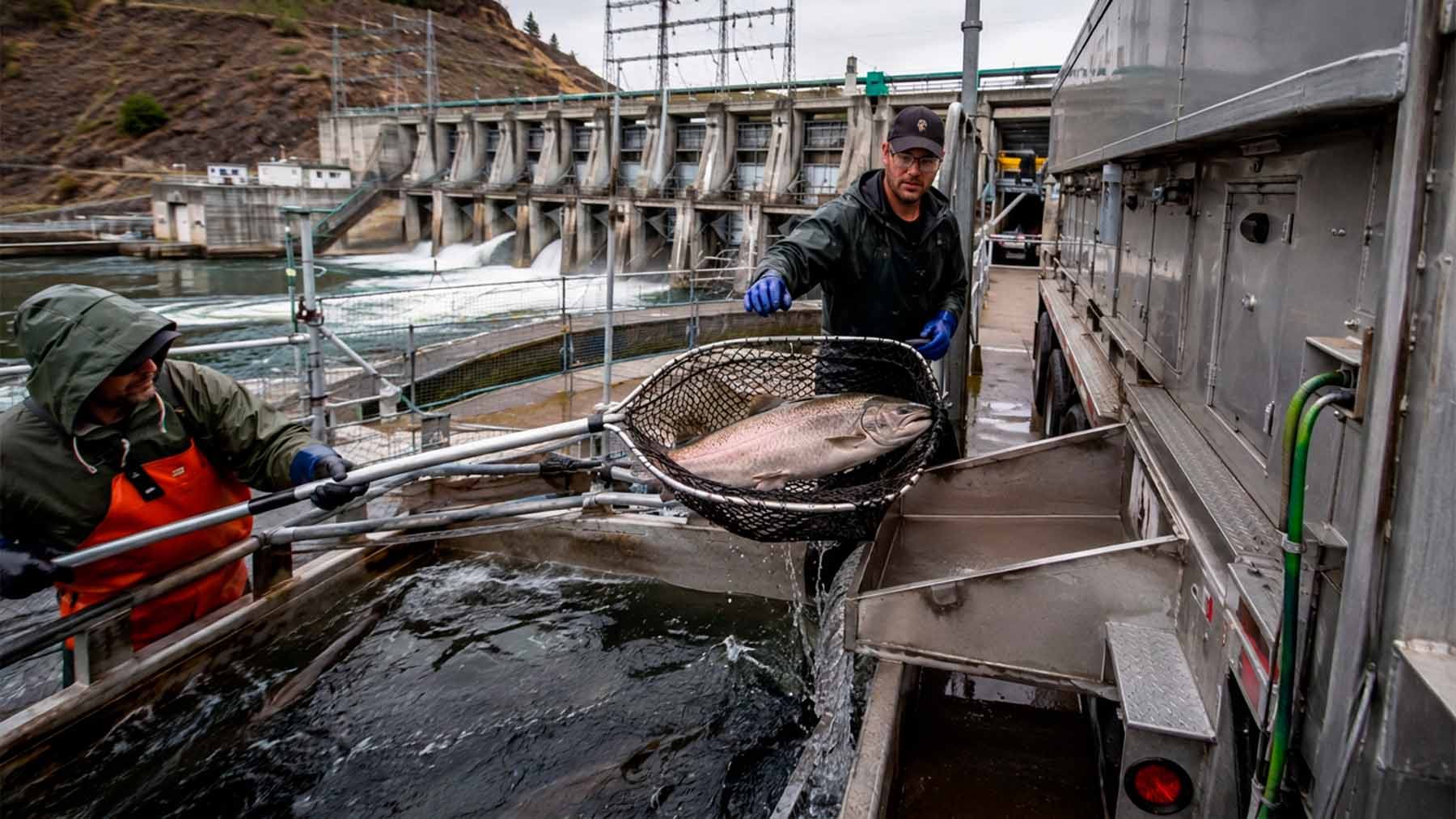
There is no fish ladder. To ensure their journey does not end at the wall, biologists net the fish, load them into trucks, drive them up the mountain, and release them upstream.
Moving the adults upriver is just one stage in the cycle. What happens to the offspring that need to get downstream?
How salmon need help to bypass a man-made barrier
Hydroelectric dams in the Pacific Northwest have been blocking migrating salmon from reaching spawning grounds at high elevation for decades.
Merwin Dam is part of the PacifiCorp Lewis River hydroelectric project on the North Fork of the Lewis River in southwestern Washington. State biologists have worked out a trap-and-haul system to help the migrating fish. The adult Chinook are manually sorted into channels, lifted out of the water, placed inside aerated tanker trucks, and transported past a second reservoir (Swift Dam). They are then dropped into the cold mountain tributaries upstream to lay eggs.
The fry hatch between three and five months later. In about a year, instinct drives the juvenile fish (now called “smolts”) downstream to the Pacific Ocean.
If they attempted to swim through the dam’s turbines, they would die, so the utility made a plan to avoid turbine strikes. A floating surface collector near the Swift Dam uses artificial pumps to draw juvenile Chinook into collection nets. Then, more workers pipe them into another truck for a ride to the lower river.
Two-way transport at a cost of millions
Operating a man-made hydroelectric dam means human intervention has to replace the natural flow of the river at both ends. It costs millions of dollars to run a two-way transport system for wild fish. It also requires hundreds of hours of constant in-person monitoring.
Driving the salmon upstream is a predictable task. But collecting the juveniles and getting them downstream involves variables that are a lot more unpredictable.
Young salmon depend on steady river currents to get to saltwater. However, in the deep water of a reservoir where currents are slow, directional cues are weak, if not non-existent.
The floating fish collector has to manufacture artificial currents to get the smolts picked up in the nets. If they miss the intake stream, they either risk the turbines or get stuck in the reservoir indefinitely.
The mechanical system had to be evaluated to determine whether it actually sustains the population, so biologists started tracking fish at every stage of the journey.
A stall at a specific stage of migration
The tracking data isolated the exact leg of the program that determines its success, according to PacifiCorp.
Upstream transport worked as intended. Biologists recorded high survival rates for trucked adults, with the vast majority of tagged fish reaching the upper river beds and spawning.
The bottleneck occurs entirely on the return trip. While the surface collector safely holds the young fish that enter it, a large percentage of juveniles never locate the artificial current in the reservoir. Computer models suggest that altering water flow near the collector intake could draw in more smolts, but low downstream capture remains the primary limit on fish numbers.
It is all about the offspring
The tracking study had clear boundaries. Researchers measured reservoir navigation and bypass survival, but they did not test how truck handling and crowded tanks affect smolts’ long-term ocean survival or saltwater adaptation.
Getting adults into clean mountain habitat yields eggs, but true recovery depends on whether their offspring can find the way out.
Until reservoir currents reliably steer juveniles into collection nets, the trucks driving up those mountain logging roads will deliver more effort than actual returning fish.
You can read all the details of the study here: Plumb, J. M., & Perry, R. W. (2026). Development of a two-stage lifecycle model to inform the trap-and-haul program for Oncorhynchus kisutch (coho salmon) in the Lewis River, Washington (No. 2026-1004). US Geological Survey.
Read the whole thing?
Get the week's signal, not the noise
Our sharpest reporting on energy, climate and nature — free, once a week.