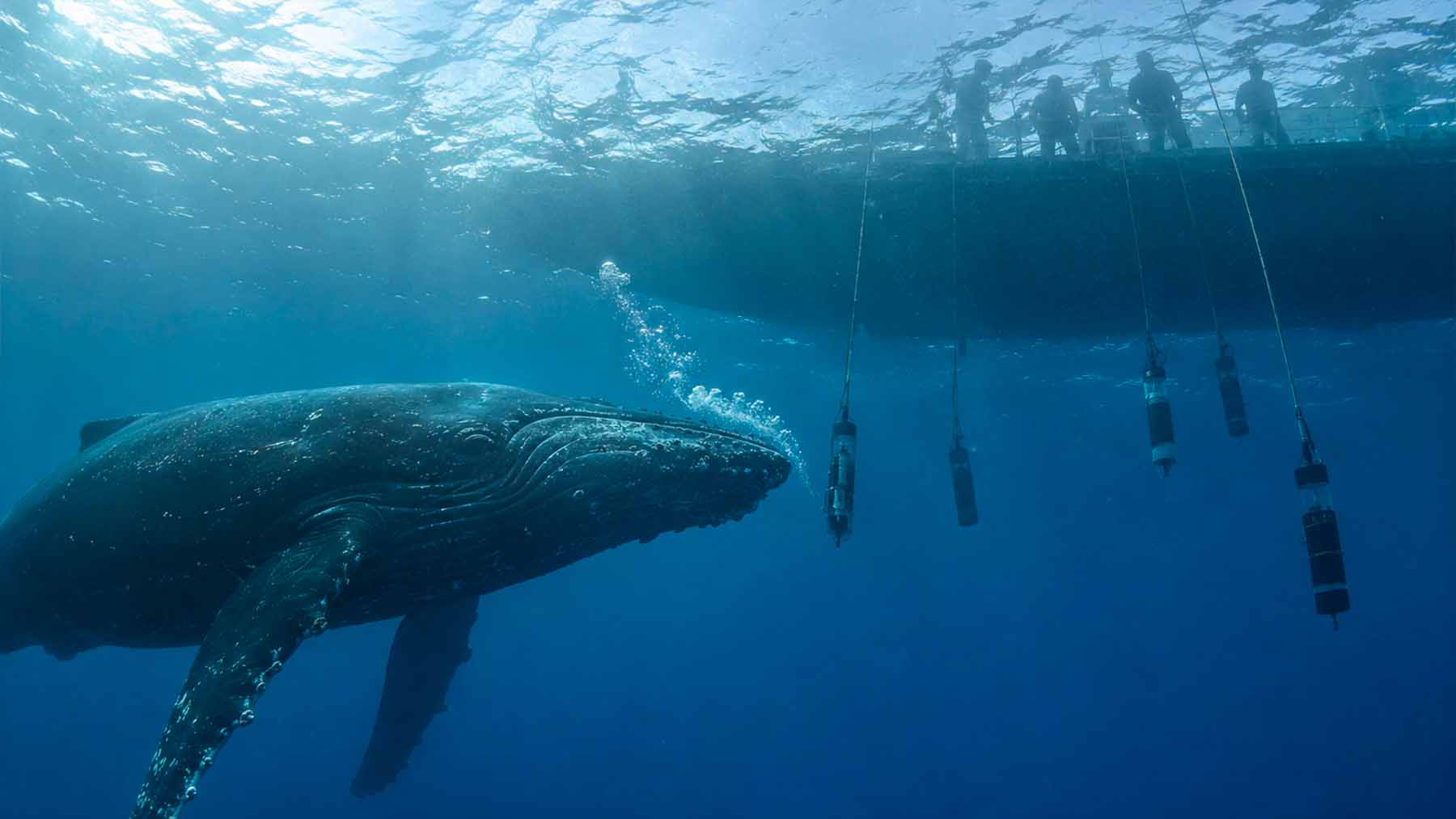
A humpback whale surfaced beside a quiet research boat in Southeast Alaska and stayed close. People usually treat whale calls as sounds meant only for other whales. Yet this animal circled the vessel and answered recorded calls coming from an underwater speaker. Newer observations have also captured humpbacks directing bubble rings toward nearby humans. Those encounters challenge the boundary between watching another species and meeting it. What could a whale be asking when it deliberately waits for our response?
How a recorded call reached one curious whale
The encounter began in Frederick Sound during August 2021. Researchers from UC Davis, the SETI Institute, and the Alaska Whale Foundation were studying humpback communication.
Their boat drifted with its engines off while speakers and recording equipment hung below the surface. The team played a “whup” or “throp,” a common social contact call.
At first, nothing answered.
Then Twain, an adult female humpback identified by her tail markings, surfaced near the boat. She remained close and moved around the vessel while the team repeated the sound.
A full-grown humpback can stretch nearly the length of a standard bowling lane.
The researchers were not translating a whale sentence. They were testing whether a humpback would recognize a familiar call and participate in turn-taking.
That distinction matters. Humpbacks already use songs, social calls, bubbles, and coordinated movements with one another.
Twain’s behavior created a rarer possibility. Instead of merely hearing a human-made playback, she seemed to treat the boat as an active partner.
All of this is so strange that it reminds us of the case of the ravens in Yellowstone.
The exchange became harder to dismiss as coincidence
The interaction lasted about 20 minutes. Twain answered 36 playback calls and often closely matched their changing timing.
When researchers changed the pause before a call, Twain adjusted her own response interval. Independent observers tracked her movements without knowing when recordings played.
The published Aquatic Biology research divided her behavior into engagement, agitation, and disengagement phases. Her strongest timing matches appeared during the first phase.
That pattern did not prove language or reveal a vocabulary. However, it supported an intentional acoustic and behavioral exchange rather than random sounds.
Follow-up work added another clue. In 2025, researchers documented humpbacks making large bubble rings during friendly encounters with humans.
These whales sometimes approached boats or swimmers before directing the rings toward them. Researchers described play, observation, and communication as possible explanations.
The overlooked detail was not any single sound. It was the whale’s repeated willingness to adjust and continue.
The message hidden inside the timing
The clearest answer is not a translated warning or a secret sentence. Twain appeared to offer something more basic: sustained contact.
The “whup” playback functioned like a greeting signal within humpback social life. Twain answered, waited, and altered her timing as the exchange changed.
That responsiveness is the hidden key. Communication begins before two species share words.
It begins when each participant notices the other, takes turns, and changes behavior in response. Twain did all three during the strongest engagement phase.
Researchers therefore are not claiming they know what she “said.” They are building methods to recognize when another intelligence is genuinely participating.
The Whale-SETI team hopes those methods can identify meaningful patterns in unfamiliar signals. That work could also inform searches for extraterrestrial intelligence or it could even help us better understand what’s happening in octopuses’ brains.
What the encounter cannot tell us yet
The study involved one whale in one opportunistic exchange. Its authors call the results preliminary and recommend more adaptive playback experiments.
There is also no evidence that Twain complained about warming seas, ships, hunting, or human noise. Assigning human concerns to her would replace listening with imagination.
Still, the environmental meaning remains powerful. Humpbacks face entanglement, vessel strikes, underwater noise, and changing ocean conditions.
Humans once reduced many humpback populations by more than 95 percent through commercial whaling. Now, some whales still approach us with curiosity rather than immediate retreat.
That does not make forgiveness a scientific conclusion. It makes attention a moral opportunity.
The next breakthrough may not resemble a dictionary translating whale sounds into English. It may begin with something quieter and more demanding.
A whale surfaces beside a boat, hears a familiar call, and chooses not to leave. For 20 minutes, two very different minds share timing across open water. We still cannot say what Twain wanted. The first duty may simply be to listen carefully. We can say she noticed an answer and kept the exchange alive. That changes the question from whether whales have something to communicate. It asks whether humans can become patient enough to recognize communication before demanding words. Maybe it’s time to get to know our planet better, so we can continue to discover surprises like this “vanished sea” that some divers found… right here in our own country.
Read the whole thing?
Get the week's signal, not the noise
Our sharpest reporting on energy, climate and nature — free, once a week.