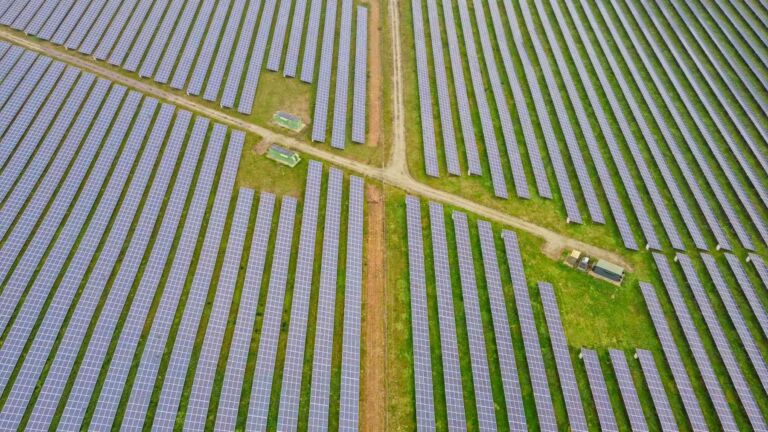
A solar panel is a heavy sheet of glass with silicon behind it.
That is not a criticism. Glass is why panels last 25 years outdoors.
It is also why they can only go where something can carry that weight, at an angle somebody decided in advance, on a structure built to hold it.
Which rules out most surfaces.
Fabric goes almost anywhere and carries almost nothing.
So the question is what a cell has to give up to live on one.
What you lose when the cell stops being rigid
The technology that bends is organic photovoltaic, which is a printed layer rather than a sliced wafer.
It is thin, it is flexible, and it can be laminated onto or woven into a textile without cracking when the textile moves.
What it does not do is convert as much. Where a silicon panel turns roughly a fifth of the light striking it into electricity, this kind of layer manages a fraction of that.
Lifespan is the other gap. Organic layers degrade under ultraviolet and moisture faster than silicon sealed behind glass, and the field record for them is short.
Against those two losses sits one gain that has nothing to do with efficiency.
The surface was already going to exist. A canopy over a square is built for shade whether or not it generates anything.
Which means the comparison is not against a rooftop array. It is against a plain sheet.
The thing standing in the square
The structure is a tensioned fabric pavilion, roughly 430 square feet of canopy held up at about 32 feet.
The cloth is a recycled polyester weave made for outdoor use, weather and ultraviolet resistant, weighing about an ounce and a half per square foot.
Into that weave are set 150 small organic modules, and here is the number that gets lost: they cover about 86 square feet.
That is roughly a fifth of the canopy area. The rest of the fabric is plain cloth.
Across the covered part the output works out at about 5 watts per square foot, giving the whole pavilion something near 424 watts.
A battery of 3 kilowatt hours sits underneath it, feeding white lamps and four color spotlights after dark, which is all the load there is.
Where it was shown and who built it
The pavilion is called Umbra and it was put up for the Dutch Design Week in Eindhoven in October of 2025.
It came out of a four year collaboration between a Dutch design studio and a Dutch tensile structures firm.
The fabric itself has been renamed once, from Suntex to heliotex, which is worth knowing when searching for earlier coverage of the same material.
The modules are supplied by a German maker of organic cells, and they are attached so they can be taken off again and replaced when better ones exist.
An industrial production process is still being developed, funded through a European scheme with Danish and German partners.
So this is a demonstrator, and the people behind it describe it as one.
The comparison that keeps getting mangled
The ratio between this and a glass panel depends entirely on which panel you pick.
A standard silicon module puts out somewhere between 18 and 21 watts per square foot in full sun. Against that, 5 watts is closer to a quarter than to a fifth.
The other confusion is the area. The output figure belongs to the covered 86 square feet, not to the 430 square feet of pavilion, and quoting it against the whole roof overstates nothing only if you say which number you used.
There is also no published year of operation for this fabric outdoors, which is the figure that would actually settle the case.
Until somebody publishes a season of readings this remains a promising surface rather than a product, in the way that a transparent coating or a record cell sits years from a roof, as the trade coverage of the canopy reports it.
What a low number is still good for
Four hundred watts is not an energy project. It is a lighting circuit.
But the surfaces this could go on are enormous and none of them will ever take glass: market awnings, stadium roofs, festival covers, temporary shelter, shade over car parks.
All of those are built and rebuilt constantly and all of them sit in the sun doing nothing electrical at present.
A poor conversion rate across an enormous area that was going to be built anyway is a different proposition from a poor conversion rate on a roof, as the design coverage of the pavilion put it.
The woven canopy is not competing with a solar farm.
It is competing with a tarpaulin.
Read the whole thing?
Get the week's signal, not the noise
Our sharpest reporting on energy, climate and nature — free, once a week.