
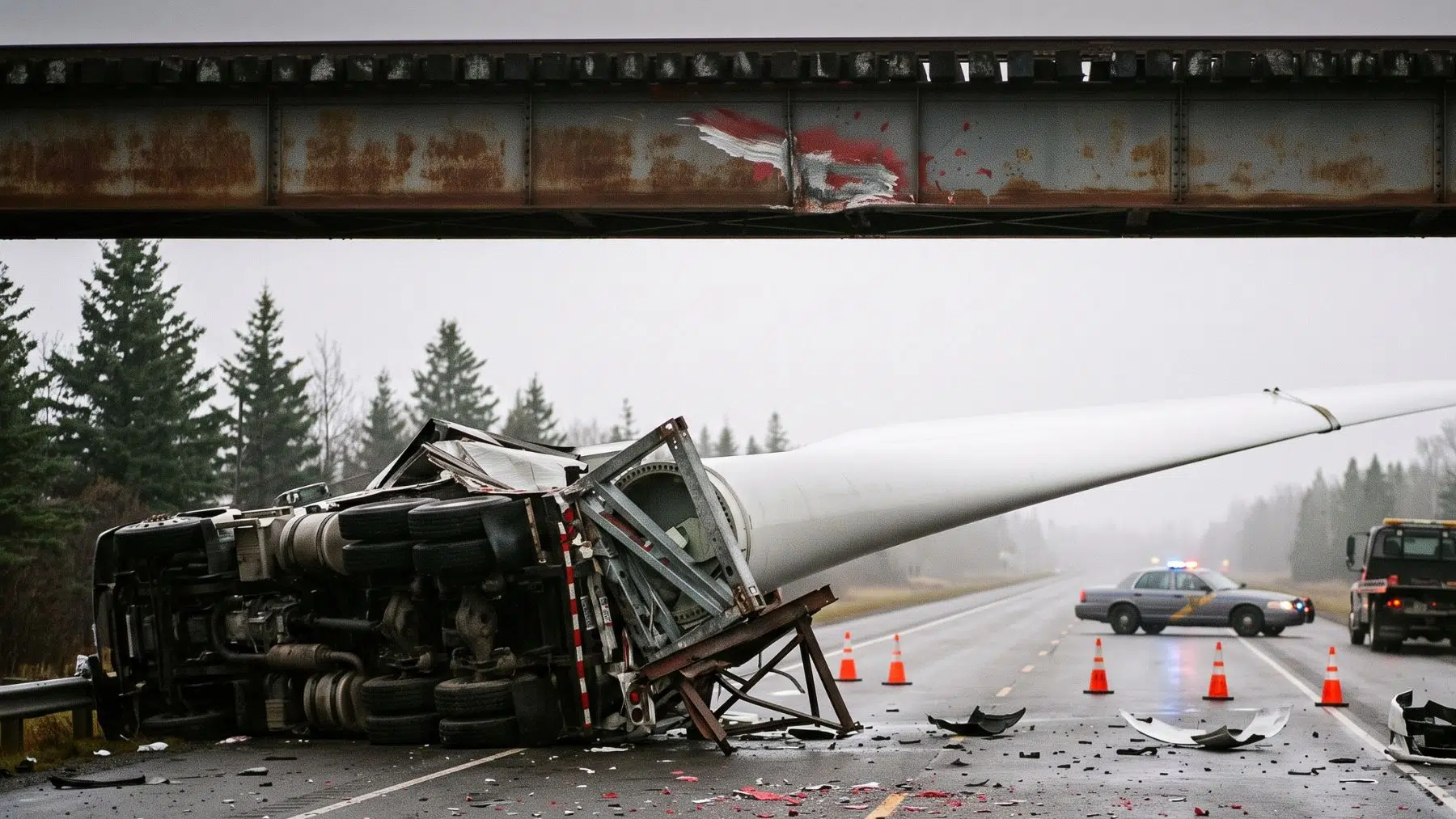
At about half past five on an August morning, a tractor trailer came up Route 1 in coastal Maine carrying one turbine blade.
The blade was 240 feet long, which is most of the way to the length of a football field and a half.
Ahead of it was a railroad trestle crossing the highway, and the underside of that trestle is not level.
The truck was not far enough into the left lane, the blade caught the low side, and both units went over.
Nobody was hurt. What happened next is the part that is hard to picture from a photograph.
What was moving through those towns
Because that truck was not a one off delivery. It was one run in a convoy program that had been going for weeks.
A wind project in Washington County needed 30 turbines, with towers standing 410 feet and blades running about 246 feet each.
Every piece came in by ship to a port terminal at Searsport, then went the last 70 miles by road.
The convoys left at 5 in the morning, ran five days a week from late June into October, and took roughly three hours to cover that stretch.
State police escorted each one, and the route threaded through four coastal towns with a detour off the highway near Ellsworth.
Residents along the route had been told to expect inconvenience. Nobody had promised there would be none.
How a blade fits under a bridge
And to see why the lane position mattered so much, you have to look at the shape of the obstacle.
An old rail trestle is not a flat ceiling. One side sits lower than the other, so the usable clearance changes across the road.
A driver hauling something oversized does not aim for the middle. He aims for the corner where the steel is highest.
The load makes that harder than it sounds, because a blade of that size overhangs far behind the trailer and swings wide on a curve.
Rigs built for this have a rear section that steers independently, worked by a second operator riding at the back.
So the whole vehicle is aimed twice, at the front and at the tail, and the two have to agree.
What went wrong that morning
Then the margin ran out, and the report on it is short and unforgiving.
The driver did not position the vehicle far enough into the left lane to clear the lower side of the trestle.
The blade struck steel, the load stopped dead, and the momentum carried the tractor and the trailer over together.
Damage to the bridge itself was described as mild, which says something about what a rail trestle is built out of.
Four agencies turned out, from the state transportation department and the county sheriff to the fire department and the environmental agency.
The environmental crew was there for the obvious reason. A tipped tractor unit carries fuel and hydraulic oil.
Why they could not simply back it out
Which brings the story to the sentence that made it national news.
Turning the vehicle around was not feasible, officials said, because of the length of the blade.
There is no intersection wide enough, no shoulder deep enough and no room at all to swing 240 feet of fiberglass through a coastal town.
So Route 1 stayed shut for close to 12 hours while crews worked out how to move an object that could only go in one direction, as the local paper reported.
The answer was to bring in a second trailer overnight and transfer the blade onto it, as the trade press covered.
Anyone who has watched a blade convoy inch through a town knows that transfer is not a quick job, any more than the assembly of an offshore project is.
The blade went home
And here is the detail that makes the whole thing worth telling.
The blade did not continue to the wind farm. It went back to Searsport, reaching the terminal at seven the next morning.
It had been about 66 miles from where it was going, and it ended the weekend roughly where it started that Friday.
Route 1 opened again, apart from another ten minute closure the next morning to let the second truck through with its load.
The project itself was finished on schedule, and those 30 turbines run at a combined 126 megawatts today.
None of which changes the plain lesson underneath. The hard part of building a wind farm is rarely the wind.
It is getting an object the length of a city block past a bridge somebody put up a century ago, on a road nobody widened since.
Read the whole thing?
Get the week's signal, not the noise
Our sharpest reporting on energy, climate and nature — free, once a week.


