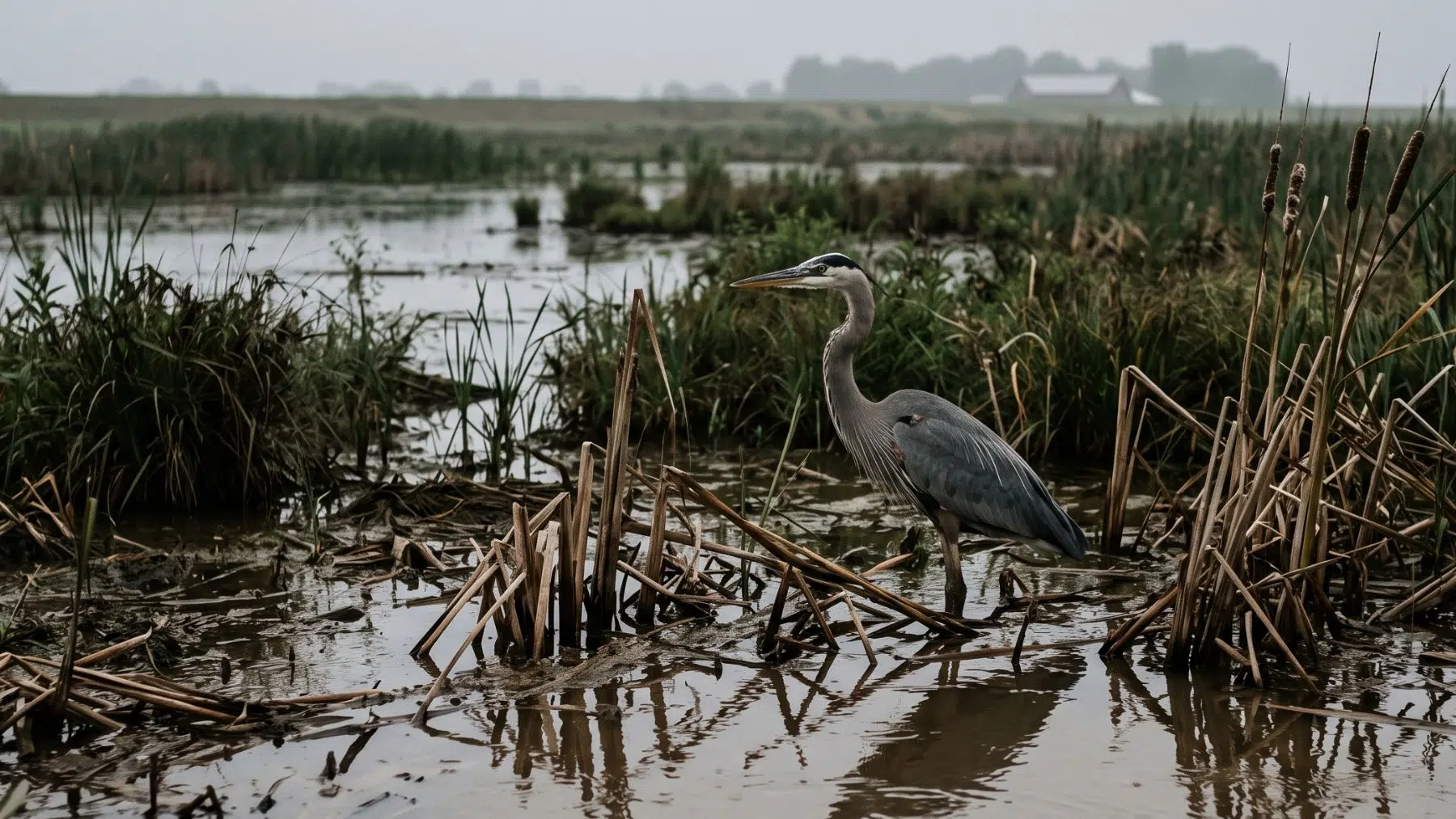
It looks like wasted land, a few acres of cattails and standing water, smelling faintly of mud and buzzing with insects in July heat.
So Americans have spent a century filling places like this in, leveling them for subdivisions and farms and parking lots.
Yet an acre of it can hold over a million gallons of floodwater before any of that water reaches a downstream house.
And nobody put a price on that until researchers ran the numbers, which came back as one of the largest figures in modern environmental science.
The summer that made everyone look down
July 2025 arrived with a ferocity that felt personal.
It opened with flash floods in a stretch of Texas known as Flash Flood Alley, where the Guadalupe River in Kerr County rose 26 feet in under an hour.
By the time the water dropped it had killed more than 130 people, among them 27 campers and counselors at Camp Mystic alone.
Then barely two weeks later a stretch of brutal midsummer heat gripped the interior of the country from 21 to 25 July.
In all, nearly 160 million people saw at least one day of extreme heat that climate change had made at least three times more likely.
As Kristina Dahl of Climate Central put it, this was not your grandmother’s heat wave.
That is two disasters and two kinds of water, with one overlooked ecosystem sitting at the center of both.
The land nobody wanted
For generations the American instinct was to drain it.
Because marshes, swamps, bogs, prairie potholes and river floodplains all stood between farmers and fields, between developers and buildable ground.
So by the twentieth century, draining them counted as an act of progress.
Worldwide since 1970 more than a billion acres of wetland have gone, roughly 22 percent of the total, at an average rate of 0.52 percent a year.
And American wetlands led that decline, where the state by state numbers turn brutal.
Iowa lost about 90 percent of its original wetlands and California more than 90 percent, while the lower Mississippi Valley gave up nearly all of it.
Nobody counted the cost, because nobody believed there was one to count.
What the marsh was actually doing
Here is what a wetland does before a flood arrives.
It regulates water flow, which slows a surge on the way down and holds supply through a drought.
That is where the million gallons an acre comes from, and it is free storage nobody has to build.
Then in a heat wave, coastal marshes and river floodplains hold local temperatures down by releasing moisture into the air.
Which amounts to living air conditioning that runs on rain and needs no grid connection at all.
On top of that, wetlands host 40 percent of global biodiversity while disappearing faster than any other ecosystem on Earth.
So the great blue heron standing still in the shallows is not just a nice sight, it is a sign the system still works.
The 39 trillion dollar number
In July 2025 the Convention on Wetlands published its most comprehensive assessment of the world’s wetlands to date.
The finding that stopped economists cold was that what remains delivers up to 39 trillion dollars in benefits every year, according to the convention.
Which is more than the entire annual economic output of the United States.
The same report priced everything already drained over the past fifty years at another 5.1 trillion dollars on top of that.
And without action, up to a fifth of what is left could vanish by 2050.
Restoration is not free either, running from roughly 400 to 28,000 dollars an acre a year depending on the site.
But for the towns that lost homes on the Guadalupe last July the arithmetic is not abstract, because the small rivers running through American towns were once buffered by marshes that took the surge before it reached a front door.
And cities that lost their wetland cover also lost the cooling layer that summer nights expose most brutally.
The thing that can still come back
Even so, the report is not a eulogy, because it also collects cases where the trend reversed.
In the Kafue Flats of Zambia a 300,000 dollar restoration effort pulled in wider investment in biodiversity, water systems and livelihoods, supporting some 1.3 million people in the process, as the UN documented.
Closer to home, restoration along the Gulf Coast and the Mississippi corridor is already slowing runoff and cooling the air in nearby neighborhoods.
Because wetlands, unlike almost anything else in the climate toolkit, can grow back.
Give a marsh its water and within a few years the cattails return, the herons return, and so does the flood barrier no engineer had to pour.
So what looks like a pile of mud and standing water turns out to be worth more per acre than almost any building ever put in its place.
Read the whole thing?
Get the week's signal, not the noise
Our sharpest reporting on energy, climate and nature — free, once a week.