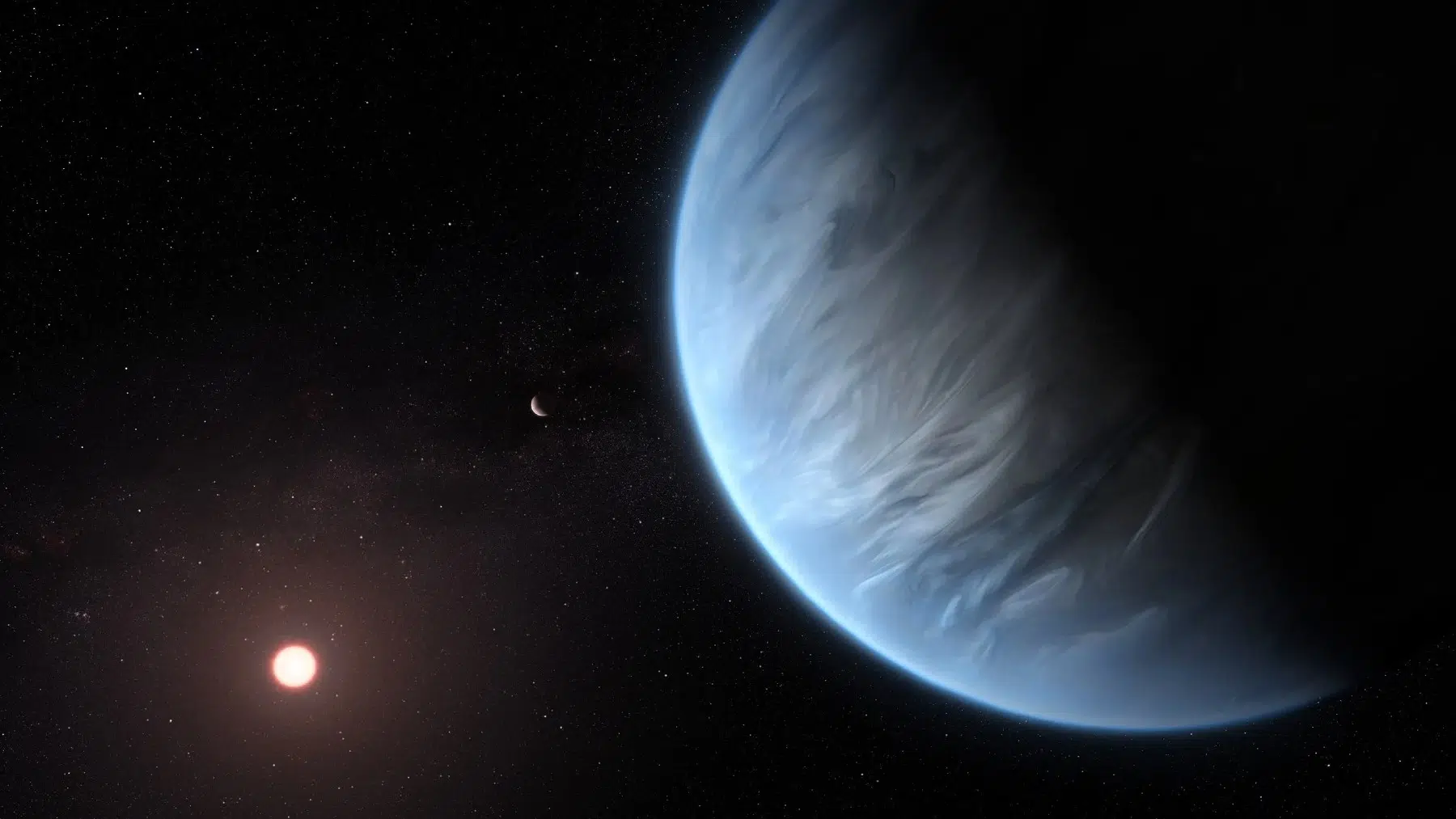
For most of human history, the question of life beyond Earth had no real evidence to support it — only speculation. But with tools like the James Webb Space Telescope (JWST), researchers have the capacity to study distant exoplanets in detail. One of the studied planets has drawn new attention, and NASA has released new findings that could shape the way we think about habitability beyond our solar system — and if this cosmic body hosts a global ocean, it could mean that organic forms of life might be living there.
A new chapter in the search for life
The James Webb Space Telescope picked up a new signal from K2-18 b, a planet located 124 light-years from Earth. The exoplanet sits in the habitable zone of its red dwarf star and shows signs of a water-rich atmosphere — a key factor when judging potential habitability. However, it’s not just the possible presence of water that stands out.
What scientists have been paying closer attention to is the possible detection of specific molecules in the atmosphere — ones that, on Earth, are often linked to biological activity.
Odd molecules in the sky
Since its launch, the James Webb Space Telescope has improved how scientists study distant planets and their atmospheres. In the case of the K2-18 b exoplanet, researchers say they may have detected dimethyl sulfide (DMS) and dimethyl disulfide (DMDS), sulfur-based molecules that, on Earth, come only from living organisms.
According to Space.com, the possible presence of DMS is notable because there are no known natural processes that produce it in large amounts without life. Along with these sulfur compounds, the team also found methane, carbon dioxide, and other gases often associated with biological activity on Earth. If future studies confirm these findings, it would be the first molecular evidence suggesting life beyond our planet.
The reason K2-18 b keeps making headlines
K2-18 b is classified as a “Hycean” exoplanet, a type of world covered mostly by ocean. For a long time, the planet wasn’t considered a top target in the search for life, with more attention going to rocky planets like Mars. However, recent research suggests that ocean worlds like K2-18 b might offer better chances.
The planet is about 8 or 9 times as massive as Earth, and it may have liquid water—one of the key requirements for life as we know it. It also orbits within the “Goldilocks” zone, where temperatures are moderate enough to potentially support life – a critical characteristic.
Scientists caution that the evidence isn’t conclusive yet, but they say the results are promising and justify more study. The James Webb Space Telescope has opened new doors in exploring the universe, but it also has its limits. As Universe Today points out, because of how observations are made, the telescope may never provide definitive proof of life beyond Earth.
The mysterious signal from the exoplanet
The data we have now is based on light signatures, not direct samples or visuals. No spacecraft is currently capable of reaching the planet, and sending a probe there is likely out of question for the foreseeable future. This means that the evidence at hand, while fascinating, remains indirect — open to interpretation and requiring careful validation.
The unusual molecular signals from the exoplanet K2-18 b could either provide important answers or raise new questions. For now, scientists remain carefully hopeful. If these chemical signatures are confirmed, they could become one of the most significant discoveries in human history. The James Webb Space Telescope will keep searching for other exoplanets, and the presence of a global ocean on a planet doesn’t always mean the world is truly habitable.
Read the whole thing?
Get the week's signal, not the noise
Our sharpest reporting on energy, climate and nature — free, once a week.