The James Webb Space Telescope has confirmed that something is falling from the sky near neighboring planets in the Milky Way. The telescope is powerful enough to look deep into the cosmos and look for the farthest points in the universe, but it didn’t have to search much to find planets with an unusual phenomenon occurring. While we associate rain with water falling from the sky, this is not what is happening in the planetary formation orbiting a young star just 300 light-years away – in the cosmic scale, this could be considered far away.
NASA is spotting discoveries while still being “close” to Earth
Since we cannot actually pinpoint a location for anything in our solar system, the reference is our sun and the last planet. While some researchers expand our stellar formation to further distances due to the actual cloud of particles surrounding the planets and where it ends. And if you think the James Webb was near the planets to study what is actually falling from the sky, you’re wrong.
The James Webb Space Telescope has never left our solar system to search for other cosmic objects in interstellar space (anything outside our system), and it’s currently 1.5 million kilometers away from Earth, completely aligned with our planet. Meanwhile, other probes like the Voyager 1 and 2 are over 20 billion kilometers away from us, and will continue to get farther as they go deep into the cosmos.
The James Webb found something strange: It’s raining, but not water
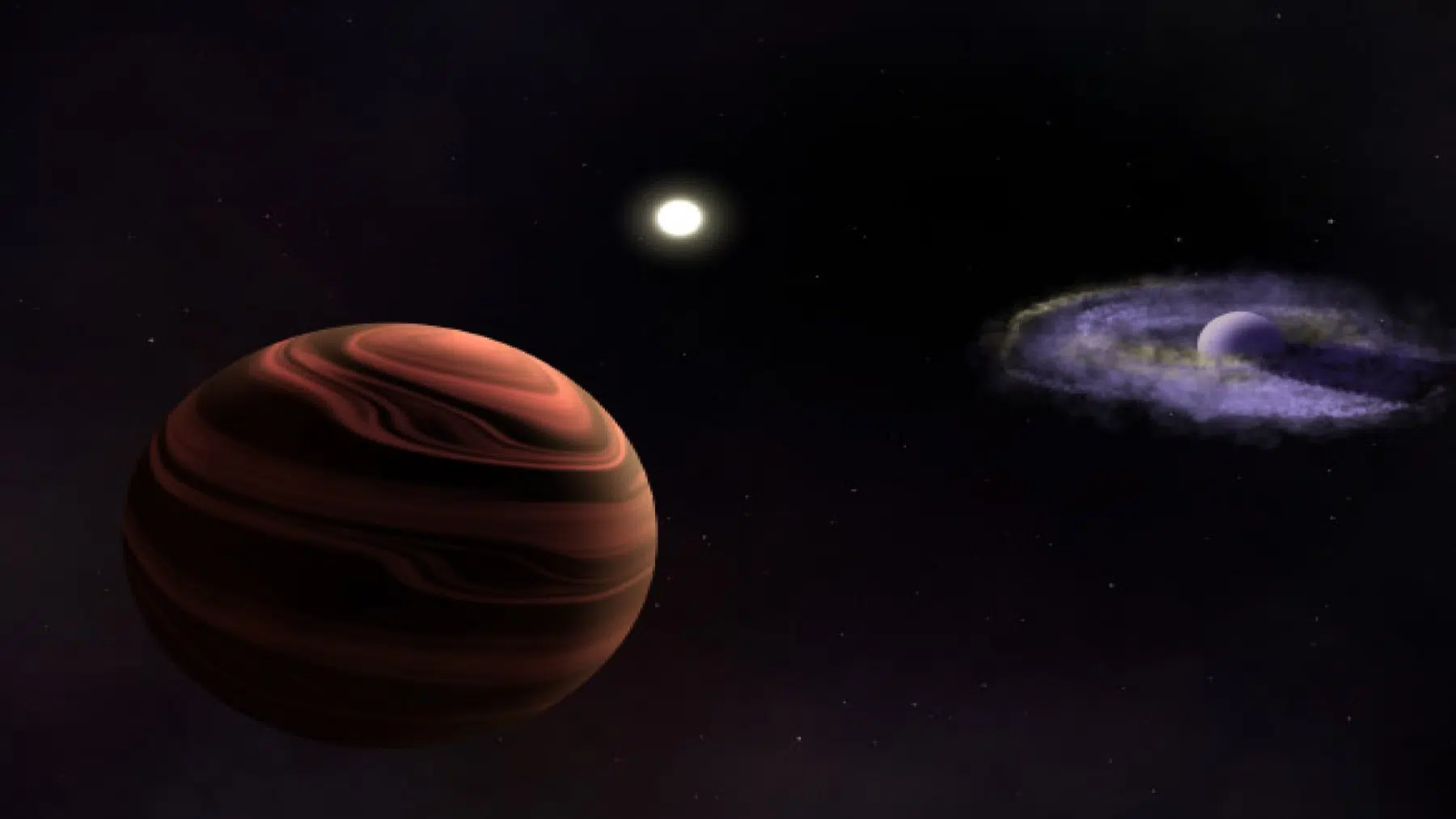
Using the James Webb Space Telescope (JWST), astronomers have found a young planetary system orbiting a star about 300 light-years away. Inside are two gas giants, YSES-1 b and YSES-1 c, both filled with coarse, gritty silica material. (Yes, Anakin, the sand really does get everywhere.) The host star is just 16.7 million years old, basically an infant compared to our 4.6-billion-year-old Sun.
Researchers say the real breakthrough here is the discovery of silicate clouds—essentially sand clouds—floating high in these alien skies. Valentina D’Orazi, from Italy’s National Institute for Astrophysics (INAF), explained that these clouds hang aloft because of a process a lot like Earth’s water cycle. Instead of water evaporating and condensing, it’s minerals: they vaporize, cool down, and then condense again, creating a kind of mineral-based weather.
The chemistry side is a key point of studying for NASA
D’Orazi also pointed out that studying this kind of chemistry is key to refining our climate and formation models for planets far beyond our solar system. Every new piece of data helps scientists test competing theories about how planets actually take shape. For the first time, astronomers have spotted silica clouds not only drifting high in a planet’s atmosphere, but also lingering in the dusty disk around it. The clouds are thought to be made of minerals like pyroxene or mixes such as bridgmanite and forsterite—the same building blocks found deep inside rocky worlds.
A powerful tool for planetary science
The James Webb was able to catch this detail because both planets sit unusually far from their star, at distances five to ten times greater than Neptune’s distance from the Sun. That wide orbit makes it easier to separate the planets’ light from the glare of their star. While this approach still works on only a handful of systems, it shows how Webb can peel back layers of detail on exoplanets and the material shaping them.
Read the whole thing?
Get the week's signal, not the noise
Our sharpest reporting on energy, climate and nature — free, once a week.