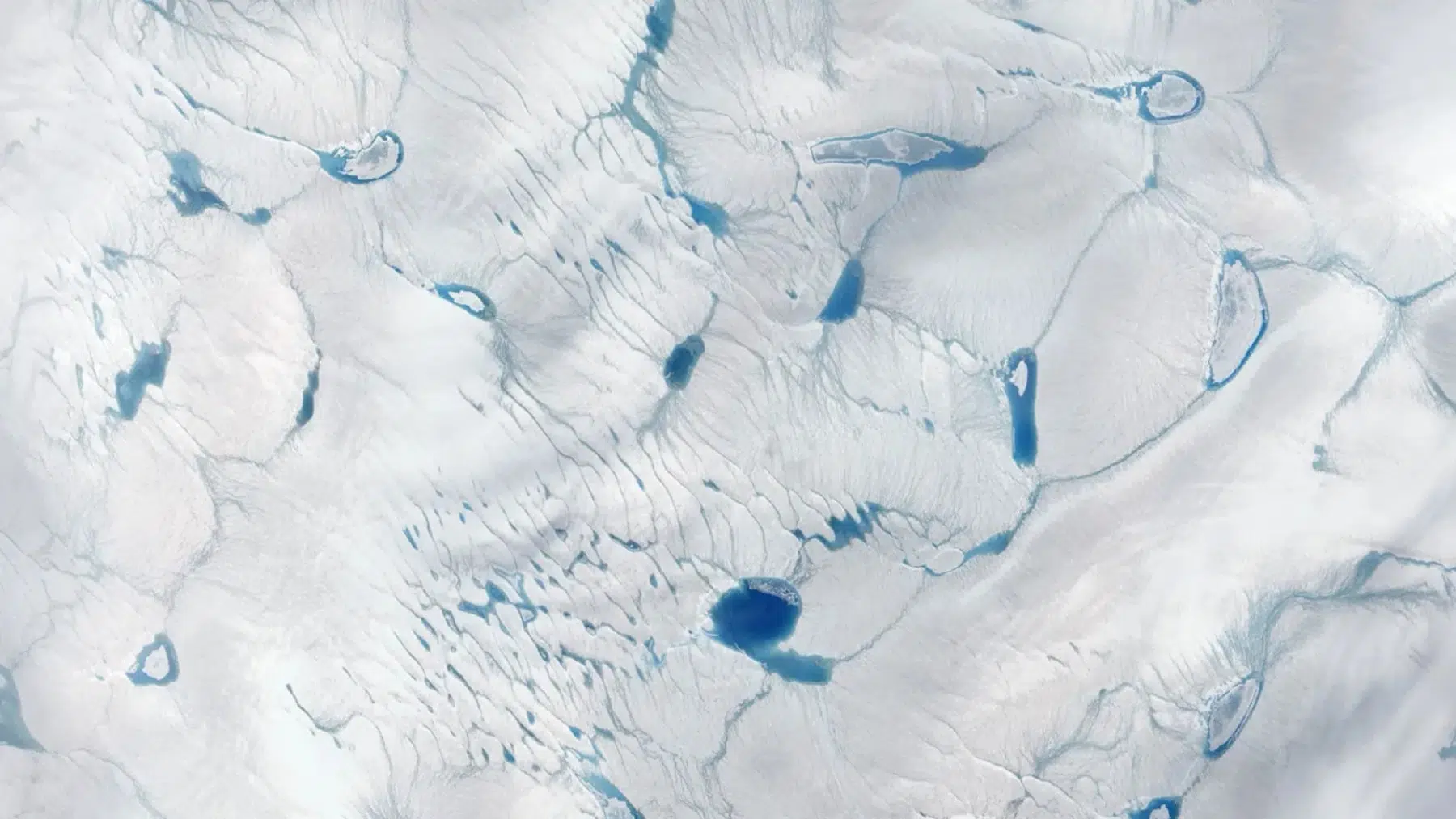
Extreme melt events on Greenland’s ice sheet were once rare enough to stand out in the climate record. Now they’re becoming the norm.
Since 1990, meltwater production during these episodes has surged sixfold — from an average of 12.7 gigatons per decade to 82.4 gigatons. Seven of the ten most intense melt events ever recorded have occurred since 2000. What’s driving that acceleration, and where it leads next, is what a new study from the University of Barcelona set out to understand.
A sixfold surge in meltwater since 1990
The numbers tell a clear story. Between 1950 and 2023, extreme melt events on Greenland’s ice sheet produced an average of 12.7 gigatons of water per decade. Since 1990, that figure jumped to 82.4 gigatons — a sixfold increase that researchers describe as historically unprecedented.
The footprint of these events is expanding alongside the volume. Surface area affected by extreme melting has grown by roughly 2.8 million km² per decade since 1990. To put that in perspective: it’s an area larger than Argentina being added to the melt zone every ten years.
Seven of the ten most intense melt episodes on record have occurred since 2000, with major events in August 2012, July 2019, and July 2021 among the most severe. What concerns researchers most is that these events have no comparable precedents in the historical record. The atmosphere simply hasn’t produced conditions like this before.
Rising temperatures are supercharging the melt
Understanding why these events are intensifying required a new analytical framework. The University of Barcelona team developed a classification method combining anticyclonic and cyclonic air mass patterns with a regional climate model — allowing them to distinguish two separate drivers: thermodynamic effects tied to atmospheric warming, and dynamic effects tied to circulation patterns.
The findings were telling. When researchers compared extreme melt events with similar atmospheric circulation patterns across different time periods, meltwater output since 1990 was still 25% higher than during the 1950–1975 baseline. Circulation patterns alone couldn’t account for the difference. When all extreme events were considered together — regardless of circulation type — that increase reached 63%.
The gap points directly at rising temperatures. Warming isn’t just creating more favorable conditions for melt; it’s amplifying the intensity of events that would have occurred anyway, pushing them well beyond what atmospheric patterns alone would produce.
Northern Greenland emerges as a new hotspot
For much of the observational record, northern Greenland remained relatively sheltered from the most severe melt episodes. That’s changing. The region has emerged as one of the areas most affected by extreme melting — a shift suggesting the ice sheet’s vulnerability is spreading into territory once considered stable.
The northward progression carries particular weight. Northern Greenland holds some of the thickest and oldest ice on the island, and under high-emission scenarios, projections suggest the most intense meltwater anomalies could increase by as much as threefold by the end of the century. Regions that have seen the least change so far may be approaching a turning point.
Global consequences beyond the ice
The implications of accelerating Greenland melt reach well beyond the island. Increased meltwater contributes to sea level rise and could alter ocean circulation patterns, with downstream effects on weather systems and coastal communities worldwide.
Lead author Josep Bonsoms frames the stakes broadly. The rapid transformation of the ice sheet, he notes, not only carries global environmental consequences but also places the Arctic at the center of new strategic, economic, and territorial dynamics. As the ice recedes, questions about access, resources, and sovereignty are becoming harder to set aside.
The study, published in Nature Communications, was conducted as part of the GRELARCTIC project at the University of Barcelona’s ANTALP research group, examining extreme melt events recorded between 1950 and 2023 — a span long enough to separate genuine trend from statistical noise.
Understanding the specific mechanisms behind these events matters not just for scientific clarity, but for building the policy foundation needed to respond to what lies ahead. Northern Greenland is now entering the picture. Projections point toward further intensification. The next decades of melt data will carry significant weight — and the ice, as the record makes clear, isn’t standing still.
Read the whole thing?
Get the week's signal, not the noise
Our sharpest reporting on energy, climate and nature — free, once a week.