A number of maps show that large areas of the Earth are uninhabited. That does not mean there are no people.
Often, those inhabiting these areas go unnoticed because little, if any, attention has been paid to them.
The same was true of a blue spider discovered in one of Africa’s most remote regions.
Research expeditions into remote regions have shown us that we do not know all there is to learn from the natural world.
One team recently completed a journey into one of the most remote regions of Africa. When returning, they brought back images of a unique creature.
What secrets exist within the somewhat under-explored region of Angola?
The landscape that keeps its secrets
Scientific discovery occurred in the Lisima Plateau area, a remote region found in the eastern part of Angola. This unique area has been historically and very poorly documented since the late 1980s.
In early February 2026, a dedicated party consisting of 16 researchers from both Africa and across the globe traveled to the plateau.
Physically rugged and extremely remote, the terrain presents significant challenges to any visitors.
Lingering impacts from Angola’s civil war also made it difficult for scientists to collect data in this challenging environment.
The photo that made people stop scrolling
For that reason, the Lisima Plateau might be one of the most interesting places left to explore on Earth. To gain a much greater understanding of the hidden life within this vast area, the research party focused its efforts on a comprehensive survey.
Members of the research party participated in the Cassai Life Atlas Project, which was generously funded by The Wilderness Project.
Upon their arrival, a variety of discoveries were made.
Species identified by the team included dragonflies, damselflies, moths, butterflies, grasshoppers, katydids, crickets, and spiders.
Many of these had never been documented by science before, though one particular finding outshone all the others.
Far more than merely a secluded wilderness, the Lisima Plateau serves a vital role. Rivers flowing from this region feed into larger African river systems, providing essential water for various communities located downstream.
A blue light – a mystery for the ages
Because of this, and for other critical reasons, experts are eager to identify the species in this region. Each new species adds to our knowledge of ecosystems that were virtually invisible to humans until recently.
On their trip to the Lisima Plateau, the team documented more than one hundred varieties of dragonflies and damselflies.
Dozens of other species were also noted, which will likely require further official identification. However, it was a different type of insect that captured the interest of the general public.
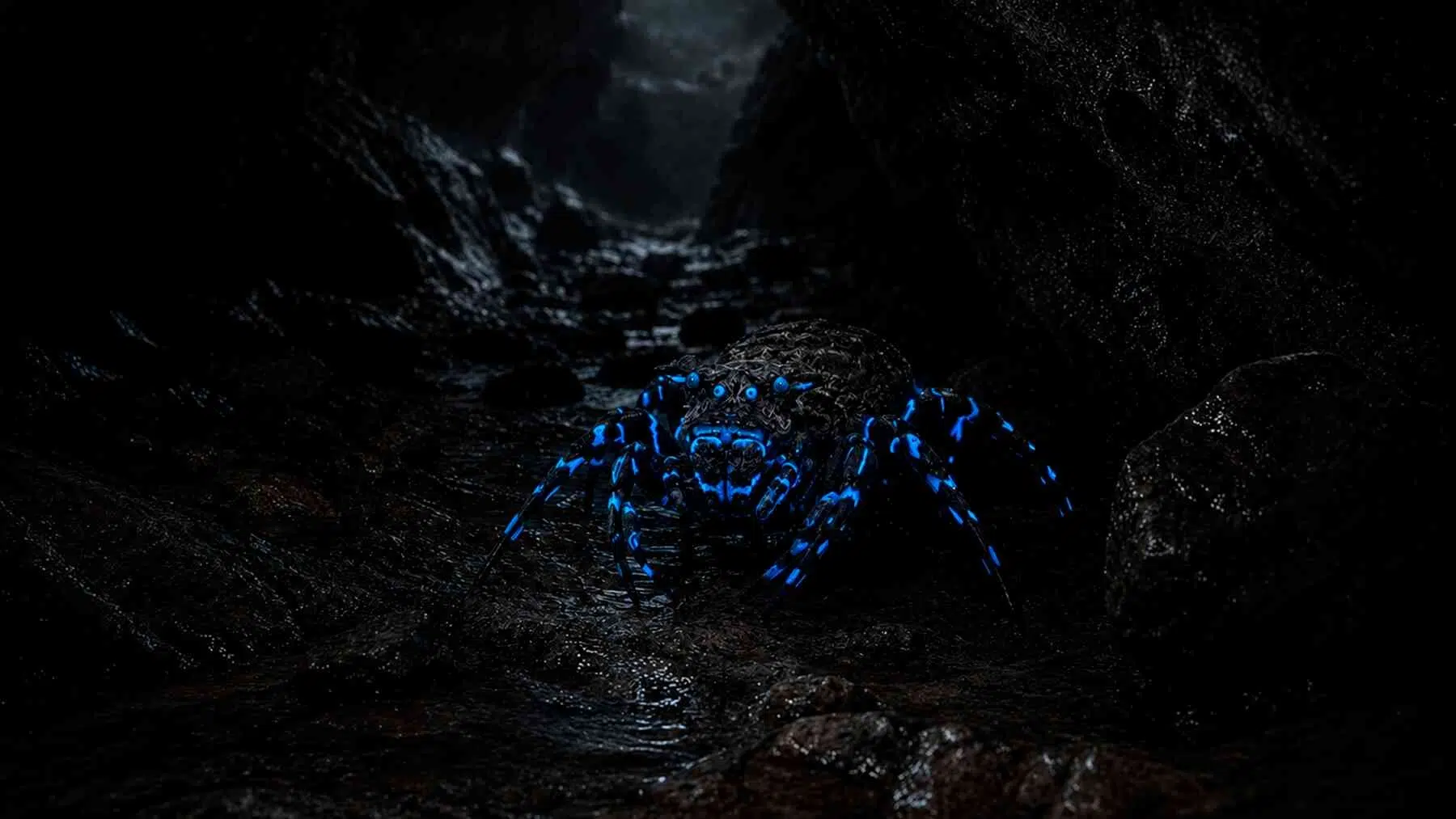
Images of a small spider that emits intense blue colors when exposed to ultraviolet light were surfacing.
Given their extreme rarity, it is easy to understand why people were naturally curious about this unusual phenomenon.
There is more to this mystery than we can see
The team studying the spider believes it belongs to the crown crab spider family. They believe that this particular specimen may be an undescribed species that has never been officially named.
The experts confirmed that this color emission occurred consistently when the spider was exposed to ultraviolet light.
Current biological theory cannot fully explain why this occurs.
Some form of chemical reaction or biological process could be responsible.
The blue-spotted spider was just one of dozens of new species discovered during the Cassai Life Atlas Study.
Samples were collected during this extensive study and carefully examined by the group. A substantial number of the collected samples still remain unidentified.
They will require additional review before they can be placed into their correct position in the evolutionary tree.
At least for now, the blue-spotted spider has become one of the most representative examples of this extraordinary expedition.
Read the whole thing?
Get the week's signal, not the noise
Our sharpest reporting on energy, climate and nature — free, once a week.