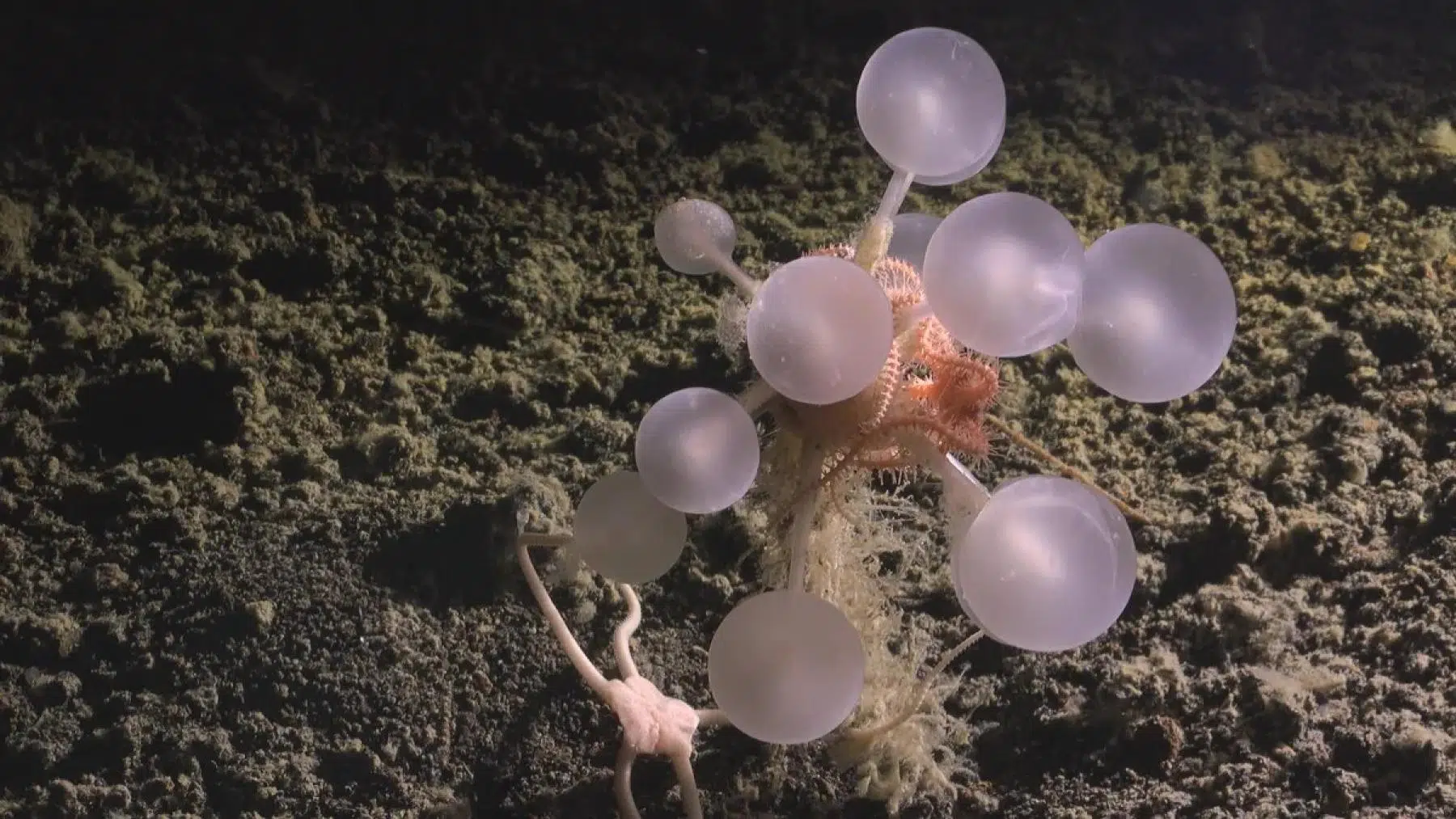
While studying the Southern Ocean, teams have begun finding strange creatures that don’t fit into any previously recorded category.
There were dozens of these discoveries, made during dives at various depths and locations across different parts of the region.
Most of them could not be classified as belonging to an established group, even after closer examination. And then there was one that didn’t belong anywhere and continued to stand out from the rest.
Where exactly was this “carnivorous sponge” found deep below?
How this discovery begins to take shape
The main issue here is the lack of research done within this area of the world.
Although much of the Southern Ocean remains unexplored, only portions of each location are studied when a sample is obtained.
As a result, research is limited to identifying only those organisms that have already been recorded. This makes it difficult to determine whether an organism is common or rare within this environment.
Researchers have now brought back thousands of samples from different areas of the deep sea.
These include trenches, active volcanoes, and newly exposed regions of the seafloor.
Each environment contained a great deal of biodiversity but also showed a wide range of differences across samples.
It was therefore surprising that one sample continuously attracted attention.
This sample did not stand out simply due to where it was located. Instead, it stood out because it behaved unlike any previously recorded one.
If additional unknown species can appear in the Southern Ocean with this level of biodiversity, what other organisms may still be hiding there?
Clues from one of the strangest samples
Insights from one of the strangest samples begin simply.
On the face of it, it doesn’t seem unique.
It’s just a sponge. There isn’t much that would suggest anything new about that.
Upon further inspection, it begins to appear less like others.
The shape is not typical of what would normally be expected.
In addition, the surface does not resemble one in the traditional sense at all. Although unusual deep-sea organisms often show repeating patterns, newly exposed seafloor has produced similar inconsistencies.
As comparisons are made, relationships begin to develop between distant oceanic species and their habitat.
These comparisons don’t explain what type of organism is being observed, which led researchers to highlight their findings through the Ocean Census while documenting new species in the Southern Ocean.
A pattern that only develops below
It does not initially make sense.
It bears no resemblance to anything commonly known or easily recognized.
Even after examining it closely, it continues to feel incorrect and out of place within its surroundings. This difference keeps drawing attention, as it does not fit into what is already understood.
A system that keeps changing
When analyzing the data, it becomes clear that this organism does not depend on filtering water to obtain food.
Rather than filter feeding, it actively catches prey.
It forms a rounded structure lined with numerous tiny hooks.
These hooks capture small floating particles or organisms as they drift past, allowing direct interaction with movement in its surroundings.
Since it responds to that movement instead of passively filtering its environment, it behaves like a trap. This characteristic alone distinguishes it from virtually all other sponges.
Given it was found deep in the Southern Ocean, how should it be viewed differently from just calling it one?
Instead of being another sponge, it becomes part of an ecosystem based on interaction and movement at small scales.
These observations contribute to a broader understanding of patterns within undiscovered ocean ecosystems across different regions.
If organisms can go undetected, how many others seem unfamiliar because no one has seen them?
Read the whole thing?
Get the week's signal, not the noise
Our sharpest reporting on energy, climate and nature — free, once a week.