At a Kansas wildlife park, a tiger had the surprise of her life; she had three new babies!
She showed no indication of being pregnant before they were born. Park staff saw almost no visual evidence that the tiger was going to have children.
Even professionals didn’t realize she was about to give birth until hours before.
That alone was notable. But these cubs held another surprise.
Their orange coats gave absolutely nothing away.
Why the birth surprised everyone involved
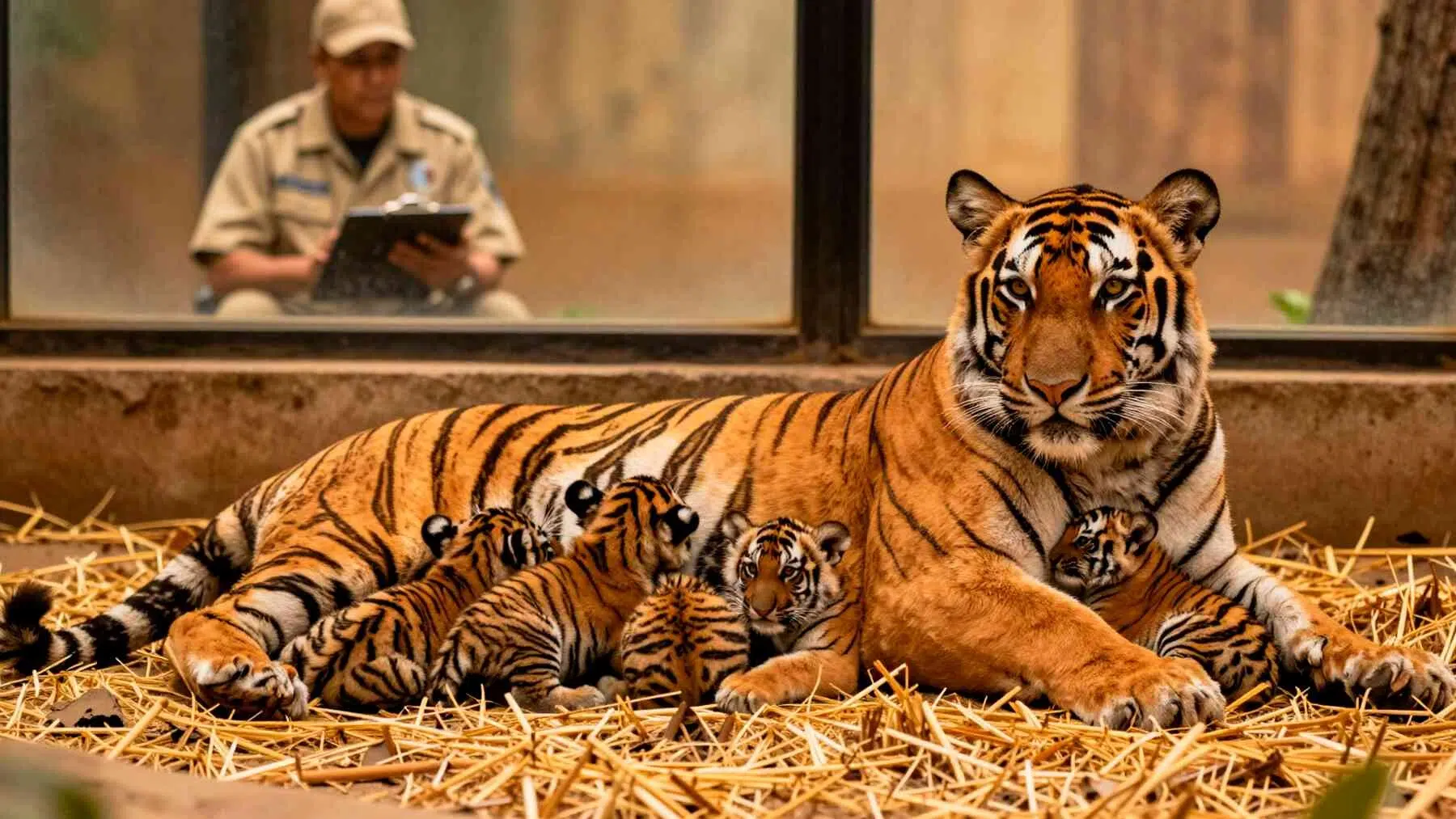
The litter included two male Bengal tiger cubs and one female cub, all born at Tanganyika Wildlife Park in Goddard, Kansas. The cubs were born to Sienna and Grayson, both Bengal tigers.
It had been many years since a tiger was born at the wildlife park.
According to officials from the park, typically, expectant tiger mothers will display very few visible signs of pregnancy.
First-time mothers exhibit fewer still.
Park employees reported that there was no confirmed evidence of mating activity involving Sienna and Grayson.
During a routine training session, an employee noticed Sienna was developing mammary glands. That realization indicated that cubs could possibly be arriving much sooner.
Following this discovery, employees prepared a birthing area and isolated Sienna from Grayson.
Shortly thereafter, three cubs were born.
The cubs carried another surprise
The newly born tigers are currently receiving care and being hand-raised in the park’s Carnivore Nursery.
Employees provide feeding and weigh-ins multiple times per day to monitor the growth and development of each cub.
The tiger’s birth wasn’t the park’s only success that year. It also welcomed six Clouded Leopard cubs and two Snow Leopard cubs.
All three species are threatened in the wild due to habitat loss or poaching.
Professional breeding programs support maintaining genetically viable populations in human care.
The cubs’ sire (father) is a White Bengal Tiger named Grayson. According to a press release from Tanganyika Wildlife Park, the father’s rare lineage was confirmed.
Tanganyika Wildlife Park officials say white coloring occurs in about one in 10,000 wild tiger births.
Their orange coats hid something rare
All three cubs were born with standard orange coats, but their ancestry holds a rare genetic story.
The “1 in 10,000 gene” is called leucism.
It is a recessive mutation that suppresses orange and yellow pigments in Bengal tigers.
The black and brown stripes stay. The blue eyes stay.
What disappears is the orange.
For a white cub to be born, both parents must carry the gene. Sienna and Grayson both have it.
That is why white Bengal tiger births are so rare in the wild.
White tigers are not a different subspecies.
They are simply Bengal Tigers with a unique genetic mutation affecting their coat coloring.
Because this trait is recessive, a parent carrying it does not guarantee that their offspring will express the gene as well.
In this instance, all three of the cubs were born with standard orange coloring. None of the cubs showed white coloring.
But they still carry the gene — one of the rarest genetic traits in wild tigers.
More than a genetic discovery
According to the Animal Experience Team Supervisor, these were the first tiger cubs she had raised at the park. Beyond the science, for zoo personnel involved in caring for these animals, this story is about far more than coat color.
One moment, personnel assumed they were caring for a tiger with few pregnancy symptoms. Next, they were working around-the-clock caring for three newborn cubs.
No sleep. No warning.
Just three tiny lives depending on them every single day.
If a single gene can hide this completely, what else are these cubs carrying that we cannot yet see?
Read the whole thing?
Get the week's signal, not the noise
Our sharpest reporting on energy, climate and nature — free, once a week.