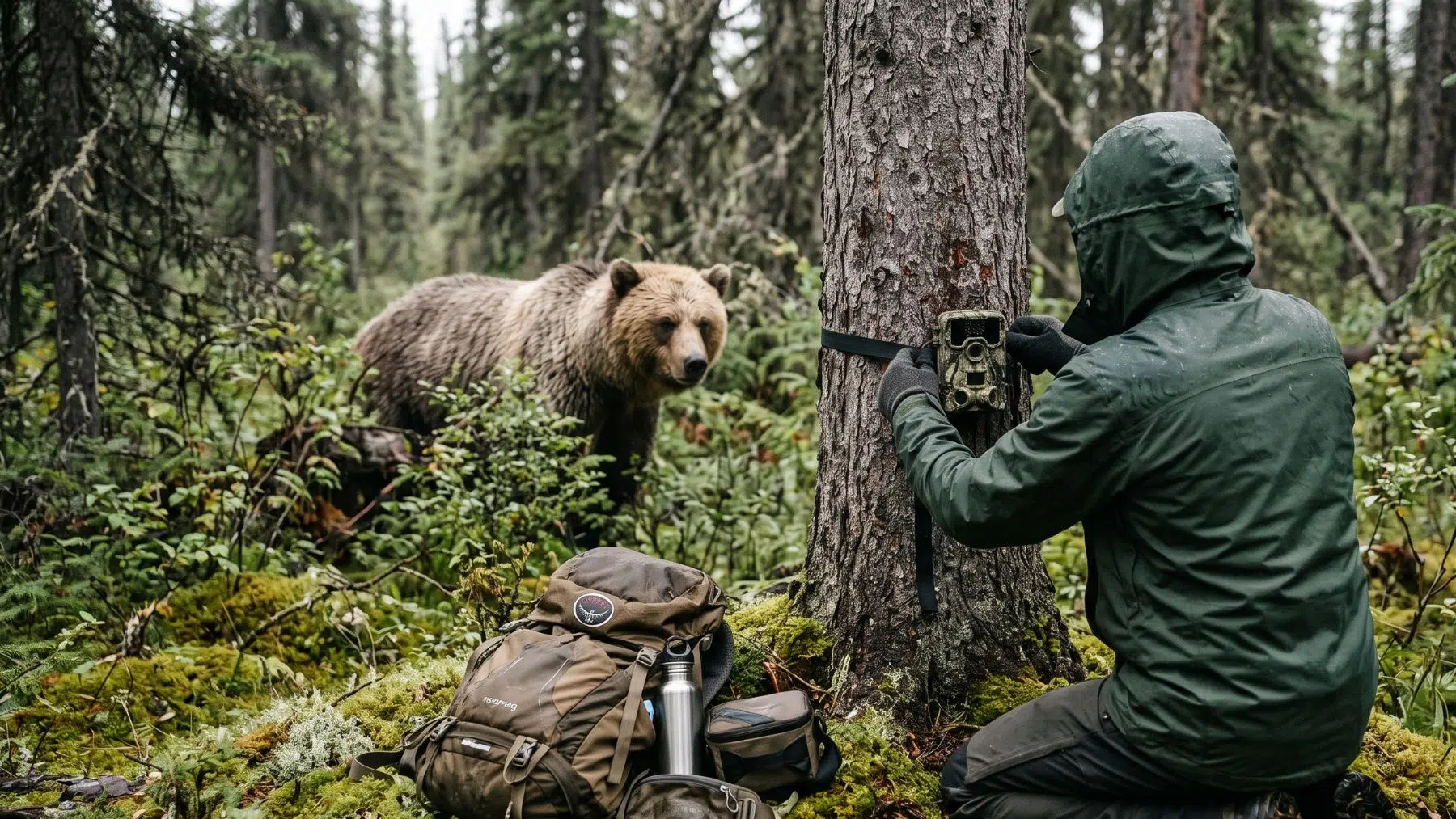
Something moved on a forest trail deep in Canada’s Yukon Territory, and a motion sensor blinked awake.
Within a matter of days, the same camera caught three separate bears walking the same narrow corridor through the spruce.
But one of them was different from the rest.
The operator described it as a “tank of a grizzly,” and when it turned toward the lens, viewers around the world stopped scrolling.
A camera bolted to a tree, and a bear that noticed
A trail camera in Canada’s Yukon Territory captured footage of three large bears using the same trail at different times, a cinnamon-colored black bear, a hulking black bear, and a “tank of a grizzly.”
The clip begins with the grizzly doing what grizzlies do: moving through the forest with total ownership of the land.
The footage starts with an enormous grizzly bear rubbing against a tree, its shoulder hump rolling with each push against the bark.
Then comes the eye-catching moment: the bear charging ferociously toward the camera in slow motion, its head lurching as it approaches within feet of the device.
The top comment on the post said it all: “Can you imagine standing where the trail camera is?”
Hundreds of replies agreed that no, they could not.
When a grizzly decides something is worth investigating
This is not the first time a Yukon grizzly has treated one of these cameras as a personal challenge.
In a separate clip shared earlier by Yukon Wildlife Cams, a grizzly was filmed having a peculiar and unexplained reaction to a motion-sensor trail camera, with the footage captured in late October.
That grizzly moved toward the device and removed its rain cover, and the sound of Velcro separating was clearly audible on the recording.
The animal then pawed at the camera several times before picking up the rain cover and appearing to play with it before walking away into the darkness.
That video garnered over 360,000 views and hundreds of comments on Facebook.
David Troup, who maintains the cameras and shared that earlier footage, wrote about it: “I’ll be honest, I’m not sure what is going on here for the most part. I’ve never seen similar behavior from a grizzly.”
He noted that he checks each camera on foot, which means walking the same trails these bears use every single day.
What those claws actually mean
When the charging bear filled the frame, one feature held every viewer’s eye: the claws.
A grizzly bear’s front claws measure about 2 to 4 inches in length, roughly double the length of a black bear’s claws, which typically measure less than 2 inches.
Grizzly bears have notably longer claws than black bears, but they are less curved, a distinction that matters. It is that combination of length and reduced curvature that suits them for digging, as they frequently excavate to find food such as roots or rodents or to create dens.
They are purpose-built shovels, well-suited for excavating soil, roots, and other materials in search of food.
Black bears, by contrast, have shorter and more curved claws, better for hooking into bark and scrambling up trees.
A young grizzly cub can still scramble up a pine in seconds, but as it matures and those front claws grow longer and flatter and more specialized for digging, that escape route becomes far harder to use.
The Yukon grizzly bear and the wilderness it calls home
The bear on that trail is part of one of the last great wild populations left on the continent.
Exact counts of Yukon grizzlies are difficult given how remote the territory is, and the Yukon government does not publish a single territory-wide total, a reminder of how hard these animals are to study at scale.
What is confirmed by the Yukon government is that Yukon grizzly bears have a very low rate of reproduction, breeding for the first time around their eighth year and reproducing only every three to four years.
That slowness makes every individual bear, and every trail cam sighting, genuinely count.
Wildlife researchers rely on trail cams as one of the few safe windows into how these animals actually live, and the footage from Yukon Wildlife Cams has now become a reference point for understanding how large predators respond to human devices in their territory.
At 149 studies and counting, a pattern kept appearing across bird research showing that even passive monitoring equipment can shift animal movement, a finding that applies just as sharply to other species sharing crowded corridors.
The thing the footage is really showing us
Millions of people watched that bear charge a plastic box bolted to a spruce tree, and most of them felt the same jolt of awe.
But wildlife researchers see something else in the frame: a healthy, massive, curious animal doing exactly what grizzlies are supposed to do.
Even an unassuming trail camera can elicit curiosity in wildlife and shape its behavior.
If a camera perturbs a grizzly enough, that bear may not return, potentially losing feeding and mating opportunities in the area.
By protecting habitat and securing garbage, it is possible to ensure grizzly bears continue to fulfill vital ecosystem roles.
The Yukon’s wilderness can absorb the weight of a “tank of a grizzly” without flinching, but only as long as the land around it stays intact.
The trail cam did not catch a threat.
It caught a glimpse of what North America looked like before we arrived, still running on four pale claws, and still entirely unbothered by the lens.
Read the whole thing?
Get the week's signal, not the noise
Our sharpest reporting on energy, climate and nature — free, once a week.