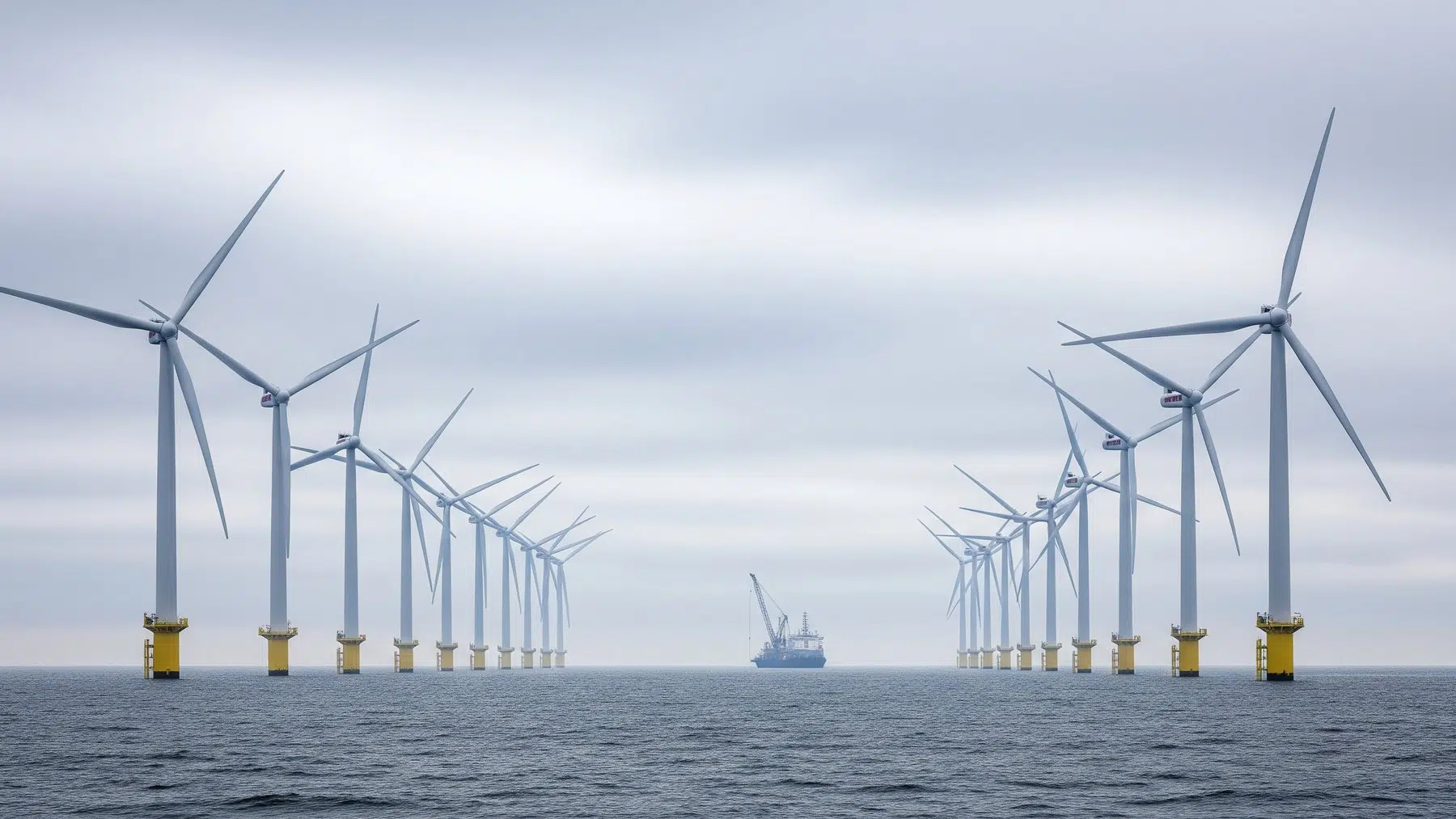
About eighteen miles off the coast of Rhode Island, a row of white towers rises from the Atlantic.
They are wind turbines, each one taller than a skyscraper.
By the summer of 2025, most of the farm was already built.
Forty five of the planned sixty five turbines stood finished in the water.
Then, one August day, every crane and vessel fell still.
A single order from Washington had frozen the whole project.
A decade of permits, then a halt
Revolution Wind is one of America’s first big offshore wind farms.
It sits in federal water southeast of Point Judith, Rhode Island.
The plan is to send clean power to Rhode Island and Connecticut.
At full strength it would carry 704 megawatts of electricity.
That is enough to power around 350,000 homes.
It was meant to help two states cut their fossil power.
Each turbine reaches hundreds of feet above the waves.
The sheer scale of the build was hard to grasp from shore.
It was set to be one of the largest in the country.
The project cleared years of federal and state review.
Its final federal approval came in the summer of 2023.
The reviews behind it had run for more than a decade.
By 2025 the finish line was finally in clear sight, and then it vanished.
The stop no one expected
In August 2025, a federal agency issued a stop work order.
It halted a project that was already about 80 percent complete.
All the foundations were in, and most of the turbines stood ready.
The order cited vague concerns about national security.
Critics said the real reason was politics, not any true risk.
Idle ships and crews reportedly cost the project millions a day.
Workers had been racing to finish before the winter storms.
A stop order this late in a build is almost unheard of.
Contracts, jobs, and deadlines all hung on the sudden pause.
The developer took the fight straight to federal court.
A nearly finished wind farm now sat frozen in place.
Nobody working on it had seen it coming.
The market took fright
The shock did not stay out at sea.
The Danish company behind the farm was already under heavy strain.
It had just launched a huge sale of new shares to raise cash.
Its stock had been sliding toward record lows for weeks.
The surprise halt in Rhode Island only deepened the fall.
On some days the shares dropped by close to a fifth.
Investors saw a finished project turned into a sudden liability.
Offshore wind has faced rising costs and tangled supply chains.
Every setback now lands harder than it once did.
For a moment the whole American offshore wind industry seemed to wobble.
The tremors reached investors thousands of miles across the ocean.
The trouble was real, but the numbers hid a bigger story.
It was a story playing out under the waves.
What was really at stake in the water
Here is the part almost no one was asking about.
According to one report, the halt struck a farm that was already 80 percent built.
Those steel foundations had stood in the sea for many months.
And the ocean had not left them bare.
Mussels, barnacles, and algae had crusted onto the metal legs.
Fish that need structure had gathered around each tower.
Offshore foundations act like sudden cliffs on a flat sea floor.
Reef species that need rock finally had somewhere to cling.
Studies at older wind farms have found fish crowding the bases.
The metal had already become a home for the sea.
Scientists call this the reef effect, and it starts within weeks.
A bare patch of seabed had begun to turn into a living reef.
Freezing the work left that new habitat in limbo too.
The turbines started spinning anyway
The story did not end with the freeze.
In late September 2025, a federal judge stepped in.
He called the sudden halt arbitrary and let the work resume.
The cranes returned, and the last turbines went up.
Crews worked through the fall to catch up on the lost time.
The legal fight over the halt is still winding on.
But the towers are turning at last.
According to one account, the farm began feeding power to the grid in early 2026.
Its reef of mussels and fish kept growing the whole time.
The same pairing of clean power and sea life shows up elsewhere, from clever octopuses to the seals near another offshore wind farm.
The homes will get their power in the end.
And below them, a reef that no one planned keeps on spreading, one mussel at a time.
Read the whole thing?
Get the week's signal, not the noise
Our sharpest reporting on energy, climate and nature — free, once a week.