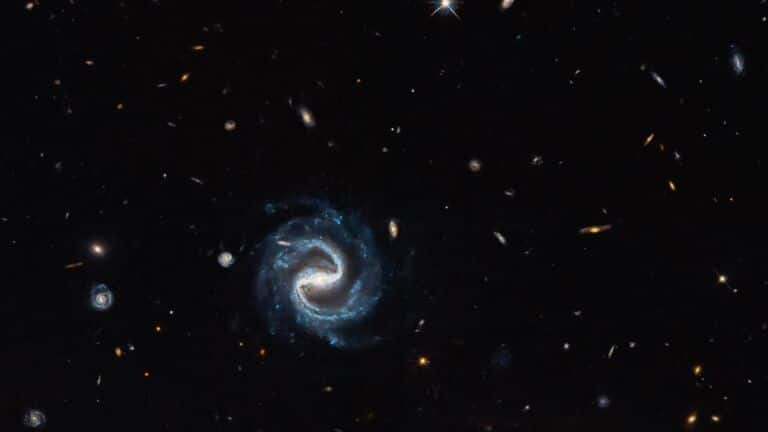
Small galaxies should form new stars when they are located at large distances from bigger galaxies.
Three dwarf galaxies near the Pinwheel Galaxy appear not to be doing so.
That, right there, generates a problem.
Astronomers have noticed this pattern many times over when they looked at dwarf galaxies.
The distance to neighboring, larger galaxies is typically the deciding factor for how long star-formation continues.
The three dwarf galaxies recently discovered do not fit this model.
Why isolation allows dwarf galaxies to keep forming stars
Dwarf galaxies obviously are not all exposed to the same environmental conditions.

Some spend their time near larger galaxies.
Others remain completely alone for hundreds of millions of years.
Different environments, therefore, can lead to different results.
When dwarf galaxies are very close to massive neighbors, they can lose the gas required for star-forming processes.
In general, those dwarf galaxies which reside in greater isolation retain that gas.
The difference exists consistently throughout the populations of dwarf galaxies that astronomers have studied.
The discovery is positioned on the “wrong” side of the divide.
The mystery begins when isolation and dormancy coincide
These three dwarf galaxies clearly appear to be isolated from more massive neighbors; they also appear to have ceased creating new stars.
Those two conditions are not commonly expected to occur simultaneously.
Isolated dwarf galaxies are generally expected to possess sufficient gas reserves.
The recent discoveries apparently disrupt this normal relationship.
The apparent conflict between being isolated and showing little recent star formation created the central question for this research.
Three unusual dwarf galaxies emerged from a backsplash search
University of California, Berkeley undergraduate Julian Shapiro identified three unusual dwarf galaxies.
The objects were located around the Pinwheel Galaxy.
Observations indicated that the objects appear to be both isolated and non-productive (i.e., no longer producing new stars).
The dwarf galaxies were labeled Shapiro Dwarf Galaxies I, II, and III.
Simulations suggesting locations of backsplash galaxies directed the search for candidates using existing survey images.
The resulting observations indicate that the objects have likely experienced significant reductions in star production during their lifetimes.
All three objects appear to be members of an extremely rare class of galaxy types.
Backsplash galaxies are one explanation, but not the only one
The most well-known theory involves so-called backsplash galaxies.
The Astrophysical Journal study found that the observed behavior of the objects is consistent with this hypothesis.
In the case of a backsplash galaxy, a smaller dwarf galaxy approaches a larger host galaxy.
Environmental forces result in the removal of the gas required for future star production.
At that point, the smaller galaxy is ejected or sent back into an environment characterized by reduced density and isolation.
Alternatively, a process called cosmic web stripping could explain similar observations.
Additionally, one of the galaxies could actually be a faint satellite of a nearby spiral galaxy rather than a backsplash system.
Future studies will need to investigate if either hypothesis provides an accurate description of the histories of these objects.
Rare nearby candidates could test a long-standing prediction
Backsplash galaxies have been proposed as part of theoretical frameworks for some years now.
However, finding numerous examples of such galaxies within a reasonable distance from observers has been significantly more challenging.
These objects may allow researchers to provide empirical testing of predictions associated with these theories.
Researchers can now directly compare theoretical predictions with the behaviors of specific systems.
Examining each system in detail will show whether current models match the nearby universe.
The search now shifts from discovery to confirmation
Researchers would like to know whether these galaxies really followed a backsplash-type development pathway.
Space telescopes may help determine more accurate distances to the systems, helping researchers better understand their pasts.
Future surveys may discover additional candidates and increase opportunities to test backsplash hypotheses.
Read the whole thing?
Get the week's signal, not the noise
Our sharpest reporting on energy, climate and nature — free, once a week.