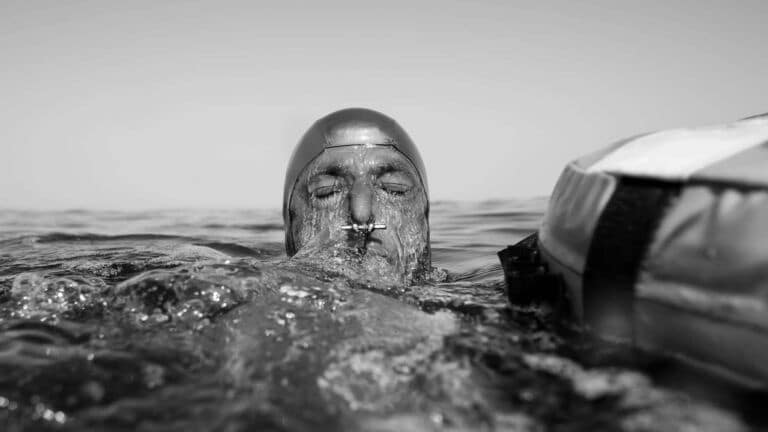
The sand stretched flat and white for miles, and somewhere behind the dunes a line of runners kept moving anyway.
Heat above. Grit in every sock.
One hundred fifty five miles of it.
Across the Gobi, the Atacama, Madagascar and the deserts of Jordan.
At every aid station, the same complaint waited, feet rubbed raw inside soaked, gritty shoes.
A sports medicine doctor had heard it so often he decided to test the cheapest thing in the kit.
A thin strip beats thick padding
The starting point is simple enough. Friction blisters form when the outer layers of skin shear against the layers beneath, separating the cells and leaving a pocket that fills with fluid. Thick pads, moleskin and greasy lubricants all try to cushion that friction, but cushioning adds bulk that can shift inside a wet sock.
Paper tape works differently, because it is extremely thin and extremely smooth. The researchers’ explanation is that the smooth surface reduces shear stress on the sensitive skin directly underneath it, so the rubbing lands on the tape rather than on living tissue. That is the theory they put forward to account for their result, not a mechanism anyone has pinned down at the cellular level.
There is a second, less obvious advantage. The adhesive is weak, so when the tape does peel off it is unlikely to tear the roof off a blister that has already formed and leave an open wound, unlike stickier remedies that come away with skin attached.
Seven days of racing wreck feet fastest
Multistage desert racing is an unusually cruel laboratory for skin. Competitors cover long distances day after day in shoes full of sand, and the physician behind this work spent roughly a decade treating endurance athletes running 25 to 50 miles a day in places from China to Chile to Antarctica.
What he kept hearing was always about feet. “Doctor, I’d be doing so well, if only for my feet,” he recalled patients telling him, and military doctors complained to him about the state of their recruits’ feet too.
Powders, antiperspirants, lubricants, tapes and adhesive pads had all been tried against blisters. Despite all of it, there was little proof that any single method reliably worked.
98 of 128 runners stayed blister free under the tape
So the team enrolled 128 competitors in the six stage, seven day, 155 mile races held in a recent year. A coin toss picked one foot per runner for taping, and trained medical assistants smoothed a single layer over that runner’s blister prone areas, or over a randomly chosen patch if the runner had no blister history.
Untaped areas of that same foot served as the comparison, which is what made the test fair, since both sat in the same shoe on the same mile of sand. By the end, 106 of the 128 runners had blistered somewhere.
But for 98 of the 128, no blister formed where the tape had been applied, and 81 runners blistered only at uncovered areas rather than underneath the tape, a 40 percent reduction reported in the Clinical Journal of Sport Medicine.
The lead author summed it up in one blunt line. “It’s kind of a ridiculously cheap, easy method of blister prevention,” he said. A roll often costs less than a dollar, far less than the balms and pads sold for the same job.
Thirty years of failed fixes came first
None of this happened on the first attempt, which is part of what makes it a good story. “People have been doing studies on blister prevention for 30 or 40 years,” the lead author said, describing a long run of trials that never produced anything both easy and effective.
One earlier attempt backfired outright. A study applied antiperspirant to the feet of military cadets and did reduce blister formation, but 57 percent of the cadets using it reported skin irritation.
That history of near misses is why the duct tape comparisons that followed matter, since not every sticky fix behaves the same way on skin under repeated strain.
One earlier trial found no benefit at all
This is not a cure for every blister, and the design matters more than the material. An earlier trial by the same group taped most of the common blister prone areas across one whole foot and compared it with the untaped opposite foot, and that version showed no benefit at all.
The authors argued the earlier approach left no untaped skin nearby for comparison and may have hidden the effect, so what the later trial supports is targeted taping of known trouble spots. Even so, the appeal is obvious because it asks so little.
No prescription, no fitting, no new shoes, just a strip of ordinary tape pressed flat before the miles begin. For anyone who has limped the last leg of a long hike with a raw patch screaming inside a sock, that is a small, hopeful kind of science.
It is the kind worth carrying in a coat pocket on the next trip to the trailhead, the same way a lab volunteer once stumbled onto an odd trick nobody expected to hold up.
Read the whole thing?
Get the week's signal, not the noise
Our sharpest reporting on energy, climate and nature — free, once a week.