The sub-Antarctic Bird Island off the coast of South Georgia has just gotten a solar-powered tech upgrade. But it is not about electricity generation; it is for the penguins.
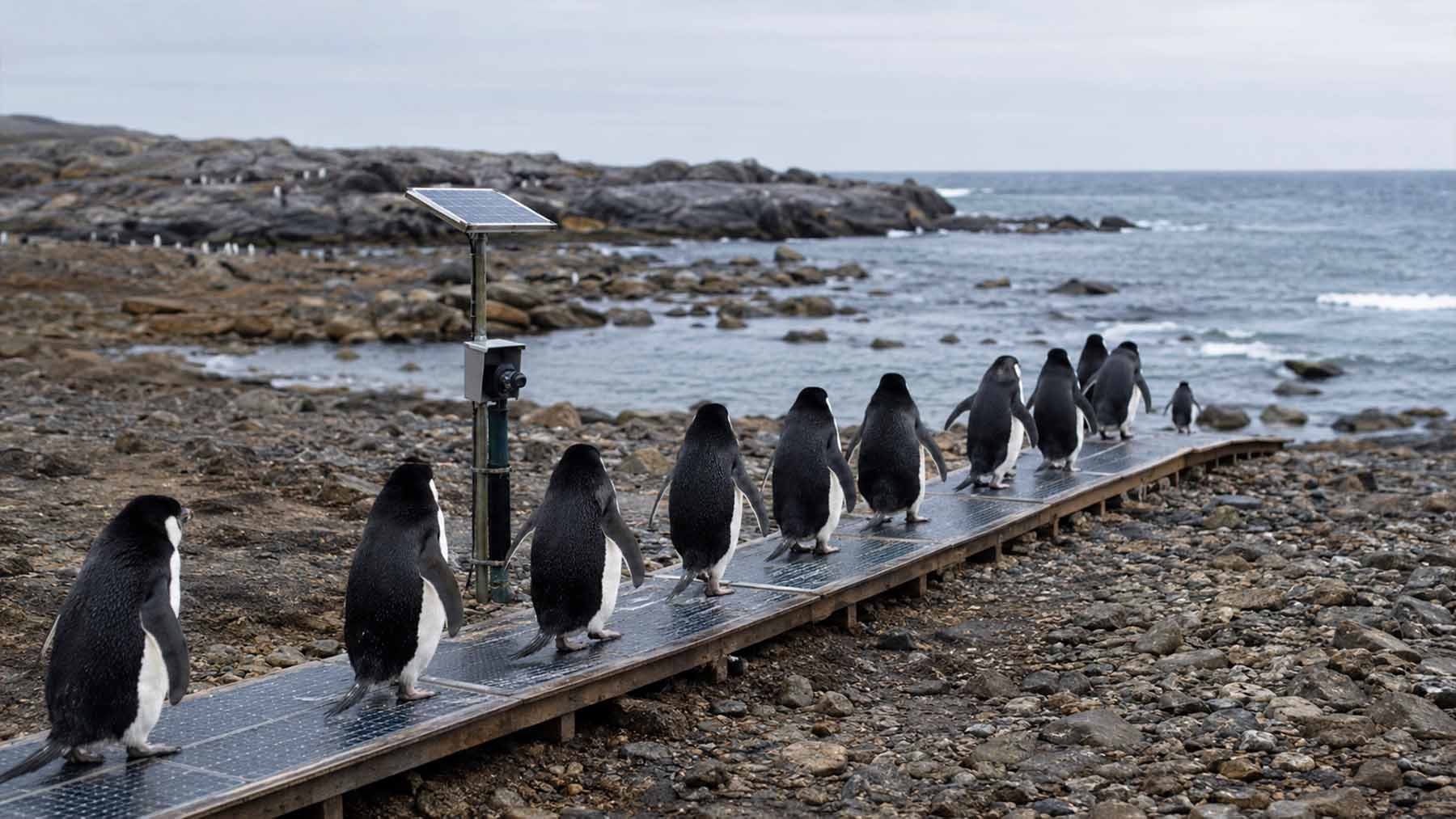
Scientists recently installed an automated weighbridge between the rocky land and the Southern Ocean, creating a ‘funnel’ for the birds moving from the colony to their food source.
When a penguin crosses the platform, its identity and physical condition are recorded for monitoring.
How does this smart technology allow the penguins to ‘check in’ automatically without human interference?
How labor-intensive research is being streamlined to remove the interference factor
On Bird Island, there is only one pathway across the terrain from the penguins’ nesting grounds to their feeding grounds. Marine researchers from the British Archaeological Society (BAS) have been monitoring the population for years, aiming to understand larger shifts in the ecosystem.
Traditionally, tracking individual birds involved field capture, requiring many hours of labor. This was also stressful for the animals, and the frequency of gathering data was limited.
For the sake of animal welfare and accuracy, engineers were driven to come up with a new way to monitor the wildlife without disturbing their daily routines.
The corridor of land chosen for the new weighbridge is unavoidable, being the only thoroughfare to the sea. It is the ideal spot to track the birds along their natural route.
Tracking challenges demand cleverer tech
As one would imagine, the sub-Antarctic conditions are hardly conducive to gathering field data. There are several logistical hurdles to consider, like freezing temperatures, severe wind, and storms. There is also the constant salt spray, which is so corrosive that electronics start degrading from the day of installation.
In the past, marine biologists had to resort to tracking tools with shortcomings. External tags and radio harnesses are bulky or heavy to such a degree that their swimming efficiency is reduced. The data becomes skewed because natural foraging behavior is affected.
Scientists operating the Higher Predators Science Program needed a weatherproof system to monitor daily migrations. It needed to endure in the elements, be fast, and not slow down the colony’s movements.
It also needed a power source that did not require replacing batteries. Eventually, engineers solved all the problems with a passive form of technology relying on an off-grid energy system.
Passive tracking and a wealth of automated data
The developers turned to transponder tags to extract the data they need. These are similar to the microchips that you use to track your pet. Once they are implanted under a penguin’s skin, they transfer data automatically as the birds move across the new platform.
The walkway incorporates a radio-frequency antenna powered by a solar array and battery bank. The antenna energizes the chip as a tagged penguin crosses the platform. In a split-second, the unique identification code is recorded at the same time that sensors in the weighbridge collect the bird’s weight.
Real-time data on feeding and health
The British Antarctic Survey‘s automated check-in system delivers real-time data on foraging, ocean health, and body condition across entire breeding seasons without any human contact. It’s expected that the system will soon be replicated in other BAS-administered regions.
Other endeavors changing the face of conservation through engineering and renewable energy have seen artificial bird nests being installed among offshore wind turbines.
Some installations are transforming the sea floor into new reefs.
By removing the need for manual handling, scientists gather unprecedented biological insights while leaving the colony entirely undisturbed. This synthesis of engineering and wildlife management is a blueprint for non-invasive ecological monitoring and a hopeful sign for the future.
Read the whole thing?
Get the week's signal, not the noise
Our sharpest reporting on energy, climate and nature — free, once a week.