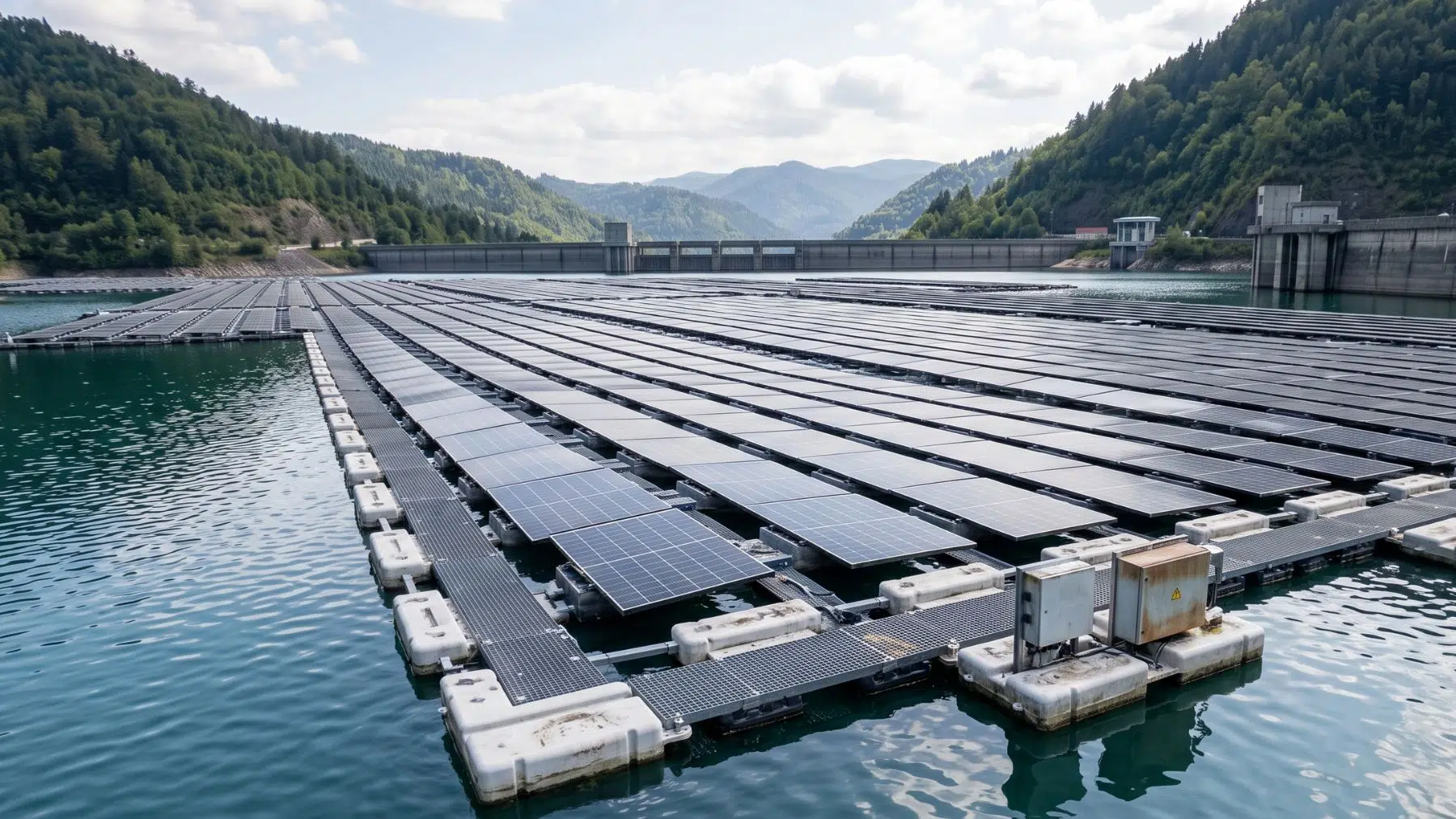
On a reservoir in the Arizona desert, something new is floating on the water.
Rows of dark solar panels ride on rafts where only the sky once reflected.
A Native community has started turning its own reservoir into a power plant.
It is one of the first projects of its kind anywhere in the country.
And it hints at something far larger.
The still water behind America’s dams could become a giant power source.
Solar’s hidden land problem
Solar power has one awkward requirement, it needs a lot of room.
A big solar farm can spread across thousands of acres of ground.
That land often competes with farms, homes, or wild habitat.
Clearing open desert or field for panels stirs real objections.
Some projects have been slowed for years by fights over land.
Every acre used for panels is an acre not used for something else.
The search for empty ground has become a real bottleneck.
Good, flat, sunny, and available land is getting harder to find.
Rooftops help, but they cannot carry the whole load.
So developers keep hunting for space no one else wants.
For solar to keep growing, it has to escape that trap.
The best untapped surface may not be land at all.
It may be sitting on water.
The surface hiding in plain sight
The United States is dotted with man made reservoirs.
Thousands of them pool behind dams both big and small.
Most were carved out generations ago for power and water.
Their surfaces are broad, flat, and wide open to the sun.
From above, many of these reservoirs look like small inland seas.
Some stretch for miles behind a single dam.
Almost none of that surface does any work beyond storing water.
That is a lot of prime real estate sitting idle.
Floating solar sets panels on rafts that ride right on that water.
The idea is already common on lakes across Asia and Europe.
In the United States it has barely begun.
Yet the reservoirs are already there, waiting and empty.
And each one hides a second advantage.
Why a dam is the perfect partner
A reservoir behind a dam is not just any pond.
It comes with a power plant already bolted to its wall.
The dam’s turbines and power lines are built and connected.
Floating panels could plug straight into that same grid link.
It is a tidy marriage of old concrete and new glass.
Better still, the two sources balance each other out.
The sun makes power by day, and the water waits on demand.
When clouds roll in, the dam simply opens its gates.
One holds steady power, the other surges when the sun is high.
Between them they can smooth out the swings of the grid.
The hardware to send that power out already stands on site.
The panels also shade the water and slow its loss to evaporation.
One reservoir could do three jobs at once.
The number that stunned the researchers
Here is the scale that makes engineers sit up.
According to one report, panels on federal reservoirs could add up to 77,000 megawatts of power.
That is enough floating solar to run close to 100 million homes.
All of it would sit on water the country has already dammed.
Not a single new acre of land would need clearing.
The study mapped reservoirs run by several federal agencies.
Together they cover an astonishing amount of open water.
Even a fraction of it would rival the largest power plants.
The findings landed as the country races to add clean power fast.
The panels would pair with dams the government already runs.
It turns a wall of old concrete into a modern hybrid plant.
A surface that once just reflected the sky could power a nation.
Why it is a beginning, not a done deal
It is important to be honest about where this stands.
That giant number is a study of potential, not a finished build.
The country still has no floating solar project even 10 megawatts across.
The first real movers are only just getting started.
According to one account, the Gila River Indian Community in Arizona is floating panels on its own reservoir.
Scientists are still studying how the shade affects fish and water quality.
Floating hardware must survive waves, ice, and shifting water levels.
The costs and the permits are still being worked out.
But the potential alone has utilities paying close attention.
The same pairing of clean power and water shows up elsewhere, from a solar farm fox to panels shading an irrigation canal.
But the surface is there, calm and enormous and waiting.
The sun rises over the water, and the dam stands ready to catch it.
Read the whole thing?
Get the week's signal, not the noise
Our sharpest reporting on energy, climate and nature — free, once a week.