Something crossed a trail camera in the forests of northeastern India on the last day of October 2022.
It triggered the sensor six times in a single pass.
The researchers reviewing the images went very still.
What they were looking at had not been photographed in this landscape in decades, and many had assumed it was simply gone.
A landscape that swallowed its own ghosts
The Kaziranga-Karbi Anglong Landscape in Assam, northeastern India, covers roughly 25,000 square kilometers of floodplain, forest and hill range.
Most visitors know it for its one horned rhinoceroses.
The landscape spans four major wildlife corridors threading between Kaziranga National Park and the Karbi Anglong hills, inside one of the most biodiverse regions on the planet.
But beneath its famous giants, a smaller story was playing out in the dark.
Researchers had confirmed that one of the forest’s most capable predators was believed to be locally extinct here since the 1990s.
Nobody had photographed it.
Nobody had heard its strange high pitched call echoing between the trees.
The corridors linking this fragmented forest had narrowed over the years, squeezed by highways and human settlements pressing in from every direction.
Eighty-three cameras, four corridors, thousands of trap days of waiting
In February 2021, a team from the Wildlife Institute of India began placing camera traps across the landscape.
The survey ran through December 2022, with 83 traps set across four ecological corridors: Panbari, Haldhibari, Kanchanjuri and Amguri.
The goal was to test whether those corridors were still working as real pathways for wildlife.
Three of the four came back largely empty for the creature they most hoped to find.
Only Amguri showed evidence of the animal’s presence, confirming its value as a functional corridor for threatened carnivores.
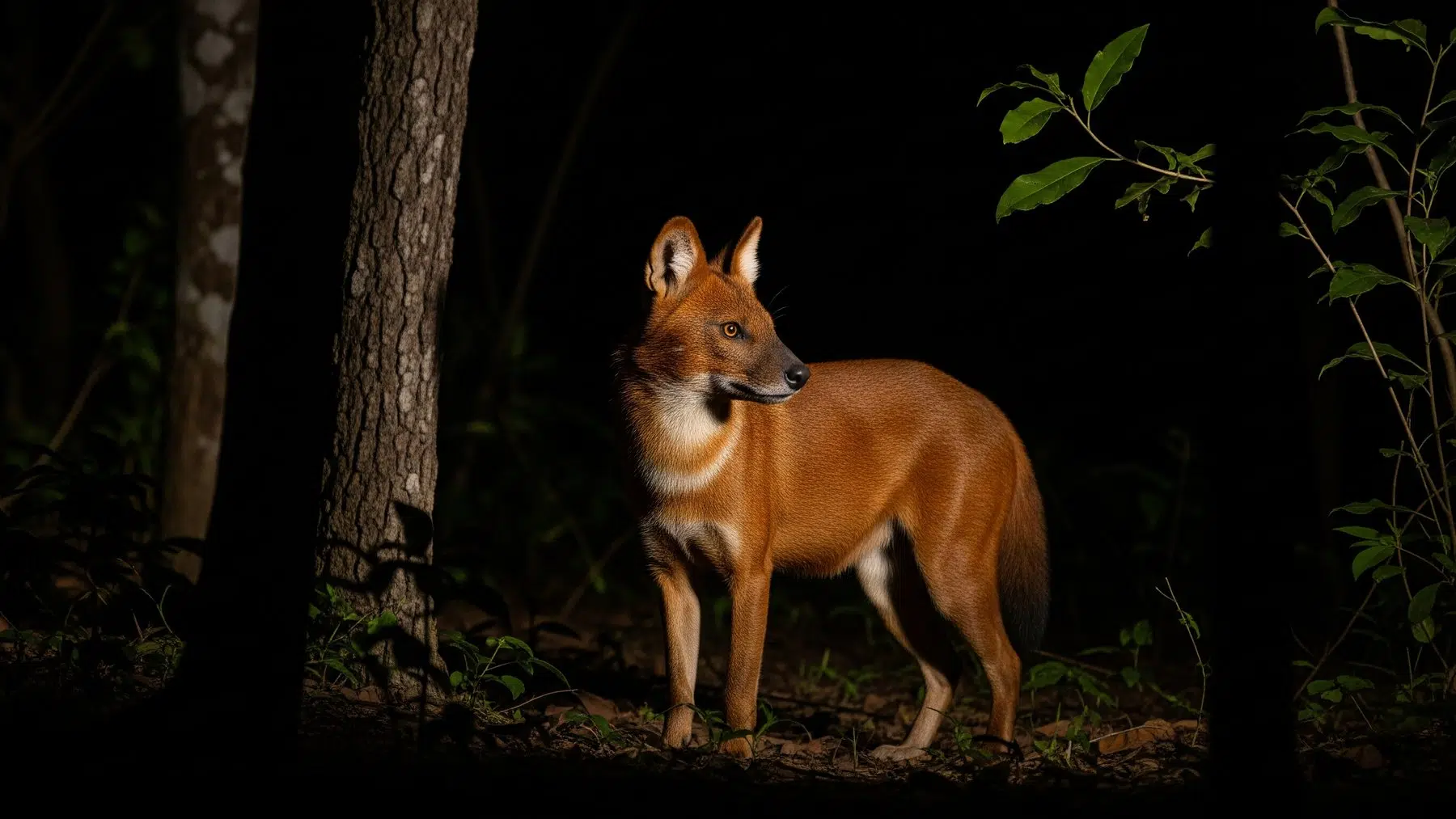
All six photographs captured during the survey showed a single individual, spotted just 375 meters from National Highway 37 and around 270 meters from the nearest human settlement.
It was threading the absolute thinnest gap between the wild world and the human one.
And it did not know anyone was watching.
The whistling hunter that packs had almost forgotten
Pack hunters are not rare on Earth, but few are as sophisticated as this one.
They are social animals, moving together when conditions allow, and they are called whistling dogs for their eerie calls used to communicate across dense forest.
They coordinate hunts with a kind of relentless precision.
This species can take down prey ten times its own body weight.
That is extraordinary for an animal that weighs roughly as much as a cocker spaniel.
Yet despite that hunting power, they had vanished from most of northeastern India.
Habitat loss and a shrinking prey population pushed them to move elsewhere in search of better hunting conditions.
The six photographs taken on October 31, 2022 were the first hard proof that at least one had found its way back.
The dhole returns to Kaziranga
The Asiatic wild dog, known as the dhole, had made an unexpected reappearance in Assam’s Kaziranga-Karbi Anglong Landscape, once feared locally extinct in the region.
The study, published in the threatened taxa journal in June 2025, represented the first photographic confirmation of a dhole in this part of Assam in decades.
Its findings were also reported by Mongabay India.
The sighting suggests the species may have survived undetected, reviving hopes for its long term survival in northeastern India.
A dhole moving through Amguri means the corridor is alive.
If it works for one of the most sensitive carnivores in the ecosystem, it likely works for dozens of others sharing the same path.
Researchers studying old growth forests and the predators that anchor them know that a single night’s camera trap image can rewrite everything, and scientists following pack hunters in other ecosystems are finding the same corridors matter everywhere.
What six photographs can change
Researchers say more surveys are needed to determine whether this dhole was a lone disperser or part of a larger group still moving through the region.
That question matters enormously.
A lone animal is a hopeful sign.
A breeding pack would be a transformation.
The animal’s behavior in those six frames was telling: it used the same route each time, suggesting it had mapped the corridor the way predators do, methodically and with purpose.
That kind of intelligent persistence in finding a way through fragmented land is exactly what conservationists hope to see in a recovering species.
The dhole did not announce its return.
It simply kept moving, the way pack hunters always have, through whatever the world left open for them.
Whether the corridors that carried it this far will survive the pressures closing in around them is the chapter that still has no ending.
Read the whole thing?
Get the week's signal, not the noise
Our sharpest reporting on energy, climate and nature — free, once a week.