Something moved through the tall firs of the Pacific Northwest over the last century, and most people never noticed it happening.
It was not a logger, not a landslide, not a fire.
It was an owl from the other side of the continent, spreading branch by branch toward the sea, and now the U.S. government has decided the only way to stop it is to send armed teams into the forest.
The plan is unlike anything American wildlife managers have ever attempted, and the bird at the center of it is one you have almost certainly heard before, probably on a camping trip, probably after dark.
A voice almost every American has heard in the dark
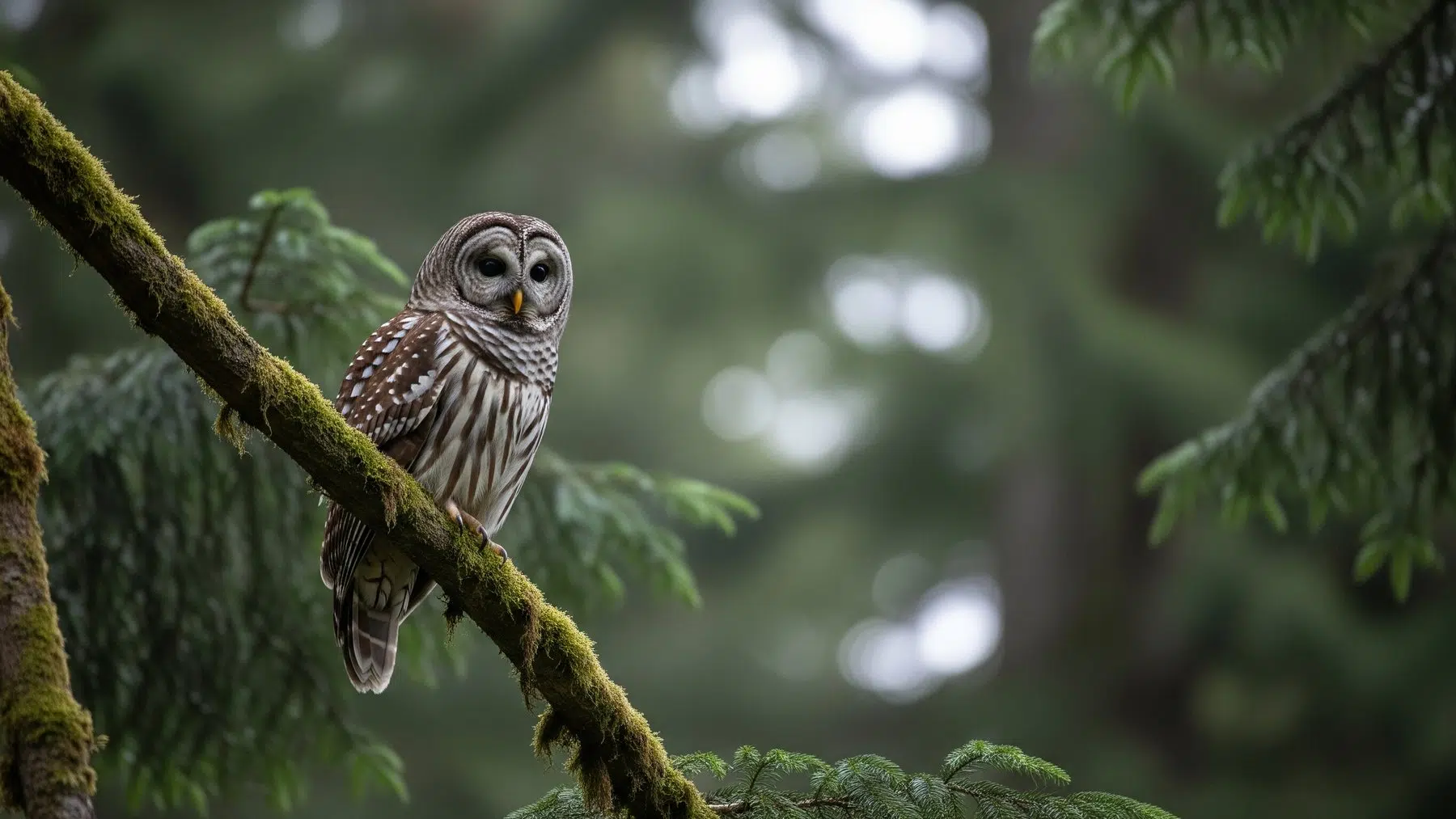
Walk through any forested campground east of the Rockies at dusk and you may hear it: a deep, rolling eight-hoot call that wildlife enthusiasts have long described as “who cooks for you, who cooks for you-all?”
That is the barred owl, and it is one of the most recognizable sounds in North American nature.
It is a medium-sized owl native to eastern North America, historically found in old, undisturbed forests east of the Great Plains, and now spread across much of the western United States as well, following a range expansion that took hold over the past century.
Most people who hear it on a summer night feel a small shiver of pleasure, the forest doing what a forest is supposed to do.
What almost no one realizes is that this bird has been on a slow, remarkable march westward for generations, rewriting the ecology of forests it was never supposed to reach.
How one bird crossed a continent without anyone stopping it
The story of the barred owl’s westward expansion reads less like an invasion and more like a slow geographic miracle.
Barred owls began to move west in the early twentieth century as a combination of human-driven changes, fire suppression, the ending of Indigenous burning practices, and tree-planting across the Great Plains, gradually broke down the treeless barrier that had kept them east for millennia.
Now they have spread across a broad swath of the Northwest, from northern California all the way up to British Columbia.
The barred owl turns out to be extraordinarily adaptable and aggressive.
The spotted owl’s only preferred habitat is old-growth forest, while barred owls can survive outside it.
That single difference in flexibility gave the newcomer a permanent edge, and the old-growth forest became a battleground.
The forest went silent in a way the data could not ignore
Wildlife biologists started noticing something wrong in the old-growth zones of Oregon, Washington and California in the 1990s.
The spotted owl, a bird that had lived in those ancient trees for centuries, was disappearing.
The U.S. Fish and Wildlife Service says population declines showed signs of improvement until about 2008, then accelerated sharply, coinciding with the barred owl’s territorial expansion.
Across the Northwest and California, spotted owl numbers have fallen by at least half, and by up to 75 percent in some areas.
The logging bans of the 1990s had been supposed to fix this.
They protected the trees, but they could not protect the spotted owl from a rival it had never evolved to face.
The plan that has split the conservation world in two
The bird driving all of this tension is the barred owl, the adaptable easterner whose friendly campfire call has become, in the old-growth West, an ecological force.
U.S. wildlife officials are embracing a contentious plan to deploy trained shooters into dense West Coast forests to kill almost half a million barred owls over three decades.
The strategy attracts barred owls with recorded calls and then shoots them when they respond and approach.
An earlier pilot study, in which around 2,500 barred owls were removed across Northwest forest sites, found that spotted owl decline slowed in those areas, though populations continued to fall, and resumed their earlier trajectory once management stopped.
But critics warn that barred owl populations would recover as soon as management efforts stopped, making the cull effectively endless.
The debate has fractured conservation groups that almost never disagree, pitting those who see the cull as a necessary rescue against those who call it an unwinnable war on a native North American bird.
You can read the full PBS NewsHour account of the plan and the fault lines it has drawn across the wildlife community.
What the forest might look like if it works, and if it doesn’t
Barred owl removal is one part of a three-pronged plan, with breeding programs and old-growth habitat protection as the other two strategies.
Even supporters concede the cull would need to continue for at least thirty years, a commitment that crosses multiple presidencies and funding cycles.
The plan is already in jeopardy after the Trump administration terminated three critical grants funding the program.
The barred owl did not choose this journey; it followed the trees humans planted and the forests that opened up because of how we managed fire.
The spotted owl’s fate now rests on a question with no easy answer: whether humans should intervene when one wild creature displaces another, even when that displacement traces back to changes humans made in the first place.
For more on the extraordinary things hidden inside familiar ecosystems, consider what scientists found beneath the ocean near New Zealand’s deep waters, and what a pattern across 149 bird studies revealed about a hidden cost landing on one creature almost nobody thought to protect.
Two owls, one ancient resident of old-growth darkness and one extraordinary continent-crossing traveler, are caught inside a human-made dilemma that the forest itself never created.
Read the whole thing?
Get the week's signal, not the noise
Our sharpest reporting on energy, climate and nature — free, once a week.