Animals don’t usually get this excited about food.
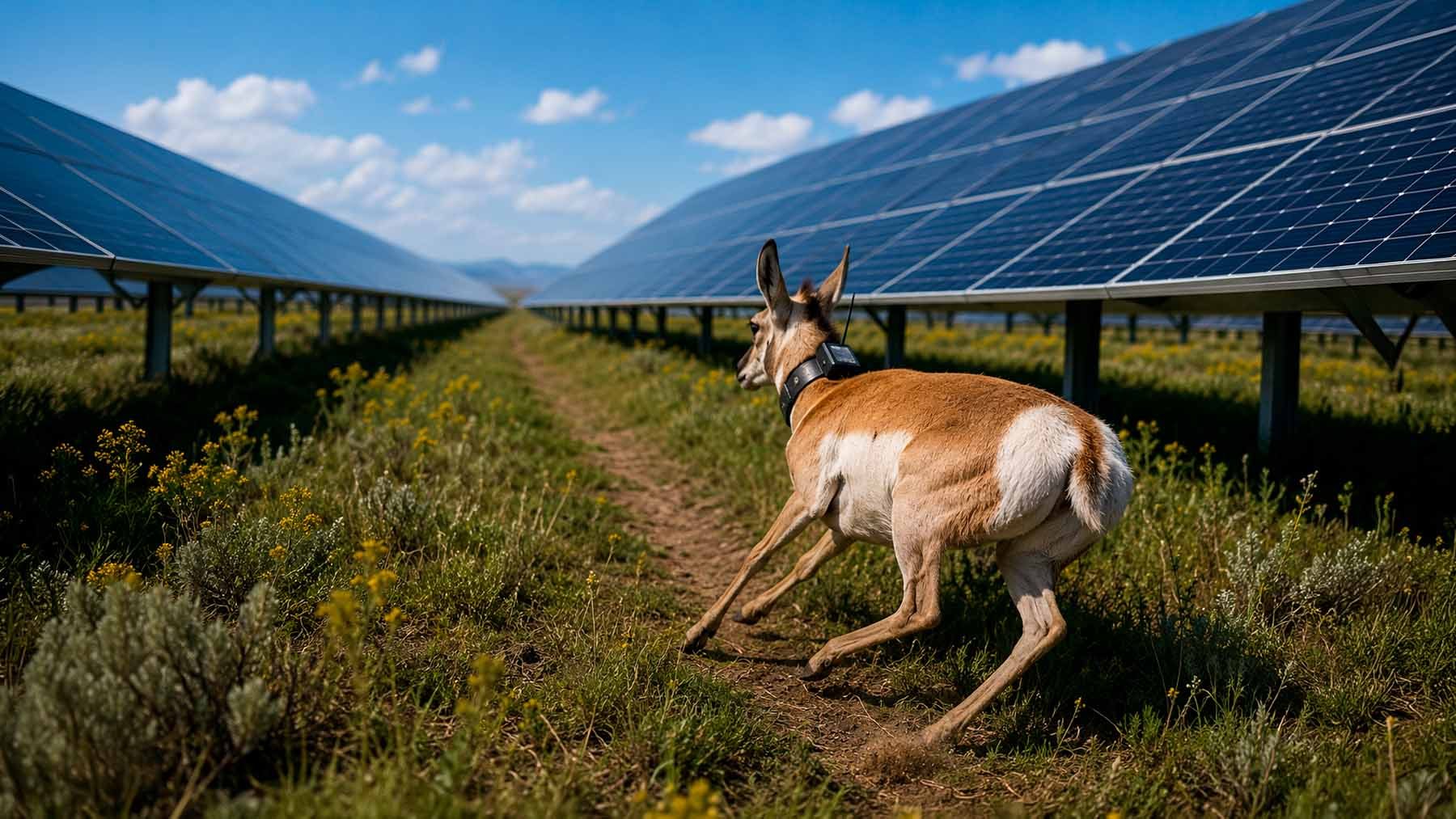
But pronghorns do, and the way they run down the trail is incredible.
These animals are the fastest land animals in the Americas. They can outrun almost every other land animal in North America.
Researchers tracked 75 GPS-collared female pronghorns near Farmington, NM.
The animals did not seem to be using their speed to overcome the obstacle.
Instead, they adjusted their behavior around it.
Following 75 animals through a changing landscape
The tracking effort focused on 75 female pronghorns.
Each hour, each collar transmitted its wearer’s location. It became one of the largest data sets recorded regarding large mammals living next to a renewable energy development.
The main focus of the study was the impact of a new solar energy project on the movement patterns of wild animals.
The San Juan Solar and Storage Project is a 1,100-acre solar energy production site. It is located adjacent to a former coal-fired power plant.
By early 2025, the GPS collars produced over 750,000 individual location reports.
This allowed researchers to measure how the animals moved before and after construction of the solar facility.
Ancient routes meet modern infrastructure
At face value, this seemed like an obvious question: Can wildlife and renewable energy coexist in the same environment?
The GPS data revealed a more complicated reality.
Pronghorns migrate long distances across the American West. Researchers have found that large-scale solar facilities can influence established migration routes.
Their movement patterns can be influenced by obstacles placed across established routes.
For many decades, large-scale solar facilities have created challenges for pronghorns.
This particular facility consists of several solar panel arrays. They are contained within six-foot-tall chain-link fencing.
There are occasional gaps between some of the fencing panels. However, according to researchers, these gaps often do not align with natural movement corridors.
Previous studies by the Wildlands Network noted reduced movement near a Wyoming solar farm. Beyond the fence-line area itself, another report from Wildlands Network indicated movement changes.
Previous clean-energy projects may have altered normal wildlife movement patterns.
Implications for future renewable energy projects extend beyond pronghorns.
Animals will react to renewable energy infrastructure expanding across North America.
Understanding this will likely guide designers developing solar farms in the region.
The fastest animals were not jumping the fences
The GPS data revealed a surprisingly consistent pattern.
Rather than halting before the solar arrays, pronghorns adapted instantly.
They carved out clean pathways right around the panels.
This highlights a defining trait of the species.
They boast unmatched speed and crawl beneath obstacles, yet they rarely jump.
Researchers used the tracking data to map existing migration corridors. They also pinpointed where those paths hit artificial roadblocks.
The resulting data pointed to a vital conclusion. Wildlife protection and clean energy development can share the landscape through smart design.
Learning from the animals
Targeted design adjustments can easily bridge the gap.
Raising the lower clearance of the perimeter fencing presents an immediate, practical solution.
This allows pronghorns to crawl underneath them easily.
Such changes would allow pronghorns to continue migrating through established corridors. They would also allow for continued operation of solar facilities.
In short, the tracking data showed that pronghorns were actively sketching out the corrections engineers need to make.
Ultimately, this research suggests that animals may be the best guides for designing landscapes they still need to cross.
More than 700,000 location points reveal how pronghorns respond to rapid changes in their environment. For thousands of years, pronghorns have followed established routes across the landscape.
Thanks to those GPS collars, researchers can map ancient migrations and protect them for generations.
Similar questions are now emerging wherever wildlife corridors intersect with expanding renewable energy infrastructure.
Read the whole thing?
Get the week's signal, not the noise
Our sharpest reporting on energy, climate and nature — free, once a week.