
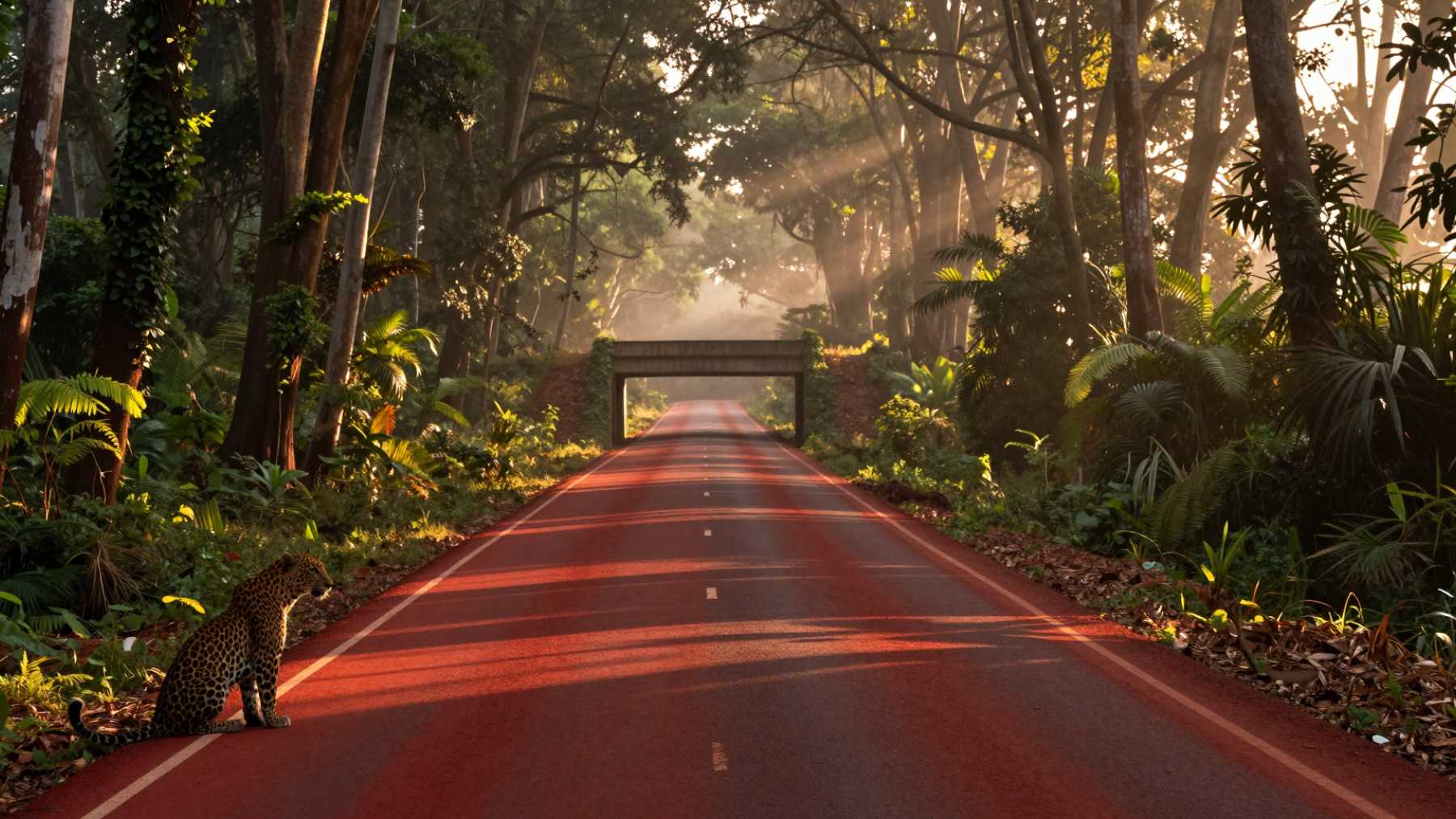
A highway cuts straight through one of Madhya Pradesh’s most biodiverse tiger reserves — shared territory for Bengal tigers, leopards, wolves, and panthers. For years, that road meant speed and efficiency on one side, and a dangerous crossing for wildlife on the other.
Then, along a 1.2-mile stretch, the asphalt turned red.
A highway through the wild
The Veerangana Durgavati Tiger Reserve in Madhya Pradesh is home to some of India’s most iconic and vulnerable wildlife — Bengal tigers, leopards, wolves, panthers, and the rare four-horned antelope. A highway running through it created an unavoidable tension: the road served human movement while cutting directly across paths animals have used for generations.
Vehicle collisions along wildlife corridors are a growing problem across India. Animals don’t recognize lane markings or speed limits, and drivers often can’t see one until it’s already too late.
In December 2025, the National Highways Authority of India (NHAI) and the Ministry of Road Transport and Highways (MoRTH) unveiled significant upgrades to this 7.5-mile stretch. The changes weren’t simply about managing traffic flow — they were about rethinking how a road can coexist with the ecosystem it passes through.
25 underpasses and the logic of animal movement
The most structurally ambitious part of the project involved building 25 wildlife underpasses along the highway. NHAI didn’t place them randomly — each one was positioned at a critical animal movement point, based on observed behavior and ecological data gathered over time.
The underpasses were built to feel natural. According to a joint press release from NHAI and MoRTH, they are “integrated with natural ground levels and drainage paths to encourage regular animal use.” The goal was to make crossings feel like a continuation of the landscape rather than an interruption of it.
Getting animals to actually use a crossing requires more than just building one. To guide wildlife toward the underpasses, NHAI installed continuous chain-link fencing along both sides of the highway — discouraging animals from stepping onto the road and funneling them toward designated crossing points instead. Research estimates that a single wildlife crossing can prevent approximately 1,400 accidents over a 70-year lifespan, a figure that makes the upfront investment look modest.
The color psychology behind red roads
The underpasses address the animal side of the equation. The red road addresses the human side.
Along a critical 1.2-mile stretch through the reserve, NHAI applied bright red, 5-millimeter-thick thermoplastic surface layers directly onto the road. The color choice wasn’t aesthetic — it was deliberate, grounded in how human perception works under real driving conditions.
Red has the longest wavelength of visible light, which makes it highly visible when other colors fade in rain, fog, or low light. Studies suggest the human brain processes red up to 10% faster than any other color. It’s the same reason red appears on stoplights, brake lights, and emergency signage the world over.
The slightly raised surface layer adds another dimension. As drivers pass over it, the texture generates mild tactile and audible feedback — a subtle cue that something has changed. “Naturally encouraging drivers to slow down, without causing discomfort or sudden braking,” NHAI and MoRTH noted in their press release. Color and texture together function as a signal system, delivering both a visual and a physical prompt that this stretch demands more attention.
India’s growing commitment to wildlife crossings
The Veerangana Durgavati project doesn’t exist in isolation. It reflects a broader shift in how India approaches infrastructure in ecologically sensitive areas.
On April 14, 2025, NHAI opened the Delhi-Dehradun Expressway — a six-lane highway that includes a 6.8-mile dedicated animal corridor running beneath it. The scale of animal activity recorded almost immediately was striking: within just 40 days, and before construction was even fully complete, researchers captured over 40,000 images of animals using the crossing.
Species documented included golden jackals, spotted deer, leopards, and peacocks. There were also more than 60 recorded instances of elephants using the corridor. That breadth suggests the crossing wasn’t merely tolerated by wildlife — it was genuinely adopted across a wide range of species and movement patterns.
These results matter because they offer evidence, not just intention.
A benchmark for wildlife-sensitive infrastructure
NHAI and MoRTH described the red road project explicitly as a benchmark — for “environmentally responsible, people-centric, and wildlife-sensitive highway development.” That framing is significant. It positions the project not as an exception, but as a model others might follow.
The agencies put it plainly: “Red roads signal not danger, but thoughtful design and green intent.” It’s a reframing of what road safety can mean — not just protecting drivers from each other, but shielding an entire ecosystem from the road itself.
What makes this approach replicable is the pairing of tools. Engineering — underpasses and fencing — addresses animal movement. Behavioral psychology — color and texture — addresses the humans behind the wheel. Neither would be sufficient on its own.
As more countries grapple with roads cutting through critical habitats, India’s approach offers a concrete framework worth studying. The next question is whether the red roads and underpasses deliver measurable reductions in collisions over time — and whether other nations, facing the same pressures, will move quickly enough to adapt the model before more wildlife corridors are lost.
Read the whole thing?
Get the week's signal, not the noise
Our sharpest reporting on energy, climate and nature — free, once a week.


