
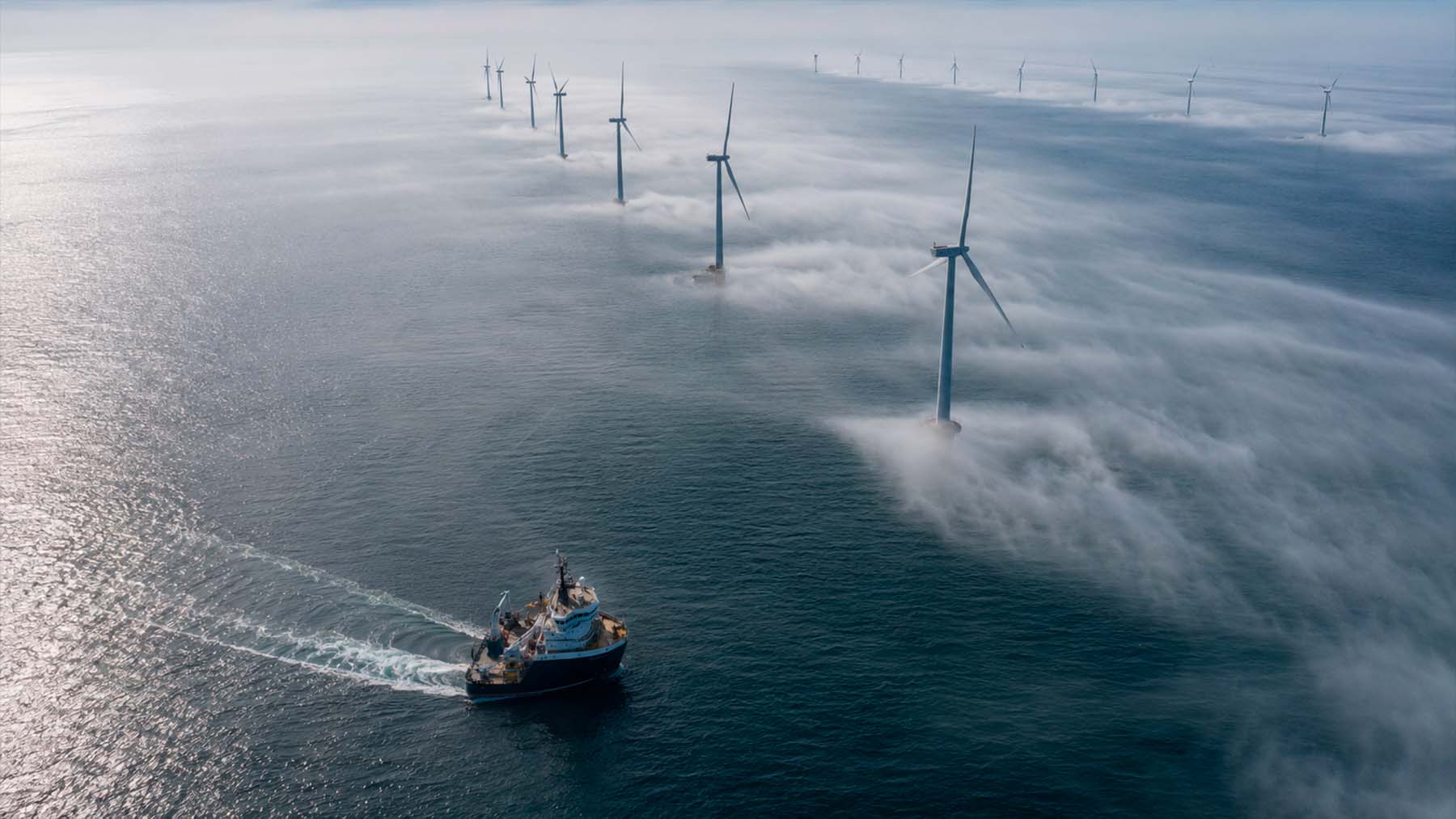
Ships navigating near offshore wind farms are encountering a hazard that was never there before. Thick sea fog has been forming downwind of turbines in waters that used to be clear.
The danger is real. Clean energy projects are multiplying across shipping channels, so atmospheric scientists have to carry out field investigations to confirm that the problem is serious enough to take measures.
How are the giant spinning blades actively generating synthetic weather?
How visibility is being reduced near offshore wind turbines
Wind arrays are starting to crowd global shipping lanes. Captains already face a challenge avoiding farms that clutter radar screens. Fog makes that task far worse.
Within minutes, the horizon is no longer clear. A captain navigating under multi-mile visibility can suddenly find themselves staring into a wall of white just a few hundred yards out—forcing emergency speed cuts and sudden course corrections inside crowded shipping channels.
Sensors confirm these micro-fog banks don’t happen randomly; they trigger only under precise temperature and humidity thresholds. Predicting these exact atmospheric windows is rapidly becoming a top priority for maritime safety agencies.
Research partners KNMI (the Royal Netherlands Meteorological Institute) and Deltares joined forces to investigate the phenomenon. They have specializations in weather and atmospheric sensors, and applied research, respectively.
Rising concerns over wind farming effects on ocean microclimates
Turbines are getting colossal. With rotor spans topping 600 feet, modern arrays churn immense volumes of marine air every second, turning localized microclimates from a theoretical worry into an urgent safety investigation.
When visibility collapses, harbor pilots must rely entirely on automated guidance systems—a risky trade-off during heavy weather that has Coast Guard officials reconsidering current safety buffer zones. Meanwhile, every slowdown costs commercial shipping lines real money, pitting freight operators directly against clean energy developers.
In addition to fog, moving turbine arrays create localized atmospheric turbulence, altered surface water currents, and modified wave action in their immediate vicinity.
The Rijkswaterstaat, which is the executive agency of the Dutch Ministry of Infrastructure and Water Management, is running field studies together with pulling data from sensors in the North Sea. The official program for shipping safety around wind farms has been dubbed MOSWOZ (Monitoring and Research Programme Shipping Safety Offshore Wind Farms).
Research data from sensors is being fed into meteorological models to upgrade real-time wind, water, and fog forecasts specifically for maritime transit zones.
Scientists need to work out the physical forces that generate localized fog to resolve spatial disputes between commercial transit and offshore energy production.
How moving blades trigger offshore fog
It turns out that it is due to rapid drops in pressure. As 600-foot blades move through the air, low-pressure zones form along their trailing edges. Local air temperatures fall in just seconds. When humid ocean air hits the cold air, it condenses. Fog is the result.
To make matters worse, spinning rotors act like giant atmospheric blenders, pulling cool surface moisture upward while mixing it with warmer air above to lock the cloud bank in place.
A Deltares report titled “Assessment of system effects of large-scale implementation of offshore wind in the southern North Sea,“ established that wind farms cause wide-ranging physical impacts across the North Sea, including altered local wind fields, modified wave patterns, and changes to marine life.
In 2024, a major simulation research endeavor focused on how wind and visibility shifts caused by turbines affect vessel collisions and captain decision-making (e.g., how crews react to sudden fog or wind gusts).
Real-time atmospheric modeling
Data logged by North Sea Portal confirms these microclimate shifts are man-made, so now meteorologists need to build real-time atmospheric models capable of predicting how fog develops. The Coast Guard is working with both Rijkswaterstaat and KNMI to decide whether new kinds of weather alerts or safety measures are needed for vessels.
With forecasting that is smarter, safety centers can let incoming ships know before they enter a turbine-generated cloud bank.
Planners and authorities need to understand the effect of blade rotation on humidity so they can maintain safety near major shipping routes.
Read the whole thing?
Get the week's signal, not the noise
Our sharpest reporting on energy, climate and nature — free, once a week.


