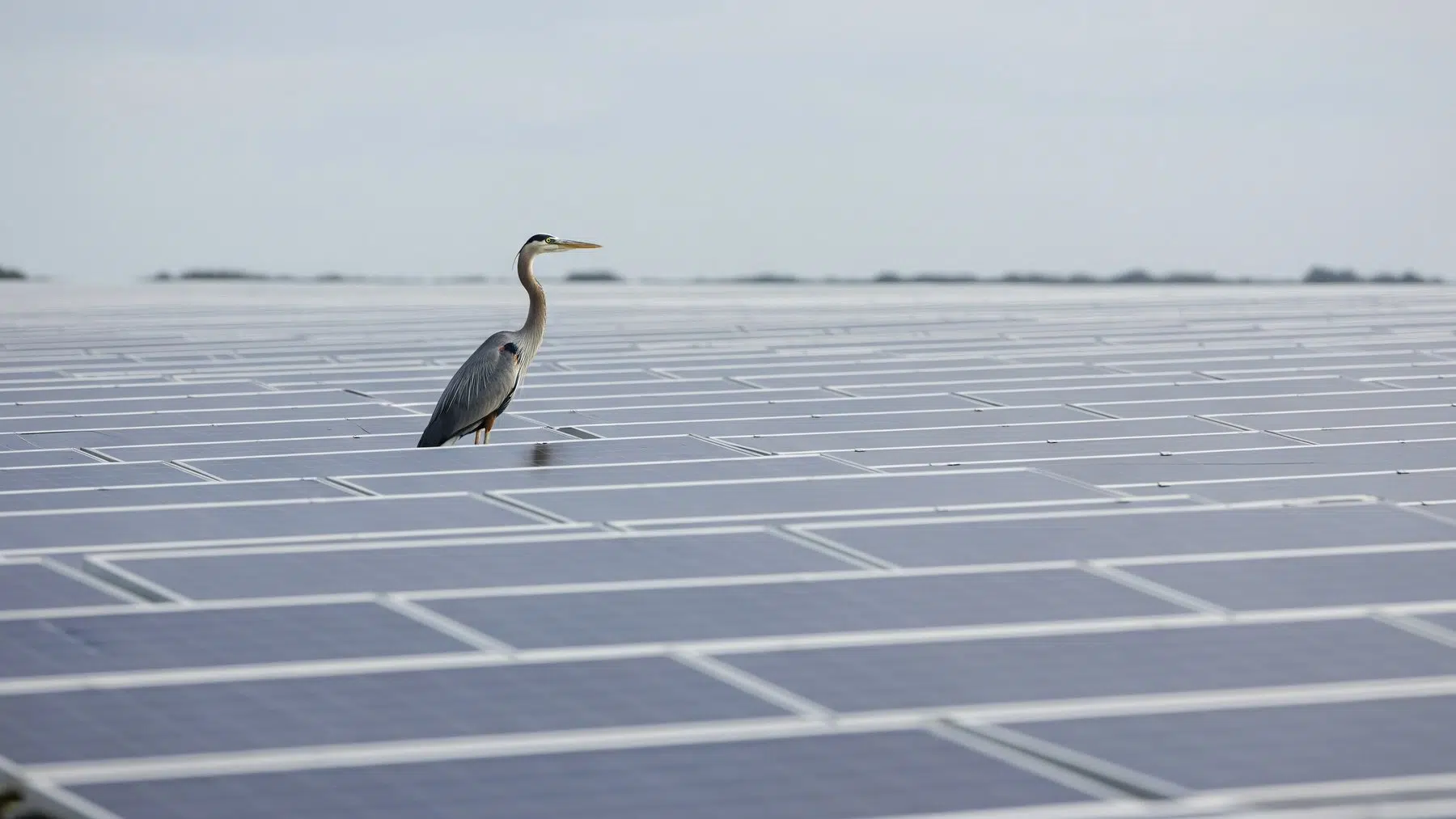
A heron lands on a solar panel in the desert, twelve miles from the nearest water.
Field crews have recorded exactly that, and the image is hard to shake.
The explanation everyone reaches for is that the glass looked like a lake to a bird that needed one.
It is a tidy story, and teams have gone out repeatedly to confirm it.
They keep coming back with almost nothing.
Where the lake idea came from
The physics underneath it is sound, which is why the idea spread so easily.
Light bouncing off a smooth dark surface comes back horizontally polarized, and a still pond does exactly that.
Insects that breed in water find it by reading that signature, since a body of water is otherwise hard to spot from the air.
Researchers have documented the trap in detail. Asphalt, oil pools, black plastic sheeting, car roofs and glass all fool water seeking insects into landing and laying eggs.
A photovoltaic panel is a smooth dark surface tilted toward the sky, so it produces the same signal.
For insects, that evidence is solid and has been for years.
The leap comes when the same logic gets extended upward to birds, and that step is where the support runs out.
What happened when biologists looked
Because somebody eventually went and checked, rather than reasoning from the optics.
A team surveyed five utility scale sites across the American southwest, sitting in desert, grassland and farmland, and compared each one against a matched patch of ground nearby with no panels on it.
If the panels were pulling birds down, the sites should have held more species than their reference plots.
They did not. A real lake in the same region held far more birds than any solar site or reference plot.
Dead bird counts came out almost identical between the two. On farmland the crews found five at the facility and six on the control ground.
And in all that watching, nobody recorded a single bird circling, approaching or landing on a panel.
A separate review pulled together 13 site years of carcass data from 10 photovoltaic plants, logging 669 birds in total.
Water dependent species made up under 8 percent, and the authors state plainly that no study in the pile had tested a cause.
The numbers nobody puts beside it
Scale is the other thing missing from the usual version of this story.
The one published estimate for large American solar puts annual bird deaths between 37,800 and 138,600.
That is a real number and not a trivial one.
Buildings and glass kill somewhere between 365 million and 988 million birds a year in the same country.
Fossil fuel power plants account for roughly 14.5 million, which puts solar at well under one percent of that alone.
There is also a technology confusion running through the whole debate.
The images people remember, of birds igniting in midair, come from concentrating solar towers that focus reflected heat onto a receiver.
Only a couple of those exist in the United States, and they have nothing mechanically in common with a tilted photovoltaic panel.
What England found instead
Meanwhile a different question got asked on the other side of the Atlantic, and the answer was the opposite of the scare.
Ecologists from a conservation charity and the University of Cambridge walked survey transects across solar sites in eastern England and counted what was living there.
On intensively farmed arable land they averaged 12 birds per stretch of about 220 yards.
On solar sites with hedgerow, rough grass and scrub left between the rows, the same stretch held 35 birds, with diversity running two and a half times higher, as the survey reported.
Woodland species did roughly nine times better on the well managed sites.
The panels were not the variable. The ground was.
A site mown to bare gravel is a parking lot, while the same site with cover between the rows is habitat, and that distinction decides the outcome at a solar site the way it does at an offshore project.
What to do with the ground under the panels
So the useful question is not whether glass looks like water.
It is what a developer does with the acres between and beneath the rows, which is space that produces nothing on its own.
Several American states have started writing pollinator and grassland standards into permits for exactly that reason.
None of this settles the heron. Water birds really do turn up at desert installations far from any water, and the reason remains genuinely unknown, as the review concedes.
That is an honest gap, and it deserves the research money going into it rather than a confident explanation.
What it does not deserve is a settled answer repeated until it sounds like one.
Because the measurable effect of solar farms on birds turns out to depend less on the panels than on whatever is allowed to grow underneath them.
Read the whole thing?
Get the week's signal, not the noise
Our sharpest reporting on energy, climate and nature — free, once a week.