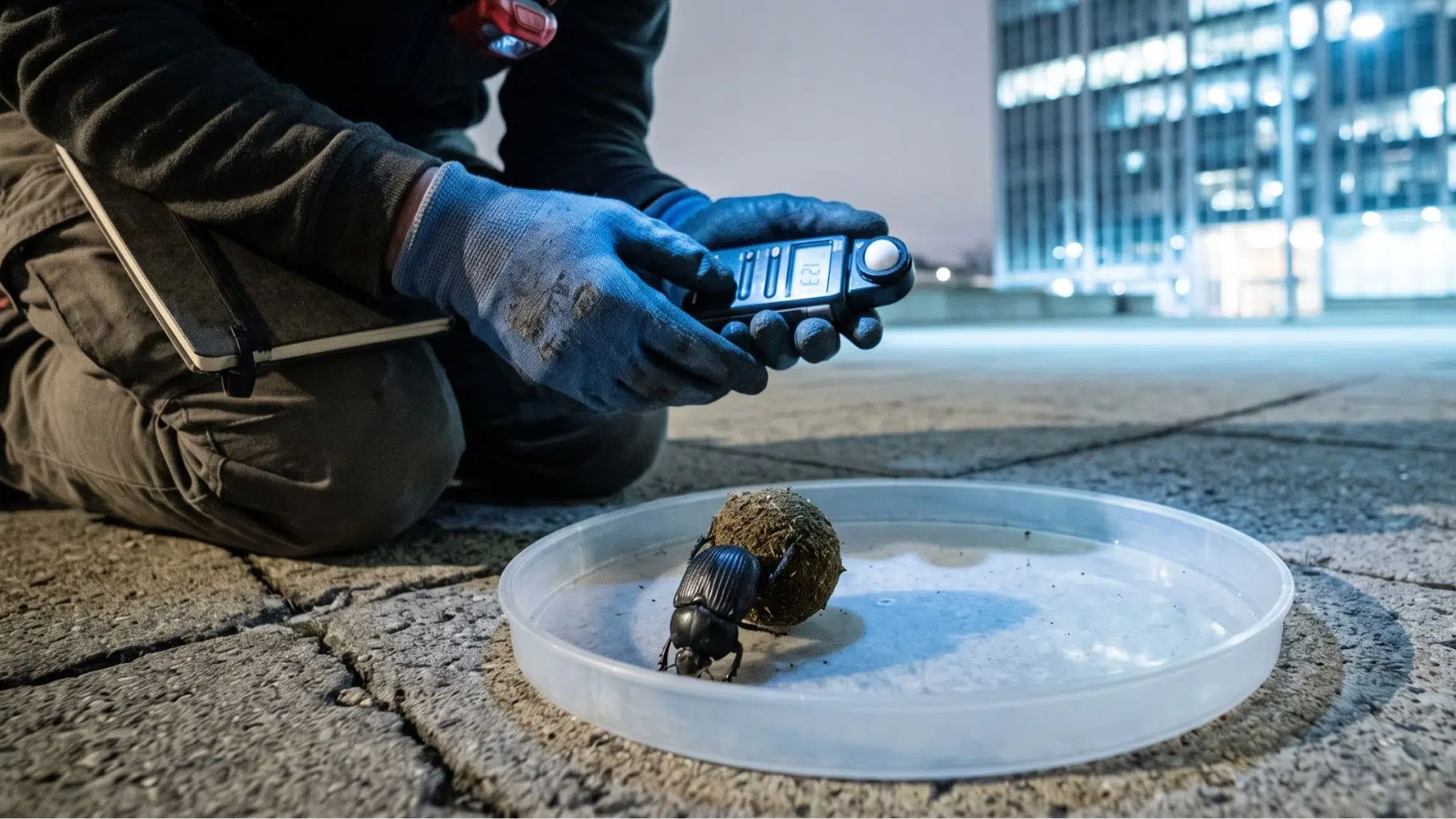
A dung beetle finds a fresh pile in the dark, cuts off a piece and rolls it into a ball.
Then it turns around, puts its front legs on the ground and its back legs on the ball, and pushes backwards and blind.
It cannot see where it is going, and it does not care where it is going.
All it needs is a perfectly straight line, and it holds one across open ground in total darkness.
How it does that took a planetarium, a set of tiny caps and two separate studies to work out.
Why the line matters more than the direction
Because a dung pile is a fight, and the ball is the prize.
Every other beetle at that pile would rather steal a finished ball than build one, so the only safe move is distance.
A straight line gets a beetle away fastest, while any curve brings it back into the crowd.
One of the researchers involved put it in terms nobody would improve on. The beetles do not care which direction they go, they just need to get away from the fight at the pile.
So the animal needs a reference that does not move as it moves.
Which rules out anything on the ground, because walking past a landmark makes you circle around it.
The caps and the planetarium
So a team from South Africa and Sweden tested the sky directly.
Working with a nocturnal species called Scarabaeus satyrus, they fitted beetles with small cardboard caps.
Some caps were opaque and blocked the view upward entirely. Others were transparent, which controlled for the weight and the nuisance of wearing one at all.
The beetles under clear caps rolled straight. The ones that could not see the sky wandered in circles.
Then came the part that settled it. The team carried the beetles into the Wits Planetarium in Johannesburg and ran them under a simulated sky they could switch on and off piece by piece.
Under the full projected starfield, the beetles held their line. Under the Milky Way alone, they still held it.
They are not reading stars
Which is where the finding gets genuinely strange.
An eye that small cannot resolve individual stars, and dung beetles performed no better under a sky full of bright points than under the galaxy band alone.
What they are reading is the gradient from light to dark, the smear of brightness that the Milky Way lays across the sky.
It is a stripe rather than a map, and a stripe is enough to hold an angle against.
You can watch them take the reading. A beetle climbs on top of its ball, rotates on the spot, then climbs down and rolls off in a fixed line.
That little rotation is a compass being set, and it happens in a few seconds.
What a lit city does to it
And then the same group went to look at beetles living in a place with no visible galaxy at all.
Skies over inner city Johannesburg are between 10 and 100 times brighter than those over rural Limpopo, and the Milky Way is simply gone.
City beetles did not lose their bearings. They swapped compass, and rolled toward brightly lit buildings instead, as the second study reported.
Which sounds like an elegant fix until you see what it costs them.
If every beetle follows the same light, every beetle rolls the same way, and the fight they were escaping reassembles down the road, as the researchers described it.
Worse, the lights lead them onto road surfaces and slabs where no ball can be buried, and a ball that cannot be buried is a wasted season, the same way summer nights in a city stop being nights at all.
When the team blocked the bright lights in Johannesburg, the beetles were completely lost. The polluted sky gave them nothing to steer by.
How old is any of this
People often say the beetles have been navigating this way for over a hundred million years, and that needs care.
A molecular analysis of 450 beetle species puts the origin of the dung beetle line at 115 to 130 million years ago, in the Lower Cretaceous.
The oldest physical trace is tunnelling in fossilised dinosaur droppings, dated to 70 to 80 million years.
But that is the age of the animal, not the age of the behavior, and no fossil records how something steered.
Nobody can date a compass. What we know is that the beetle is very old and the sky it uses is very recently broken.
Which is an unusually short list of things to fix. Shield the lamp, aim it down, and the stripe comes back.
Read the whole thing?
Get the week's signal, not the noise
Our sharpest reporting on energy, climate and nature — free, once a week.