
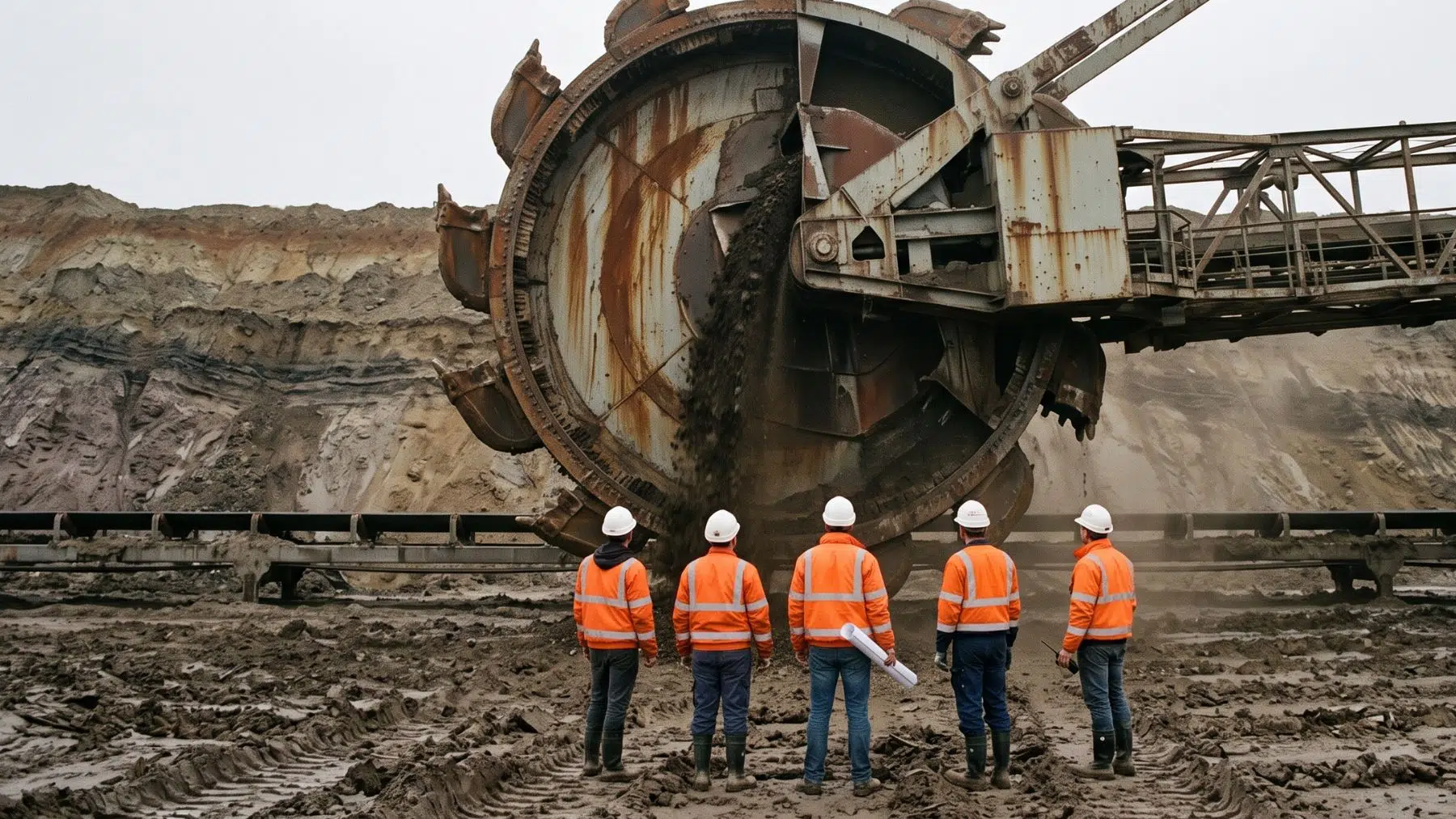
In a brown coal pit in western Germany there is a machine that stands 315 feet tall and stretches 738 feet from end to end.
It weighs about 31 million pounds, which makes it the heaviest thing that moves under its own power anywhere on land.
It takes five people to run it.
Between them they shift roughly 240,000 tons of ground in a day, every working day of the year.
And the part of that job it does best has been done for far longer by an animal that weighs a few milligrams.
What five people are operating
Because the scale of this thing does not land properly until you break it into pieces.
At the front is a rotating wheel more than 70 feet across, and the number that gets misprinted most often is that one.
Around its rim sit 18 steel buckets, each with room for over 530 cubic feet of soil.
The wheel turns slowly and never stops, so each bucket fills at the bottom of the arc and empties at the top onto a belt running back through the machine.
Volume rather than force is the whole design. It does not smash rock, it peels a face and carries the material away.
Everything behind the wheel exists to hold that wheel steady and to carry away what comes off it.
The boom, the counterweight, the crawlers and the belts are all in service of one rotating rim.
It does not carry an engine
And that is the detail most people miss when they look at a photograph of it.
There is no fuel tank, no diesel and no exhaust. The bucket wheel and everything behind it run on external electricity, 16.56 megawatts of it.
That means a cable, and the cable means the machine can never be further from the grid than the cable is long.
It also travels at a crawl, well under a mile an hour, on rows of crawler pads that spread the weight over soft ground.
Moving one of these from one pit to another is measured in weeks rather than hours, and it goes overland at walking pace.
So the largest land vehicle on the planet is also, in practical terms, a building that happens to creep across a pit floor.
What it is really digging
Which raises a question almost nobody asks about a machine built for a coal mine.
Most of what it lifts is not coal. It is the dirt on top of the coal, and there is a great deal more of the former.
Brown coal in that region lies under hundreds of feet of sand, gravel and clay that has to come off first.
So the excavator spends its life removing the covering rather than the prize, and the belt behind it runs the spoil to a dump on the other side of the pit.
The economics only work because the seam is thick, the machine never has to stop, and nothing else could shift that volume of covering material.
Which is also why the whole operation sits on a countdown, since German lignite burning is scheduled to end within the decade and the pit closes with it.
A miner that fits on a fingernail
Then there is the other way to move earth, and it turned up in a very different country.
Entomologists working the goldfields of Western Australia looked at termite mounds and found elevated gold in the material the insects had carried up, as the agency reported.
The colonies dig down through surface cover and bring up grains from a deposit sitting 13 to 16 feet below.
The lead researcher also found metals collecting inside the insects themselves, in an excretory organ, forming something like tiny kidney stones.
Sampling a mound is therefore a way to test what lies underneath without drilling, and drilling is by far the expensive part of exploration.
The trick is the same one that decides the cost of a blade convoy or an offshore project, which is finding out what is down there before committing steel to it.
One is 25 years old, the other is far older
None of which makes the two things the same, and it is worth being exact about the difference.
The excavator works a lignite pit in Germany. The termites were studied in Australia, and they are not sorting coal.
The machine dates from the end of the last century, as the trade press has laid out in detail.
Termites go back roughly 170 million years, which is old but nothing like the hundreds of millions the internet usually claims.
What the two share is a method. Both move enormous quantities of earth in very small portions, continuously, and let the total do the work.
One of them needs a power station behind it. The other one needs a colony.
Read the whole thing?
Get the week's signal, not the noise
Our sharpest reporting on energy, climate and nature — free, once a week.


