White-faced capuchin monkeys have to cope with a resource crisis when seasonal rainfall in Costa Rica does not materialize. When the El Niño drought hit in 2014 and lasted until 2016, there was major damage done to the landscape. Fruit trees missed production during these seasons, and streams dried up completely.
When the resources started to disappear, the normally peaceful monkeys’ sociable days were over.
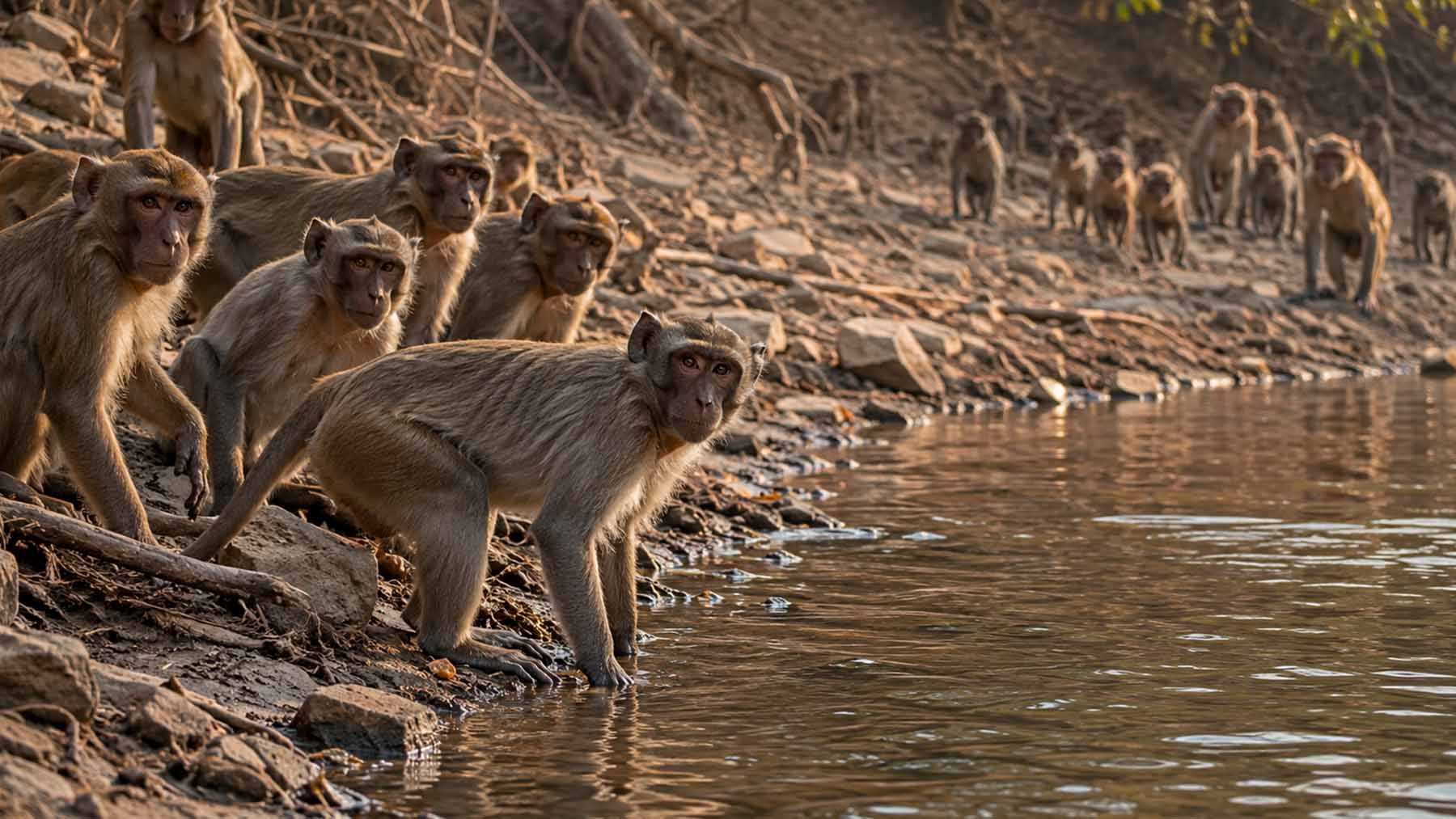
When dehydration and starvation became the reality, groups of capuchins gathered on the banks of the forest’s remaining waterways, and cooperative foraging turned to territorial defense.
How dropping water levels drew rival monkey groups
During a typical dry season, the white-faced capuchins find fruit and insects by traveling wide ranges of tropical dry forest. The El Niño drought of the last decade meant that the foraging routes that the monkeys had relied on for years failed.
At the same time, fruit production also failed across thousands of acres. The monkeys suffered without their primary hydration and food sources. Water became the most important asset if survival was going to be possible.
The capuchins were driven to abandon their territory and concentrate along the few remaining river water sources.
Eventually, dozens of monkeys occupied cramped riverbank sections. When everything is normal, the groups keep their distance. In this case, the stress caused by the drought kept rising. Encounters became impossible to avoid and happened more often.
Food and water options were disappearing, and the toll of reduced energy intake and dehydration on the animals’ bodies was growing. Individuals started defending their borders while aggression over the last water sources started becoming the norm.
Group conflict over resources was inevitable
The persistent drought conditions saw the collapse of capuchin social structures. The competition was both internal and external, with stress developing among members of the same groups as well.
Observation of the larger groups of monkeys revealed that individual foraging efficiency dropped. There were too many members of the same group competing for the same limited food, so in general, feeding was reduced.
In this case, there was strength in numbers. The bigger groups started asserting themselves, claiming prime riverbank access. Smaller groups were pushed into less favorable zones that were either degraded or short on resources.
The physical toll on the population of drained capuchins started immediately. Field researchers noted significant weight loss. The most vulnerable members suffered the most. Infant mortality went up to 84%. This is more than three times the normal rate. Adult females also died at a higher rate than the males.
The new extreme level of stress saw the social structures in the groups collapse even further. Females were observed abandoning dying infants to search for food. Groups fractured into defensive units determined to hold their claims along the water’s edge.
Extreme climate changes make group living dangerous
The Lomas Barbudal Monkey Project carried out field observations for decades. The data shows that severe climate events change the costs and benefits of group living, and populations take years to recover.
Living in a large group would normally mean dominance over neighbors. The drought conditions, however, eroded this advantage due to internal competition.
Under these conditions, the bigger groups had to travel further and compete more with each other. Some individuals were forced to disperse or break up into smaller groups to survive.
There’s more to study about capuchin social structures
Their group sizes were not stable, and the animals adapted to stress by shifting the overlap in different groups’ ranges. Territorial defense became necessary for survival, and aggression was a natural progression.
Climate shifts mean more frequent and severe droughts across Central America. These behavioral adjustments may reach a limit and change primate behavior permanently. Conservation efforts are vital to undo the harm caused by centuries of carbon emissions, and humans need to do more alongside the push for green energy production.
The full study can be read here: Jacobson, O.T., Crofoot, M.C., Finerty, G.E. et al. Environmental fluctuations alter the competitive trade-offs of group size in a social primate. Nat Ecol Evol 10, 919–931 (2026). https://doi.org/10.1038/s41559-026-03048-8
Read the whole thing?
Get the week's signal, not the noise
Our sharpest reporting on energy, climate and nature — free, once a week.