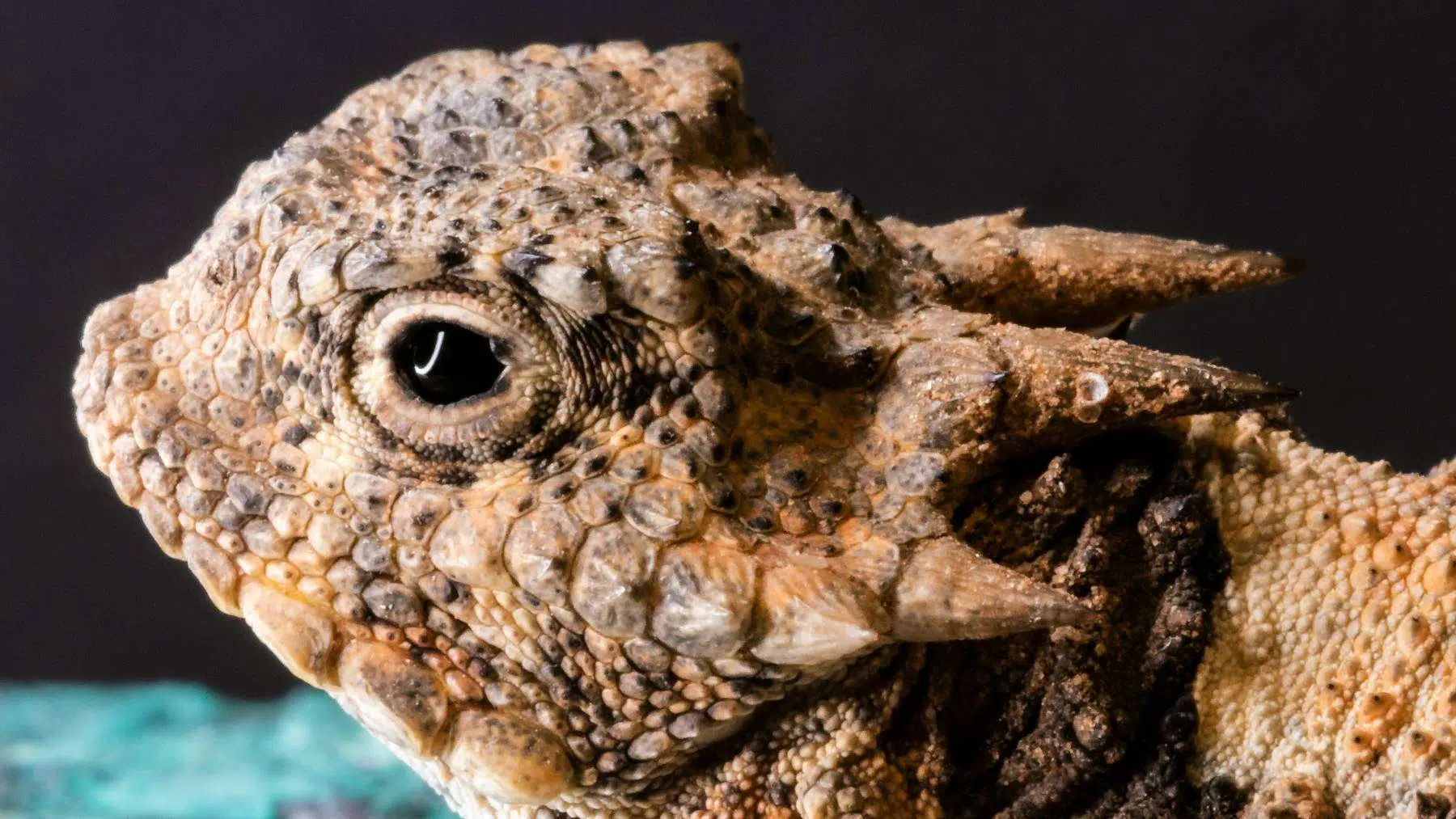
A coyote closes in. The horned lizard — squat, spiky, barely the size of a fist — holds its ground. It doesn’t bolt. It doesn’t puff up or play dead.
What happens next is harder to explain.
This small reptile of the American Southwest has developed one of the most unsettling survival strategies in the animal kingdom. And to understand how it works, you have to look beyond the lizard’s armor — and into what it’s been eating.
A defense strategy unlike almost anything else in nature
Horned lizards — often called “horny toads” despite being fully reptilian — are a favorite target of coyotes, foxes, and domestic dogs across the American Southwest. Their spiky bodies offer some protection, but those spines aren’t the first line of defense. The lizard actually prefers to keep predators from getting close enough to matter.
That preference is what makes ocular autohemorrhaging so remarkable. When threatened, the horned lizard squirts blood directly from its eyes. The stream can travel over three feet, giving the lizard enough distance to slip away before the predator recovers from the shock.
The spikes exist, but they’re a last resort. The lizard’s real strategy is deterrence at a distance — pulled off using a mechanism that is, by any measure, unlike almost anything else in the animal kingdom.
How the lizard engineers a blood spray on demand
This isn’t a reflex. The horned lizard controls the entire process voluntarily, triggering it when danger arrives and stopping once the threat passes.
The sequence begins when the lizard constricts the veins responsible for moving blood away from its head. Pressure builds rapidly. Blood floods the ocular sinuses — the cavities surrounding the eyes — until the accumulation becomes too great to contain. Small capillaries then rupture, releasing the blood, while muscles around the eyes contract to direct and propel the spray outward with surprising force. Those ruptured capillaries heal quickly once the defense is complete, leaving the lizard ready to repeat the process if necessary.
The lizard doesn’t just bleed — it engineers the bleed, controls its direction, and recovers from it.
The secret weapon hidden inside the blood
Here’s where the story gets stranger. The spray itself is startling, but visual shock alone doesn’t stop a determined coyote. What actually drives predators away is something inside the blood — its smell.
The blood of a horned lizard contains formic acid and metabolized venom peptides. These compounds produce an odor that canine predators find deeply aversive. Not merely unpleasant — chemically targeted. The blood’s composition appears to be especially effective against the dogs, coyotes, and foxes that most commonly hunt these lizards.
These compounds don’t come from the lizard’s own biology in any straightforward sense. They come from what the lizard eats. The blood is, in effect, a delivery system for borrowed chemistry — and the source of that chemistry is both dangerous and deliberate.
Eating danger to become dangerous: the harvester ant connection
Harvester ants are the horned lizard’s primary food source, providing essential amino acids, proteins, and formic acid that the lizard depends on to survive. But harvester ants also sting, and their venom is genuinely painful.
The lizard has adapted to this over millions of years, developing a thick mucus lining in its mouth that protects it from being stung while consuming the ants. Impressive on its own — but evolution didn’t stop there.
Over time, the lizard began metabolizing the ants’ venom compounds directly into its bloodstream. The formic acid and peptides that harvester ants use as weapons against their own predators now circulate through the lizard’s body and get deployed against the lizard’s predators in turn. It eats danger and becomes dangerous. That’s a remarkable evolutionary loop, and it took millions of years of pressure to close it.
What this reveals about evolutionary ingenuity
Some horned lizards have been observed squirting blood multiple times within a single 20-minute window. The precise upper limit of how often they can do this — and how that varies across individuals, age groups, or populations — remains an open question.
What’s clearer is the dual role this behavior plays in the broader ecosystem. By feeding heavily on harvester ants, horned lizards help regulate those populations. Deploying ant-derived compounds against canine predators then turns a dietary dependency into a survival advantage — one behavior serving two ecological functions at once.
That kind of layered efficiency is what makes this lizard worth pausing over. Evolution doesn’t plan. It doesn’t optimize toward elegance. It works with whatever is available — a diet, a circulatory system, a predator’s sensitive nose — and across vast stretches of time, it finds combinations that stick.
The horned lizard didn’t set out to weaponize its blood. It just kept eating ants, and the rest followed. Which raises a quiet question worth sitting with: how many other animals are carrying hidden weapons we haven’t thought to look for yet?
Read the whole thing?
Get the week's signal, not the noise
Our sharpest reporting on energy, climate and nature — free, once a week.