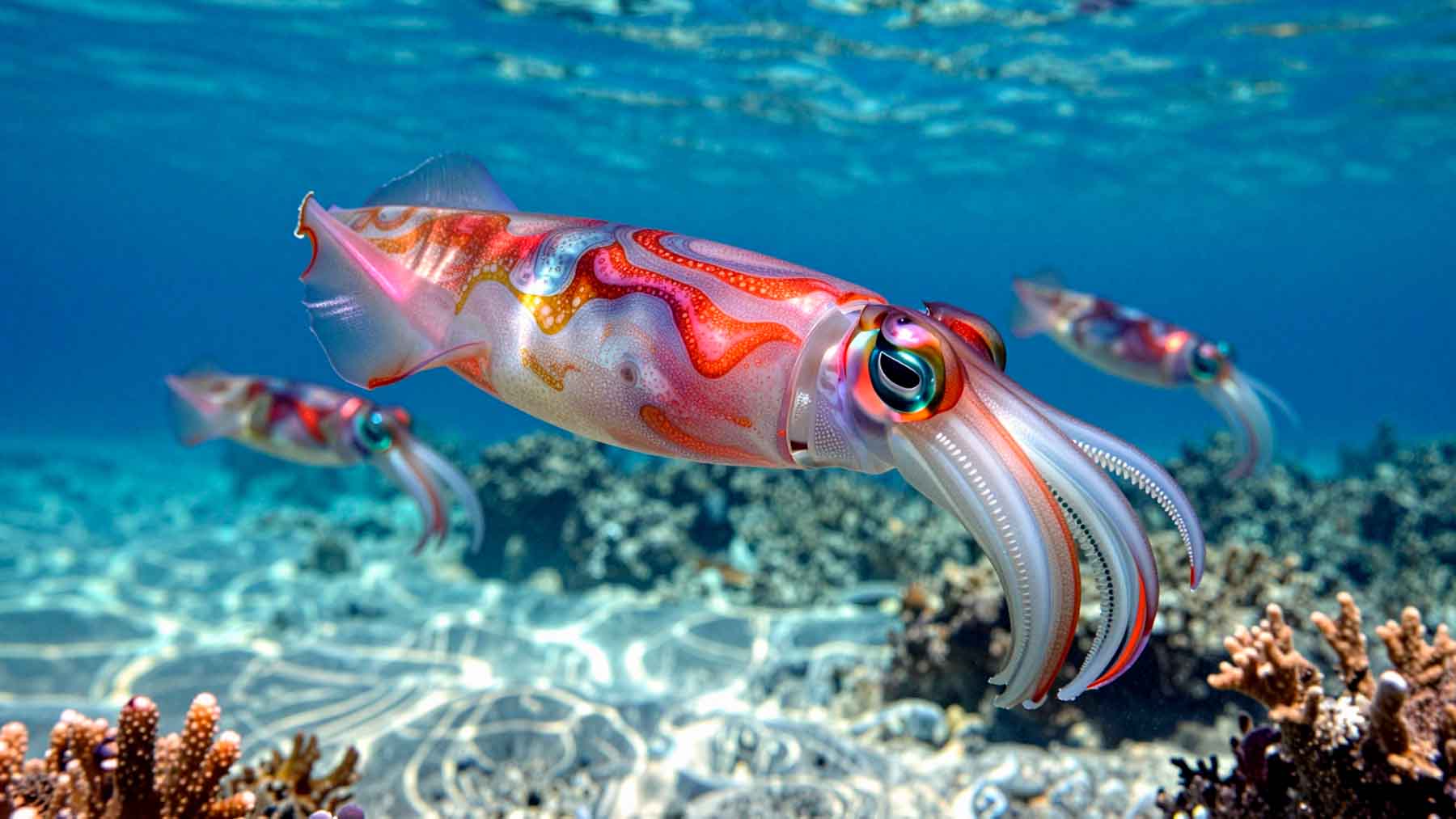
Picture a male Caribbean reef squid caught in an impossible moment: a potential mate on one side, a rival male closing in on the other. Mating season gives him no time to choose which problem to solve first.
Somehow, he doesn’t have to. The answer is already visible — written across his skin in two completely different messages, running at the same time, each aimed at a different audience.
A skin that speaks two languages at once
The secret lies in thousands of tiny structures called chromatophores. These cells contain pigment sacs that expand and contract as the squid stretches or relaxes its skin. Stretch it, and the pigment deepens into bold, saturated color. Relax it, and those same colors fade or disappear entirely. It’s a system built for speed and precision.
What makes Caribbean reef squid unusual isn’t just that they change color — many cephalopods do that. It’s that they can sustain two completely different patterns on opposite sides of their body simultaneously. One side runs an entirely separate chromatic program from the other.
This dual-sided display has been observed in both males and females, ruling out the possibility that it’s some rare individual quirk. It appears to be a core trait of the species. The whole system is governed by the squid’s nervous system, which points to a level of neurological complexity that’s easy to underestimate in an animal this small.
Red and pink: the language of attraction
When a male reef squid wants to attract a female, he flashes combinations of bright reds and pinks, according to AZ Animals. These colors emerge as the chromatophores contract, pushing pigment to the surface in vivid pulses — unmistakable, and clearly intentional.
Males will sometimes escalate to what’s called a marquee display: a rapid, traveling wave of color moving across the skin in a repeating pattern. This works especially well at longer distances, broadcasting the signal to females who might otherwise miss it entirely. Divers who’ve witnessed the behavior describe it as an underwater light show, colors shifting and cycling within seconds. Researchers have also confirmed that males actively scout for nesting sites and females — and that the same scouting trip doubles as a patrol for rivals.
Bright white: a warning written in light
While the mating side of the squid runs its warm, inviting display, the opposite side tells a completely different story. Rival males approaching from the other direction see only bright white, flickered rapidly in a pattern that reads as unmistakably aggressive.
The squid often reinforces this warning by keeping its brow ridges gold — a detail that sharpens the contrast and amplifies the threat. The overall effect is the opposite of the mating display: assertive, confrontational, deliberately unsettling. There’s also a physical dimension to it. Flashing white can make the squid appear larger than it actually is, adding an intimidation factor that goes beyond color alone.
Zebra stripes and the limits of emotional interpretation
When the situation escalates further, reef squid have one more signal in reserve: a zebra stripe pattern that spreads across the skin in high-contrast bands. Associated with extreme agitation and a clear willingness to fight, it leaves little room for misinterpretation.
It’s tempting to describe all of this in emotional terms — lust, anger, jealousy. Scientists are cautious about that framing, and rightly so. Attributing human emotions to marine species requires more evidence than behavioral signals alone can provide. What the signals do confirm are distinct internal states: heightened alertness, competitive stress, strong motivational drive. Size matters in these encounters too — larger males carry a real advantage, and their displays likely carry more visual weight as a result.
A fleeting performance with high biological stakes
Here’s the detail that reframes everything: both male and female reef squid die shortly after reproducing. The entire elaborate communication system — the dual color displays, the marquee flashing, the zebra stripes — plays out once, in service of a single reproductive event.
That makes the sophistication of the display all the more striking. Evolution produced one of the animal kingdom’s most complex communication systems for a creature with a lifespan measured in months.
Open questions remain. The squid’s range and habitat make long-term behavioral studies genuinely difficult to conduct, and researchers are still mapping how these signals function across different contexts and populations.
We tend to reserve our admiration for the communication systems of mammals and birds — species we find easier to relate to. The Caribbean reef squid suggests we may be looking in the wrong places. Complexity doesn’t always announce itself loudly. Sometimes it flickers quietly, in two colors at once, just beneath the surface.
Read the whole thing?
Get the week's signal, not the noise
Our sharpest reporting on energy, climate and nature — free, once a week.