
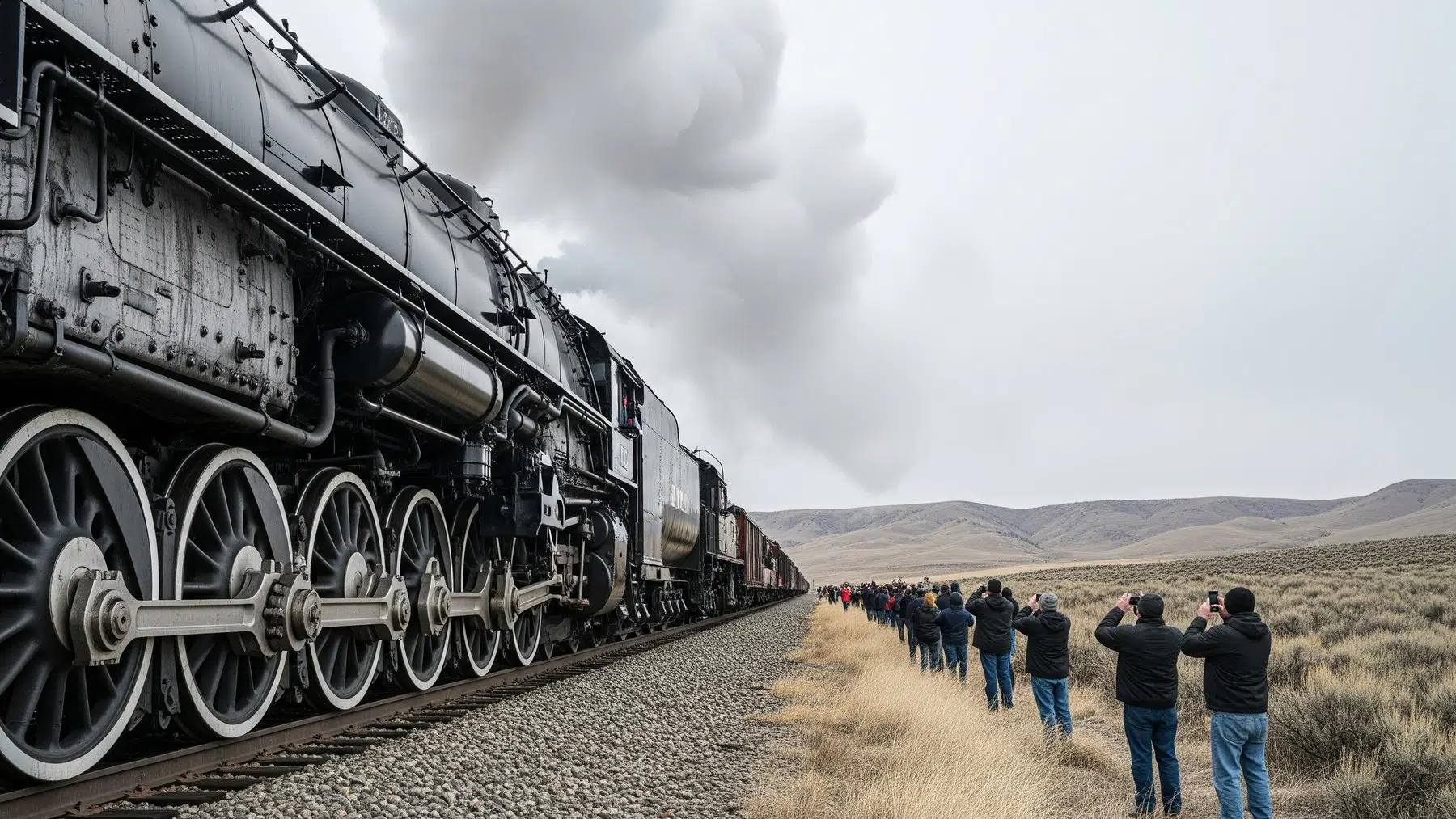
The sound arrives before anything else does.
Not a horn, but a low beat under your feet, four exhausts a second, still a mile out of sight.
Then the plume clears the ridge.
Along the fence line the cameras have been set up since before dawn, and the road behind them is parked solid for two miles in both directions.
None of these people came for a train. They came because this one bends.
How something 133 feet long takes a curve
A steam locomotive is built around a rigid frame with the boiler sitting on it like a beam. Make that frame long enough to carry the power a mountain grade needs, and the thing will not go round a curve.
The fix was to cut the running gear in half.
The front set of eight driving wheels is hinged to the frame and swings, while the rear set stays bolted rigid beneath the boiler. Going into a bend the front half leads and the back half holds the straight line, so a wheelbase this long behaves like something far shorter.
Steam still has to reach the moving half. It gets there through flexible ball joints, which are the part that leaks and wears and has to be watched.
What it bought was a hill. One grade west of Cheyenne had eaten helper engines for decades, and the point was to put a single locomotive over it with nothing pushing.
What 600 tons looks like standing still
Up close the numbers stop mattering and the proportions take over. The driving wheels come to 68 inches, roughly chest height on most people, and there are sixteen of them in a row.
The tender behind carries 25,000 gallons of water, which is more than a backyard swimming pool holds.
Engine and tender together come to 600 tons, which is why it moves by arrangement with the railroads it borrows. Bridges get rated first. Routes get chosen around it.
One thing has changed since it was new. The grates came out during the rebuild and a fire pan and burner went in, so it burns heavy fuel oil now, not the 28 tons of coal it was built for.
Where the numbers come from
It was not built in the West at all. It came out of a plant in Schenectady, New York, in 1941, and it was delivered west to Wyoming.
Which is the whole point of what it is doing now. The railroad says plainly that this is the first time the locomotive has steamed across the Mississippi and into the Ohio Valley since it was delivered.
The tour runs in two legs. The western one made 27 whistle stops across four states in a month, and the eastern one left Cheyenne in late spring.
Counted end to end it reaches 14 states and more than 50 whistle stops, with eight cities setting aside display days, from Omaha and West Chicago through to Philadelphia and St. Louis.
The railroad’s chief executive framed it as a birthday present. “Union Pacific couldn’t be prouder” to share this powerful piece of history with the nation, he said.
What it was never the best at
The reputation runs a little ahead of the record. It is the longest steam locomotive ever built and the largest still running, and both of those hold, but most powerful does not.
A rival hauling coal out of the Appalachians beat it, putting 7,498 horsepower to the drawbar against this one’s 6,290, and on six coupled axles instead of eight.
Peak output also came in a narrow band. It arrived at around 41 miles an hour, which is a strange place for a freight engine to do its best work.
Moving it is an operation in itself. Clearances, bridge ratings and turning space are settled ahead of the train, much the way an oversize load gets a route before it gets a driver, and the published schedule is the end of months of that.
Why anyone stands in a field for this
The draw is not nostalgia, or not only that. A diesel is a sealed box that hums, and everything deciding what happens inside it is hidden from view.
Here the argument is on the outside. Rods, cranks, valve gear and linkages turn heat into rotation in front of you, slowly enough to follow, and somebody with no training at all can watch the sequence and work out what is causing what.
That is rarer than it sounds. Almost nothing built since runs its mechanism where anyone can see it, and the few that do are very old or very large, much as a road that generates power holds attention because you can stand on it.
The rebuild ran for years before it steamed again, and the fuel conversion was among the larger changes.
So what crosses the river this summer is not quite the machine that left the builder. It is close enough, and it is going the one direction it has never gone before.
Read the whole thing?
Get the week's signal, not the noise
Our sharpest reporting on energy, climate and nature — free, once a week.


